Gold rises sharply to six-week high on dismal US labor market data
- Gold price leaped over 1% to $2,385, spurred by mixed US NFP data and heightened Fed rate cut speculation.
- June NFP surpasses forecasts, yet revisions for April and May indicate an accelerating labor market cooldown.
- US Dollar Index (DXY) declines 0.16% to 104.95; 10-year Treasury yield drops more than six basis points to 4.284%.

The Gold price rallied during the mid-North American session following the release of June’s US Nonfarm Payrolls (NFP) report, which exceeded forecasts, but two previous months’ downward revisions hinted that the labor market is cooling faster than the figures show. Therefore, traders bet that the Federal Reserve (Fed) will cut rates in September, increasing a headwind for the Greenback and a tailwind for the yellow metal.
The XAU/USD trades at $2,391 and registers gains of over 1.40% in the day and more than 2.70% in the week after bouncing off daily lows of $2,349, sponsored in part by a weaker US Dollar, which remains undermined by lower US Treasury bond yields.
The US Dollar Index (DX) is losing 0.16%, down to 104.95, while the US 10-year benchmark yield tumbles more than six basis points (bps) to 4.284%.
US NFPs for June were positive, but the data from April and May were downwardly revised, hinting that the economy added 111,000 fewer jobs than reported in those two months. Consequently, the Unemployment Rate rose a tenth in June, above consensus.
Other data from the US Bureau of Labor Statistics (BLS) revealed that Average Hourly Earnings (AHE) remained flat MoM but declined yearly.
Aside from this, geopolitics continued to play an important role in the golden metal’s path. Israeli Prime Minister Benjamin Netanyahu sent a delegation to continue negotiations on hostages and reiterated the war wouldn’t end until Israel achieves all its objectives. Meanwhile, a Hamas leader said they’re waiting for a positive response from Israel to start negotiations on the details of a deal, according to CNN.
Daily digest market movers: Gold price advances post US NFP
- US Nonfarm Payrolls increased by 206K, surpassing the estimated 190K, but April and May's figures were revised down to 108K and 218K, respectively.
- Average Hourly Earnings (AHE) declined from 4.1% to 3.9% YoY, which is in line with expectations, while the Unemployment Rate increased from 4% to 4.1%.
- On Wednesday, the Federal Open Market Committee (FOMC) revealed June’s Meeting Minutes, which showed that most participants estimated that the current policy is restrictive but had opened the door for rate increases. Policymakers acknowledged the economy is cooling and could react to unexpected economic weakness.
- According to the CME FedWatch Tool, odds for a 25-basis-point Fed rate cut in September are at 70%, up from 66% on Thursday.
- December 2024 fed funds rate futures contract implies that the Fed will ease policy by 40 basis points (bps) toward the end of the year.
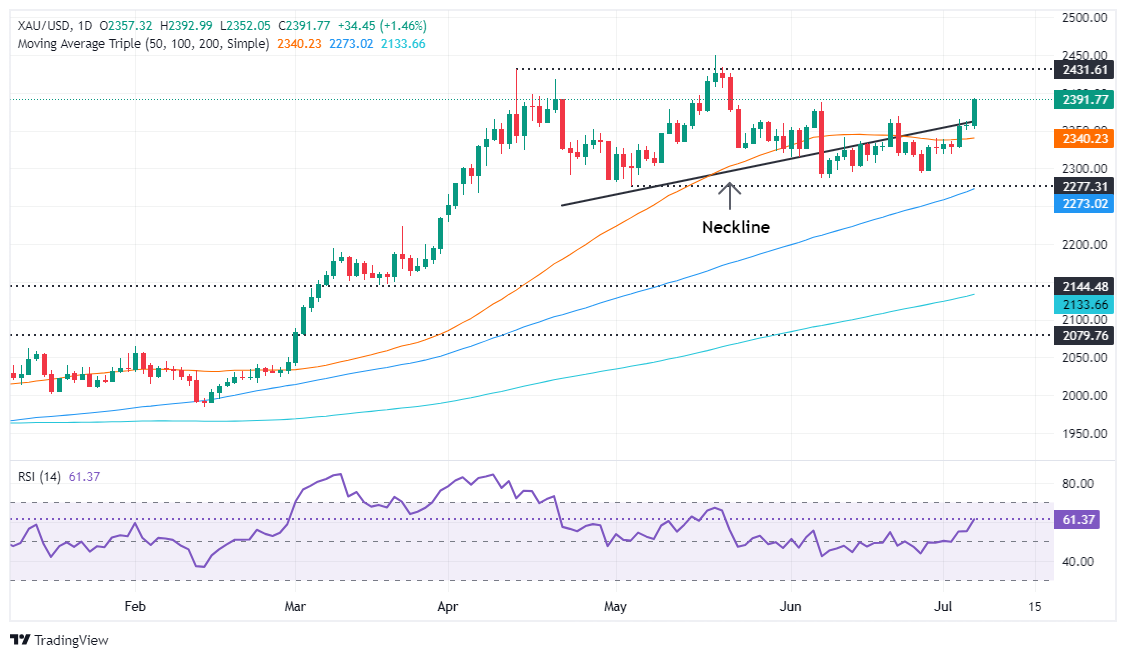
Technical analysis: Gold price crushes Head-and-Shoulders neckline, aims for $2,400
Gold price has decisively broken the Head-and-Shoulders neckline, lifting spot prices near the $2,390 mark, indicating that bulls are in charge and higher prices lie ahead.
The momentum has shifted in buyers' favor as depicted by a bullish Relative Strength Index (RSI). A daily close above the June 21 high of $2,368 could open the door for a higher trading range within the $2,370-$2,400 area, with buyers targeting higher prices.
If the price breaks above $2,400, it will expose the year-to-date high of $2,450 before challenging $2,500.
On the other hand, if sellers drive the spot price below $2,350, further declines could target the $2,300 level. If this support fails, the next demand zone would be the May 3 low of $2,277, followed by the March 21 high of $2,222.
Gold FAQs
Gold has played a key role in human’s history as it has been widely used as a store of value and medium of exchange. Currently, apart from its shine and usage for jewelry, the precious metal is widely seen as a safe-haven asset, meaning that it is considered a good investment during turbulent times. Gold is also widely seen as a hedge against inflation and against depreciating currencies as it doesn’t rely on any specific issuer or government.
Central banks are the biggest Gold holders. In their aim to support their currencies in turbulent times, central banks tend to diversify their reserves and buy Gold to improve the perceived strength of the economy and the currency. High Gold reserves can be a source of trust for a country’s solvency. Central banks added 1,136 tonnes of Gold worth around $70 billion to their reserves in 2022, according to data from the World Gold Council. This is the highest yearly purchase since records began. Central banks from emerging economies such as China, India and Turkey are quickly increasing their Gold reserves.
Gold has an inverse correlation with the US Dollar and US Treasuries, which are both major reserve and safe-haven assets. When the Dollar depreciates, Gold tends to rise, enabling investors and central banks to diversify their assets in turbulent times. Gold is also inversely correlated with risk assets. A rally in the stock market tends to weaken Gold price, while sell-offs in riskier markets tend to favor the precious metal.
The price can move due to a wide range of factors. Geopolitical instability or fears of a deep recession can quickly make Gold price escalate due to its safe-haven status. As a yield-less asset, Gold tends to rise with lower interest rates, while higher cost of money usually weighs down on the yellow metal. Still, most moves depend on how the US Dollar (USD) behaves as the asset is priced in dollars (XAU/USD). A strong Dollar tends to keep the price of Gold controlled, whereas a weaker Dollar is likely to push Gold prices up.
Author

Christian Borjon Valencia
FXStreet
Markets analyst, news editor, and trading instructor with over 14 years of experience across FX, commodities, US equity indices, and global macro markets.

















