Gold price rises as buyers stepped in ahead of crucial US PCE report
- Gold benefits from a weaker US Dollar, and edges up 0.45%, amid firm US Treasury bond yields.
- Investors eye the upcoming PCE Price Index, the Fed’s preferred inflation measure, which could impact rate cut expectations.
- The US Dollar Index (DXY) falls as the CME FedWatch Tool indicates a 66% chance of a rate cut in September, up from 59.5%.

Gold jumped off last Friday’s low and benefitted from a weaker US Dollar on Monday. On Friday, investors are bracing for the release of the Federal Reserve’s preferred gauge for inflation, the Personal Consumption Expenditures (PCE) Price Index. XAU/USD trades at $2,332, up 0.49%, while the Greenback falls amid firm US Treasury bond yields.
Risk appetite deteriorated; investors seeking safety flock to the golden metal. US Treasury bond yields are flat, as depicted by the 10-year Treasury note standing at 4.253% unchanged.
The US Dollar Index (DXY), which tracks the value of American currency against a basket of six other currencies, fell 0.26% to 105.53.
The US economic docket will feature the Fed’s preferred gauge for inflation, the PCE. If the data aligns with the consensus, this will mean that the disinflation process is evolving as Fed policymakers expect and increase the chances for an interest rate cut as soon as September.
According to the CME FedWatch Tool, traders are pricing in a 66% chance of easing in September, up from 59.5%.
In the meantime, San Francisco Fed President Mary Daly said the labor market is ‘nearing” an inflection point, where further weakening will signify higher unemployment. Daly’s comments signal she’s leaning dovish as she added, “At this point, inflation is not the only risk we face.”
The December 2024 federal funds rate futures contract implies the Fed will ease policy by just 36 basis points (bps) toward the end of the year.
Daily digest market movers: Gold price advances on a soft US Dollar
- Headline PCE is expected to hit 0% in May, lower than April’s 0.3%, and in the twelve months to May, to edge lower from 2.7% to 2.6%.
- Core PCE is foreseen at 0.1% MoM, down from 0.2%, and on an annual basis, is estimated to dip from 2.8% to 2.6%.
- Last week’s US economic data was mixed. On the growth side, the economy remains robust via strong S&P Global Flash PMIs and a slowdown in Retail Sales. Nevertheless, it shows some weakness on the labor market side.
- Fed officials advised patience regarding interest rate cuts, emphasizing that their decisions would remain data dependent. Despite last week's positive CPI report, policymakers reiterated the need to see more data like May's before considering any changes.
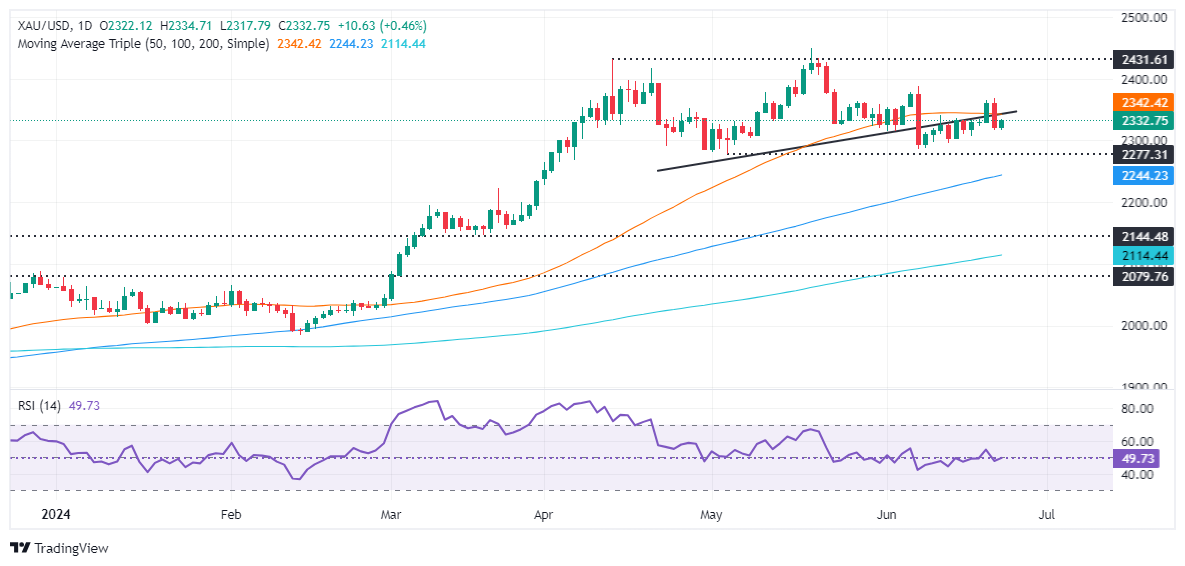
Technical analysis: Gold price climbs and test Head-and-Shoulders neckline at around $2,330
Gold price remains downward biased after forming a ‘bearish-engulfing’ chart pattern on Friday. This further validates the Head-and-Shoulders chart pattern, meaning that further downside is expected for the non-yielding metal
The XAU/USD next support would be $2,300. Once cleared, XAU/USD would fall to $2,277, the May 3 low, followed by the March 21 high of $2,222. Further losses lie underneath, with sellers eyeing the Head-and-Shoulders chart pattern objective from $2,170 to $2,160.
Conversely, if Gold reclaims $2,350, that will expose additional key resistance levels like the June 7 cycle high of $2,387, ahead of challenging the $2,400 figure.
Economic Indicator
Personal Consumption Expenditures - Price Index (MoM)
The Personal Consumption Expenditures (PCE), released by the US Bureau of Economic Analysis on a monthly basis, measures the changes in the prices of goods and services purchased by consumers in the United States (US).. The MoM figure compares prices in the reference month to the previous month. Price changes may cause consumers to switch from buying one good to another and the PCE Deflator can account for such substitutions. This makes it the preferred measure of inflation for the Federal Reserve. Generally speaking, a high reading is bullish for the US Dollar (USD), while a low reading is bearish.
Read more.Next release: Fri Jun 28, 2024 12:30
Frequency: Monthly
Consensus: 0%
Previous: 0.3%
Source: US Bureau of Economic Analysis
Author

Christian Borjon Valencia
FXStreet
Markets analyst, news editor, and trading instructor with over 14 years of experience across FX, commodities, US equity indices, and global macro markets.