Gold price edges higher on mixed US jobs outlook, insightful FOMC minutes
- Gold climbs following Fed minutes hinted at a potential slowdown in the rate easing cycle.
- US Dollar Index maintains gains, while US Treasury yields show a slight pullback from recent highs.
- Gold market watchers eye US Nonfarm Payrolls report and UoM Consumer Sentiment data.

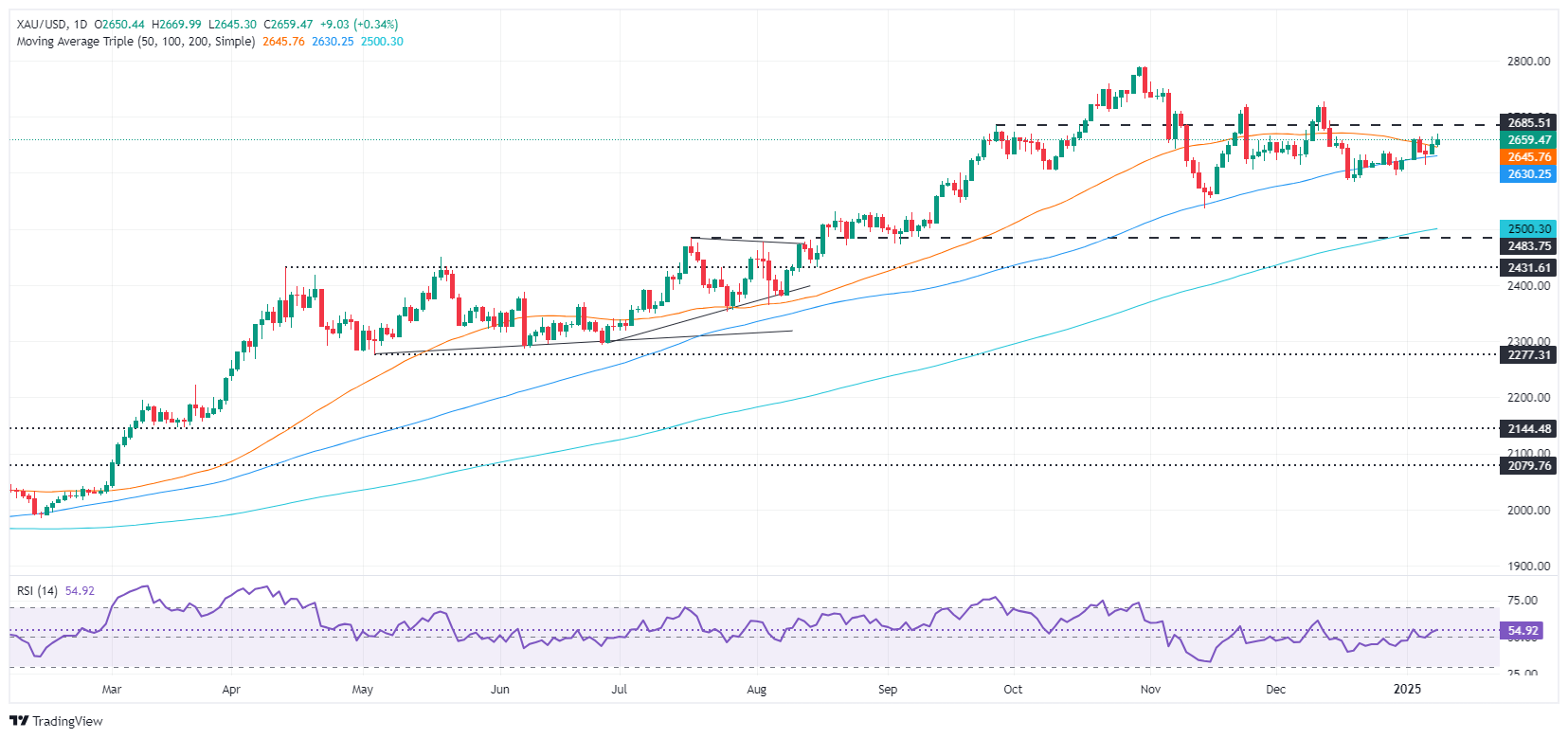
Gold price climbed during the North American session after the United States (US) Federal Reserve (Fed) struck a neutral to slightly hawkish tone in last December meeting minutes, hinting that it “would be appropriate to slow pace of easing.” At the time of writing, XAU/USD trades at $2,659, up by 0.34%.
During the December meeting, officials decided to lower borrowing costs by 25 basis points. However, “some participants said there was merit in keeping rates unchanged at that meeting, citing the higher risk of persistently elevated inflation.” Following the minutes’ release, XAU/USD edged towards $2,658 before paring some of those gains.
The US Dollar Index (DXY), which measures the Greenback’s performance against a basket of six currencies, holds to earlier gains of 0.33% at 109.04. The US 10-year benchmark note coupon retraced after hitting 4.73% to 4.699%, up by three basis points (bps).
Earlier, market participants shifted wary of a CNN article revealing that US President-elect Donald Trump might consider a national economic emergency declaration, allowing him to impose tariffs on adversaries and allies.
Bullion buyers ignored mixed US jobs reports, as private companies hired fewer people than expected. However, the US Department of Labor revealed that Americans' applications for jobless benefits were reduced compared to the previous week and came below forecasts.
Fed Governor Christopher Waller crossed the wires and said that tariffs would not cause persistent inflation, which would continue to fall towards the Fed’s 2% goal. Waller added that he favors further rate cuts, which would be data-dependent.
In the meantime, Gold traders are eyeing Friday's release of the US Nonfarm Payroll report and the University of Michigan (UoM) Consumer Sentiment. If both readings come stronger than expected, the XAU/USD might edge lower on broad US Dollar strength.
Daily digest market movers: Gold price climbs amid high US yields, ignore US data
- Gold shrugs off higher US real yields, rising three bps to 2.31%.
- Initial Jobless Claims in the US dropped to 201K for the week ending January 3, down from 211K and well below the forecast of 218K, according to the Department of Labor.
- ADP reported that private sector hiring totaled 122K in December, falling short of the 140K expected by economists.
- Market expectations indicate the Federal Reserve may implement two rate cuts in 2025, with the December Fed funds futures contract pricing in 54 basis points of easing.
- Gold surged to a two-day high of $2,664 following news that China’s central bank increased its reserves for the second consecutive month, adding 300K ounces to reach 73.3 million. The People's Bank of China (PBoC) resumed bullion purchases, which could keep XAU/USD prices skewed to the upside.
XAU/USD technical outlook: Gold price surges above $2,650
Gold price remains consolidated but slightly tilted to the upside after reclaiming the 50-day Simple Moving Average (SMA) at $2,648. If bulls push prices above $2,660, it will pave the way to challenge $2,700 before testing the December 12 peak at $2,726, ahead of the record high at $2,790.
On the flip side, if sellers drag the XAU/USD below the 100-day SMA of $2,628, look for a test of $2,500 before Gold extends its losses to the 200-day SMA at $2,498.
Gold FAQs
Gold has played a key role in human’s history as it has been widely used as a store of value and medium of exchange. Currently, apart from its shine and usage for jewelry, the precious metal is widely seen as a safe-haven asset, meaning that it is considered a good investment during turbulent times. Gold is also widely seen as a hedge against inflation and against depreciating currencies as it doesn’t rely on any specific issuer or government.
Central banks are the biggest Gold holders. In their aim to support their currencies in turbulent times, central banks tend to diversify their reserves and buy Gold to improve the perceived strength of the economy and the currency. High Gold reserves can be a source of trust for a country’s solvency. Central banks added 1,136 tonnes of Gold worth around $70 billion to their reserves in 2022, according to data from the World Gold Council. This is the highest yearly purchase since records began. Central banks from emerging economies such as China, India and Turkey are quickly increasing their Gold reserves.
Gold has an inverse correlation with the US Dollar and US Treasuries, which are both major reserve and safe-haven assets. When the Dollar depreciates, Gold tends to rise, enabling investors and central banks to diversify their assets in turbulent times. Gold is also inversely correlated with risk assets. A rally in the stock market tends to weaken Gold price, while sell-offs in riskier markets tend to favor the precious metal.
The price can move due to a wide range of factors. Geopolitical instability or fears of a deep recession can quickly make Gold price escalate due to its safe-haven status. As a yield-less asset, Gold tends to rise with lower interest rates, while higher cost of money usually weighs down on the yellow metal. Still, most moves depend on how the US Dollar (USD) behaves as the asset is priced in dollars (XAU/USD). A strong Dollar tends to keep the price of Gold controlled, whereas a weaker Dollar is likely to push Gold prices up.
Author

Christian Borjon Valencia
FXStreet
Markets analyst, news editor, and trading instructor with over 14 years of experience across FX, commodities, US equity indices, and global macro markets.