Gold closes week above $2,700, US PCE data in Focus
- Gold prices rally 1.50% on Friday, boosted by a decrease in US 10-year Treasury yields to 4.40%.
- Escalating geopolitical concerns, including potential expansion of the Russia-Ukraine conflict, fuel demand for Bullion’s safe-haven status.
- US economic data shows mixed signals; Services and Composite PMIs outperform while Manufacturing PMI remains in contraction.

Gold price rallies to a new two-week high on Friday during the North American session as US Treasury bond yields drop. Geopolitics continued to play its part, keeping the golden metal bid, while US business activity improved, capping the non-yielding metal advance. The XAU/USD trades at $2,710, gaining 1.50%.
The yellow metal surged due to a slight fall in US Treasury yields. The US 10-year T-note dipped two basis points to 4.40%, a tailwind for Bullion prices, set to print gains of more than 5% on the week.
Risks that the Russia-Ukraine war might broaden and transform into a US-Russia conflict keep Bullion prices higher. This and uncertainty about the Middle East conflict involving Israel and Lebanon may pave the way for retesting the XAU/USD all-time high at $2,790.
Data-wise, the US economic docket featured the release of S&P Global Flash PMIs for November. The Services and Composite indices expanded, exceeding estimates and October’s figures. However, the Manufacturing PMI, despite improving above forecasts and the previous month’s release, remained below the 50 line, which divides expansion/contraction territories.
Recently, the University of Michigan (UoM) revealed that Consumer Sentiment among Americans improved compared to the preliminary reading, while inflation is expected to approach the Federal Reserve’s (Fed) 2% goal in the 12 months ahead.
In the meantime, some Fed officials who crossed the wires became slightly concerned about inflation progress stalling. Even though the majority advocate for a looser policy, they acknowledge the economy remains robust; and if inflation entrenches above the 2% goal, they could pause its easing cycle.
Traders trimmed the chances for a 25 bps rate cut at the December meeting. The CME FedWatch Tool sees a 56% probability of lowering rates, down from a 58% chance two days ago.
Key economic indicators, including the Federal Reserve's meeting minutes, October Durable Goods Orders, and the Core Personal Consumption Expenditures (PCE) Price Index, the Fed's preferred inflation gauge, are set for release next week.
Daily digest market movers: Gold refreshes two-week peak on geopolitical jitters
- Gold prices recovered as US real yields retreated two basis points to 2.068%.
- The US Dollar Index (DXY), which tracks the buck's performance against six currencies, gains over 0.34%, up at 107.00 near weekly highs.
- US S&P Global PMIs for November showed growth, with the Services PMI rising to 57.0 and the Composite PMI to 55.3, both surpassing the prior month. The Manufacturing PMI edged up from 48.5 to 48.8, aligning with expectations.
- The University of Michigan Consumer Sentiment Index improved from 70.5 to 71.8 in November but fell short of projections. Meanwhile, as anticipated, one-year inflation expectations eased slightly from 2.7% to 2.6%.
- According to Chicago Board of Trade data via the December fed funds futures contract, investors are pricing in a 22 basis-point rate cut by the Federal Reserve by the end of 2024.
Technical outlook: Gold price buyers, set their sight around $2,800
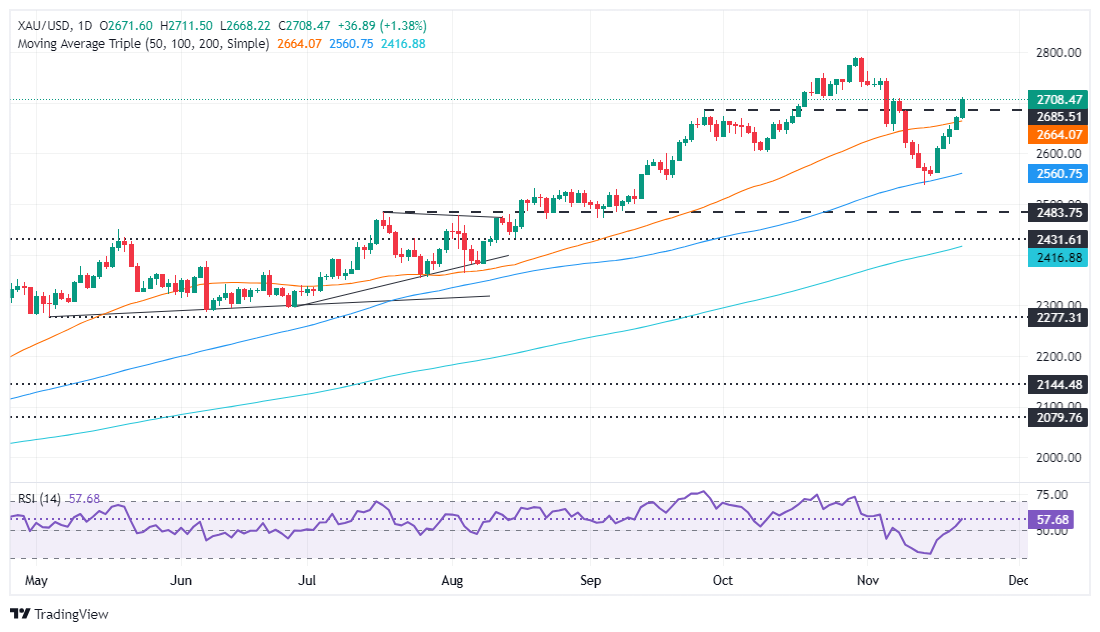
Gold’s rally is set to continue with prices aiming to challenge the $2,750 figure once more. On Thursday, the yellow metal crossed above the 50-day Simple Moving Average (SMA) of $2,663, prompting buyers to push XAU/USD’s spot prices higher.
In that environment, if Bullion prices clear $2,750, the all-time high at $2,790 is next. A breach of the latter will expose the $2,800 figure and pave the way to test $3,000, which Goldman Sachs sees as the next major resistance.
On the other hand, if XAU/USD tumbles below $2,700, the non-yielding metal could begin to trade range-bound within the $2,650-$2,700 range unless bears clear the November 14 swing low of $2,536, followed by $2,500.
The Relative Strength Index (RSI) has shifted to a bullish bias, indicating buyers are in charge.
Fed FAQs
Monetary policy in the US is shaped by the Federal Reserve (Fed). The Fed has two mandates: to achieve price stability and foster full employment. Its primary tool to achieve these goals is by adjusting interest rates. When prices are rising too quickly and inflation is above the Fed’s 2% target, it raises interest rates, increasing borrowing costs throughout the economy. This results in a stronger US Dollar (USD) as it makes the US a more attractive place for international investors to park their money. When inflation falls below 2% or the Unemployment Rate is too high, the Fed may lower interest rates to encourage borrowing, which weighs on the Greenback.
The Federal Reserve (Fed) holds eight policy meetings a year, where the Federal Open Market Committee (FOMC) assesses economic conditions and makes monetary policy decisions. The FOMC is attended by twelve Fed officials – the seven members of the Board of Governors, the president of the Federal Reserve Bank of New York, and four of the remaining eleven regional Reserve Bank presidents, who serve one-year terms on a rotating basis.
In extreme situations, the Federal Reserve may resort to a policy named Quantitative Easing (QE). QE is the process by which the Fed substantially increases the flow of credit in a stuck financial system. It is a non-standard policy measure used during crises or when inflation is extremely low. It was the Fed’s weapon of choice during the Great Financial Crisis in 2008. It involves the Fed printing more Dollars and using them to buy high grade bonds from financial institutions. QE usually weakens the US Dollar.
Quantitative tightening (QT) is the reverse process of QE, whereby the Federal Reserve stops buying bonds from financial institutions and does not reinvest the principal from the bonds it holds maturing, to purchase new bonds. It is usually positive for the value of the US Dollar.
Author

Christian Borjon Valencia
FXStreet
Markets analyst, news editor, and trading instructor with over 14 years of experience across FX, commodities, US equity indices, and global macro markets.
















