Gold climbs to historic levels as US Treasury yields edge lower after US PPI
- Gold prices recover, buoyed by falling US Treasury yields and a weaker US Dollar.
- Mixed signals from producer inflation, labor data bolster Gold amid uncertainties.
- Fed officials' inflation worries enhance Gold’s safe-haven appeal, swaying sentiment.

Gold price erased Wednesday’s losses and climbed past the $2,360 area on Thursday, shrugging off a red-hot consumer inflation report. Further data was revealed earlier during the North American session with the Producer Price Index (PPI) showing signs of easing inflation. Consequently, US Treasury yields fell, capping the US Dollar rally.
XAU/USD spot trades at new all-time highs at around $2,374 a troy ounce, posting solid gains of 1.70%. The US Bureau of Labor Statistics (BLS) revealed additional inflation data on the producer side, alongside Initial Jobless Claims. The number of Americans filing for unemployment benefits was below the previous reading and forecasts, indicating the labor market remains tight.
Federal Reserve (Fed) officials grabbed some highlights. New York Fed President John Williams and Richmond Fed President Thomas Barkin added that recent inflation data was disappointing and doesn’t increase confidence that disinflation is spreading.
Daily digest market movers: Gold shrugs off hot US CPI report, resumes uptrend
- The March US Producer Price Index (PPI) showed that the disinflation process continues, with data clocking at 0.2% MoM, below estimates of 0.3%. The core PPI printed at 0.2% MoM, which is below estimates and February’s reading.
- In the twelve months to March, the PPI rose by 2.1%, less than projections but surpassing February’s 1.6%. The core PPI stood at 2.4%, however, above estimates and the previous month's data.
- Initial Jobless Claims for the week ending April 6 dipped from 222K to 211K, below estimates of 215K, reinforcing the labor market's robustness following last Friday’s release of the Nonfarm Payrolls report.
- High inflationary levels in the United States, revealed by the March Consumer Price Index (CPI) report, prompted investors to trim expectations of the Fed’s rate cuts.
- Data from the Chicago Board of Trade (CBOT) suggests that futures traders expect just two cuts to the fed funds rate as they project the main reference rate to end the year at 4.955%.
- Despite that, the fall of US Treasury nominal and real yields is a headwind for Gold prices. US real yields fall three basis points to 2.148%.
- The US Dollar Index (DXY) also witnessed a substantial increase, soaring over 1% to reach new YTD high of 105.27.
- World Gold Consortium reveals that the People’s Bank of China was the largest buyer of the yellow metal in February, increasing its reserves by 12 tonnes to 2,257 tonnes.
Technical analysis: Gold’s rise resumes as buyers eye $2,400
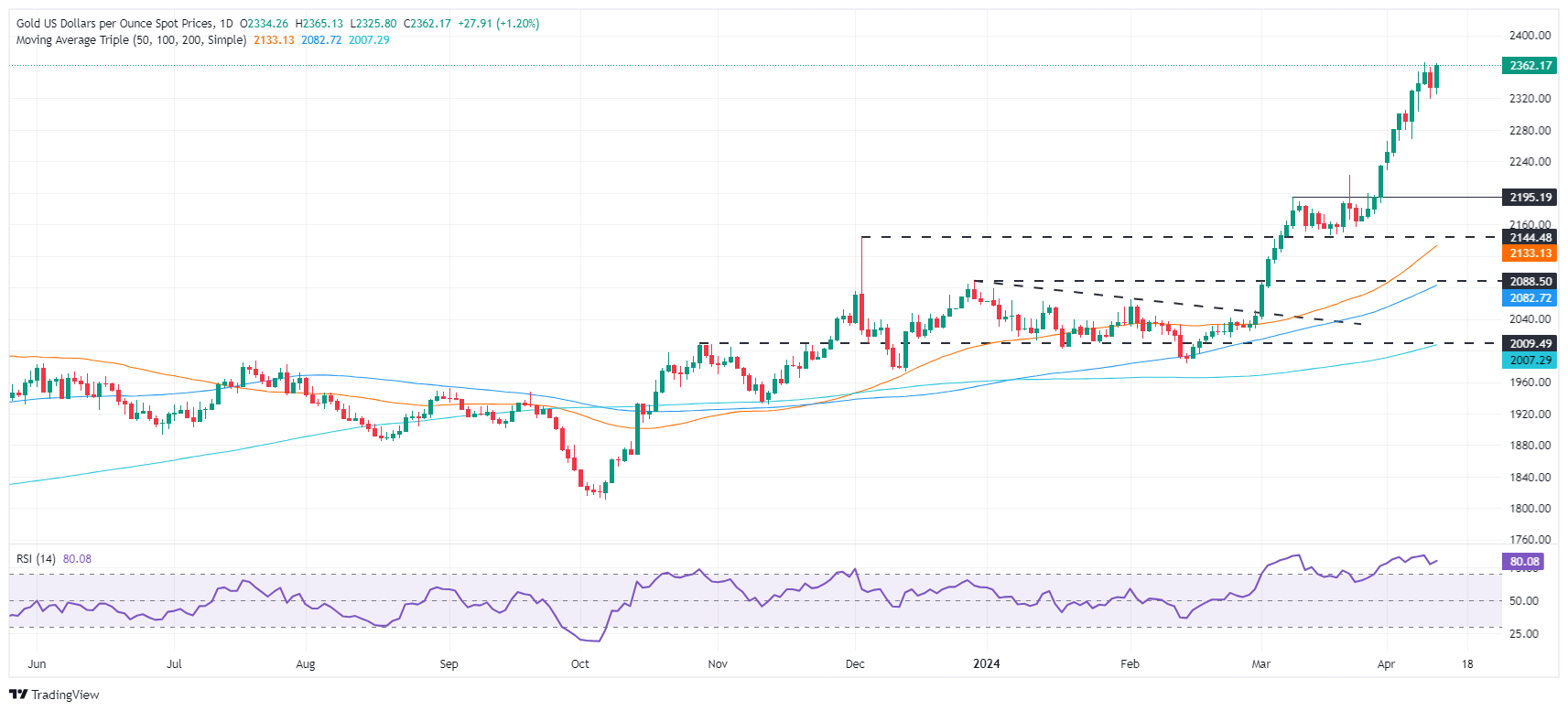
Gold remains upwardly biased despite dipping toward the $2,310 area on Wednesday. Nevertheless, the drop in US real yields sponsored XAU/USD’s last leg up, with buyers threatening to push prices to refresh all-time highs.
If XAU/USD decisively surpasses the $2,365 area, it would pave the way to challenging the psychological $2,400 mark. Further upside is seen at $2,450 and $2,500.
On the other hand, if the precious metal’s price drops below $2,359, look for a challenge of the April 10 low of $2,319, followed by the April 8 daily low of $2,303. Once cleared, the next support would be March’s 21-session high of $2,222. Further losses are seen at $2,200.
Gold FAQs
Gold has played a key role in human’s history as it has been widely used as a store of value and medium of exchange. Currently, apart from its shine and usage for jewelry, the precious metal is widely seen as a safe-haven asset, meaning that it is considered a good investment during turbulent times. Gold is also widely seen as a hedge against inflation and against depreciating currencies as it doesn’t rely on any specific issuer or government.
Central banks are the biggest Gold holders. In their aim to support their currencies in turbulent times, central banks tend to diversify their reserves and buy Gold to improve the perceived strength of the economy and the currency. High Gold reserves can be a source of trust for a country’s solvency. Central banks added 1,136 tonnes of Gold worth around $70 billion to their reserves in 2022, according to data from the World Gold Council. This is the highest yearly purchase since records began. Central banks from emerging economies such as China, India and Turkey are quickly increasing their Gold reserves.
Gold has an inverse correlation with the US Dollar and US Treasuries, which are both major reserve and safe-haven assets. When the Dollar depreciates, Gold tends to rise, enabling investors and central banks to diversify their assets in turbulent times. Gold is also inversely correlated with risk assets. A rally in the stock market tends to weaken Gold price, while sell-offs in riskier markets tend to favor the precious metal.
The price can move due to a wide range of factors. Geopolitical instability or fears of a deep recession can quickly make Gold price escalate due to its safe-haven status. As a yield-less asset, Gold tends to rise with lower interest rates, while higher cost of money usually weighs down on the yellow metal. Still, most moves depend on how the US Dollar (USD) behaves as the asset is priced in dollars (XAU/USD). A strong Dollar tends to keep the price of Gold controlled, whereas a weaker Dollar is likely to push Gold prices up.
Author

Christian Borjon Valencia
FXStreet
Markets analyst, news editor, and trading instructor with over 14 years of experience across FX, commodities, US equity indices, and global macro markets.