Gold price bulls take a breather near multi-month top amid positive risk tone
- Gold price catches fresh bids on Friday and builds on over a one-month-old uptrend.
- The uncertainty about Trump's trade policies underpins the safe-haven precious metal.
- Bets for more Fed rate cuts weigh on the USD and further benefit the XAU/USD pair.

Gold price (XAU/USD) enters a bullish consolidation phase during the first half of the European session and oscillates in a range above the $2,770 area, near a multi-month top touched earlier this Friday. The US Dollar (USD) attracts sellers for the second straight day and drops to over a one-month low amid a fresh leg down in the US Treasury bond yields, triggered by US President Donald Trump's comments that he could reach a trade deal with China. This, along with bets that the Federal Reserve (Fed) will cut interest rates further by the end of this year, acts as a tailwind for the non-yielding yellow metal.
Apart from this, worries about the potential economic fallout from Trump's protectionist policies turn out to be another factor driving flows towards the safe-haven Gold price. That said, a generally positive tone around the equity markets holds back traders from placing fresh bullish bets around the XAU/USD amid slightly overbought conditions on short-term charts. Nevertheless, the commodity remains on track to register gains for the fourth straight week as traders look to the flash US PMIs, due later during the early North American session, for short-term opportunities on the last day of the week.
Gold price remains well supported by Fed rate cut bets, weaker USD
- Investors remain concerned about the potential economic fallout from US President Donald Trump's tariffs, which continues to push the safe-haven Gold price higher on Friday.
- The US Dollar slides back closer to the monthly trough in reaction to Trump's remarks on Thursday that he will apply pressure on the Federal Reserve to bring down interest rates.
- The markets started pricing in the possibility that the US central bank will lower borrowing costs twice by the end of this year amid signs of abating inflationary pressures in the US.
- Trump said on Friday that his conversation with Chinese President Xi Jinping was friendly and that he could reach a trade deal with China and would rather not use tariffs.
- This eases worries that Trump's protectionist policies could boost inflation and supports prospects for further policy easing by the Fed, benefiting the non-yielding yellow metal.
- Traders now look forward to the flash PMIs for fresh insight into the global economic health, which might influence the broader risk sentiment and drive the XAU/USD.
Gold price consolidates amid slightly overbought RSI; bullish bias remains
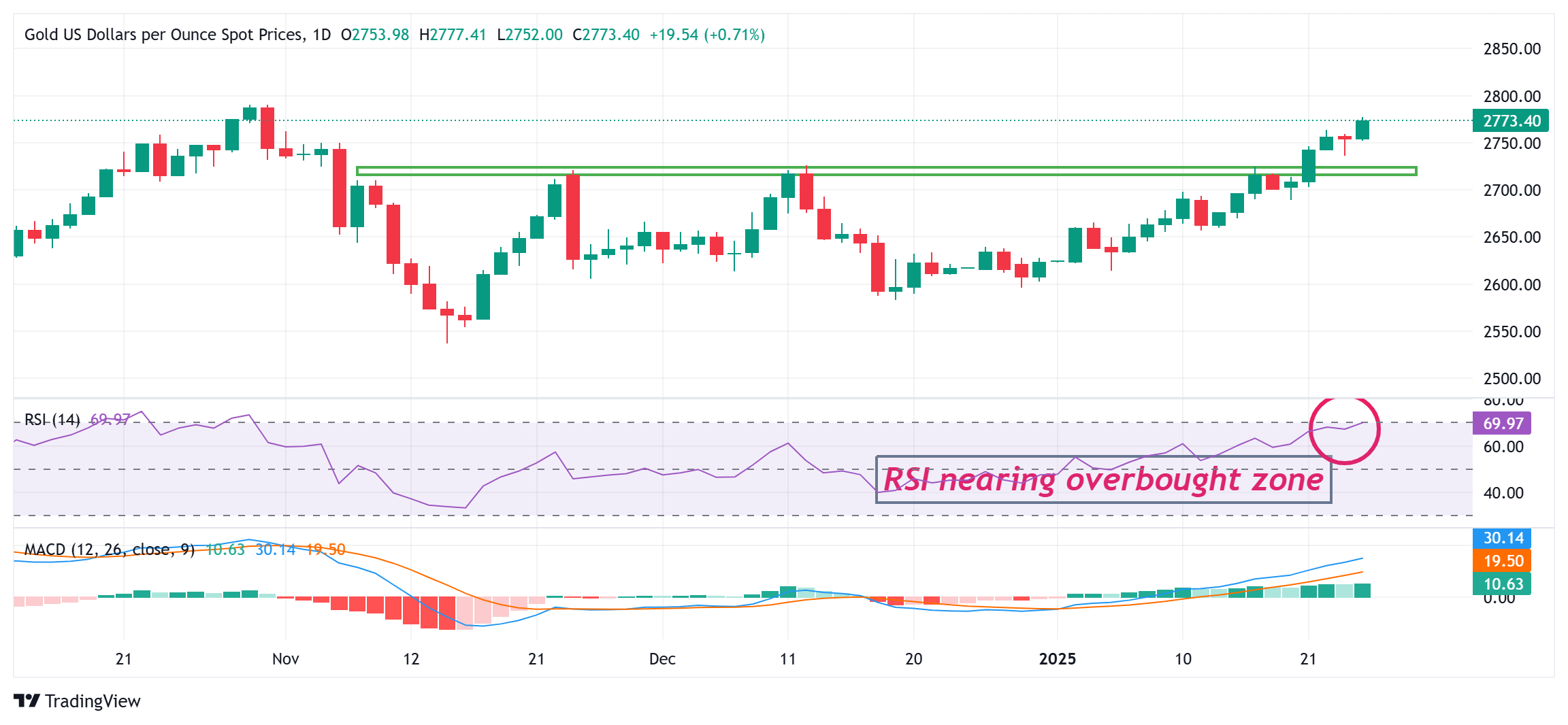
From a technical perspective, the emergence of some dip-buying on Thursday and the subsequent move up validate a bullish breakout through the $2,720-2,725 supply zone. That said, the Relative Strength Index (RSI) on the daily chart has moved on the verge of breaking into overbought territory, making it prudent to wait for some near-term consolidation or a modest pullback before positioning for further gains. Hence, some follow-through momentum is more likely to confront a stiff hurdle near the all-time peak, around the $2,790 region.
On the flip side, immediate support is pegged near the $2,760-2,758 area, below which the Gold price could slide to retest the overnight swing low, around the $2,736-2,735 region. Any further slide could be seen as a buying opportunity and remain limited near the $2,725-2,720 resistance-turned-support. The latter should act as a key pivotal point, which if broken decisively might shift the bias in favor of bearish trades and pave the way for deeper losses.
Risk sentiment FAQs
In the world of financial jargon the two widely used terms “risk-on” and “risk off'' refer to the level of risk that investors are willing to stomach during the period referenced. In a “risk-on” market, investors are optimistic about the future and more willing to buy risky assets. In a “risk-off” market investors start to ‘play it safe’ because they are worried about the future, and therefore buy less risky assets that are more certain of bringing a return, even if it is relatively modest.
Typically, during periods of “risk-on”, stock markets will rise, most commodities – except Gold – will also gain in value, since they benefit from a positive growth outlook. The currencies of nations that are heavy commodity exporters strengthen because of increased demand, and Cryptocurrencies rise. In a “risk-off” market, Bonds go up – especially major government Bonds – Gold shines, and safe-haven currencies such as the Japanese Yen, Swiss Franc and US Dollar all benefit.
The Australian Dollar (AUD), the Canadian Dollar (CAD), the New Zealand Dollar (NZD) and minor FX like the Ruble (RUB) and the South African Rand (ZAR), all tend to rise in markets that are “risk-on”. This is because the economies of these currencies are heavily reliant on commodity exports for growth, and commodities tend to rise in price during risk-on periods. This is because investors foresee greater demand for raw materials in the future due to heightened economic activity.
The major currencies that tend to rise during periods of “risk-off” are the US Dollar (USD), the Japanese Yen (JPY) and the Swiss Franc (CHF). The US Dollar, because it is the world’s reserve currency, and because in times of crisis investors buy US government debt, which is seen as safe because the largest economy in the world is unlikely to default. The Yen, from increased demand for Japanese government bonds, because a high proportion are held by domestic investors who are unlikely to dump them – even in a crisis. The Swiss Franc, because strict Swiss banking laws offer investors enhanced capital protection.
Author

Haresh Menghani
FXStreet
Haresh Menghani is a detail-oriented professional with 10+ years of extensive experience in analysing the global financial markets.