Gold price sticks to positive bias amid pre-holiday subdued trading action
- Gold price edges higher on Tuesday, albeit lacking strong follow-through buying.
- Geopolitical tensions and trade war fears lend support to the safe-haven XAU/USD.
- The Fed’s hawkish shift acts as a tailwind for the USD and caps the precious metal.

Gold price (XAU/USD) struggles to capitalize on its modest intraday gains on Tuesday and remains below a multi-day top set the previous day amid mixed fundamental cues. Geopolitical risks stemming from the protracted Russia-Ukraine war and tensions in the Middle East, along with trade war fears, continue to offer some support to the safe-haven precious metal. That said, the Federal Reserve's (Fed) hawkish shift keeps a lid on the commodity.
The US central bank last week signaled that it would slow the pace of interest rate cuts in 2025. The outlook remains supportive of elevated US Treasury bond yields, which assist the US Dollar (USD) to hold steady near a two-year peak and cap the non-yielding Gold price. This makes it prudent to wait for some follow-through buying before positioning for an extension of the recovery from a one-month low touched last week amid thin trading volumes.
Gold price bulls seem non-committed amid Fed's hawkish outlook
- The Federal Reserve last week tempered the outlook for further rate cuts in 2025, marking a turning point in its monetary policy and underscoring uncertainties surrounding potential policy changes under the incoming Trump administration.
- The yield on the benchmark 10-year US government bond shot to its highest level since May on Monday and the US Dollar stood firm near a two-year peak touched last week, which should cap the upside for the non-yielding Gold price.
- The Israel Defense Forces (IDF) said this Tuesday that sirens were sounded in the centre and south of Israel and that it had intercepted a projectile fired from Yemen as Israeli forces continued their attacks in besieged northern Gaza.
- Russian forces captured two villages in Ukraine and are making steady progress in the Donetsk area. US President-elect Donald Trump urged Ukrainian President Volodymyr Zelenskyy to consider a ceasefire and abandon Russian-occupied territories.
- Traders now look forward to the release of the Richmond Manufacturing Index, which, along with the US bond yields, will influence the USD and provide some impetus amid a relatively thin liquidity on Christmas Eve.
Gold price seems vulnerable; bearish flag pattern in the making
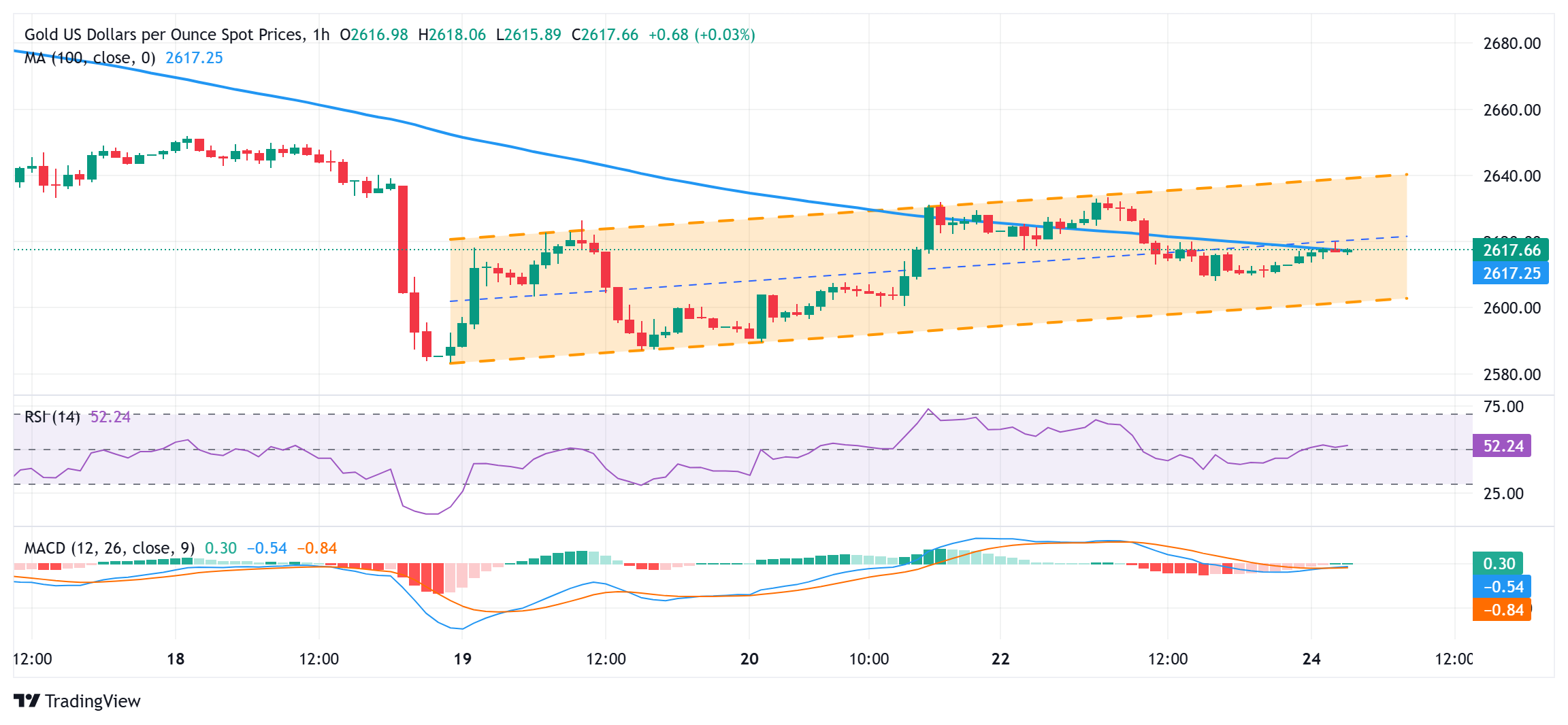
From a technical perspective, the recent recovery from a one-month low, along an ascending channel, constitutes the formation of a bearish flag pattern on hourly charts. Moreover, oscillators on the daily chart remain in negative territory, suggesting that the path of least resistance for the Gold price is downward. That said, it will still be prudent to wait for a convincing break below the channel support, currently pegged around the $2,605-$2,600 area, before positioning for any further depreciating move.
The subsequent downfall could drag the Gold price back towards the monthly trough, around the $2,583 region touched last week. Some follow-through selling will be seen as a fresh trigger for bears and set the stage for a slide towards the November monthly swing low, around the $2,537-$2,536 area en route to the $2,500 psychological mark.
On the flip side, the $2,633-$2,634 zone, or a multi-day top touched on Monday, which nears the top boundary of the ascending channel, might continue to act as an immediate strong barrier. A sustained strength beyond might prompt some short-covering and lift the Gold price to the $2,654-$2,655 region. The latter should act as a key pivotal point, which if cleared decisively will negate the near-term negative bias and pave the way for additional gains towards reclaiming the $2,700 round figure.
Fed FAQs
Monetary policy in the US is shaped by the Federal Reserve (Fed). The Fed has two mandates: to achieve price stability and foster full employment. Its primary tool to achieve these goals is by adjusting interest rates. When prices are rising too quickly and inflation is above the Fed’s 2% target, it raises interest rates, increasing borrowing costs throughout the economy. This results in a stronger US Dollar (USD) as it makes the US a more attractive place for international investors to park their money. When inflation falls below 2% or the Unemployment Rate is too high, the Fed may lower interest rates to encourage borrowing, which weighs on the Greenback.
The Federal Reserve (Fed) holds eight policy meetings a year, where the Federal Open Market Committee (FOMC) assesses economic conditions and makes monetary policy decisions. The FOMC is attended by twelve Fed officials – the seven members of the Board of Governors, the president of the Federal Reserve Bank of New York, and four of the remaining eleven regional Reserve Bank presidents, who serve one-year terms on a rotating basis.
In extreme situations, the Federal Reserve may resort to a policy named Quantitative Easing (QE). QE is the process by which the Fed substantially increases the flow of credit in a stuck financial system. It is a non-standard policy measure used during crises or when inflation is extremely low. It was the Fed’s weapon of choice during the Great Financial Crisis in 2008. It involves the Fed printing more Dollars and using them to buy high grade bonds from financial institutions. QE usually weakens the US Dollar.
Quantitative tightening (QT) is the reverse process of QE, whereby the Federal Reserve stops buying bonds from financial institutions and does not reinvest the principal from the bonds it holds maturing, to purchase new bonds. It is usually positive for the value of the US Dollar.
Author

Haresh Menghani
FXStreet
Haresh Menghani is a detail-oriented professional with 10+ years of extensive experience in analysing the global financial markets.

















