Gold prints new record peaks as Fed rate cut expectations surge
- Gold hits new all-time high at $2,586 amid rising expectations of a significant Fed rate cut, with a 43% chance of a 50 bps reduction.
- US Treasury yields fall, US Dollar Index drops to 101.09, boosting Gold's ascent.
- Global ETFs experience strong inflows; improved US Consumer Sentiment and lower inflation expectations prompt speculation on more Fed easing.

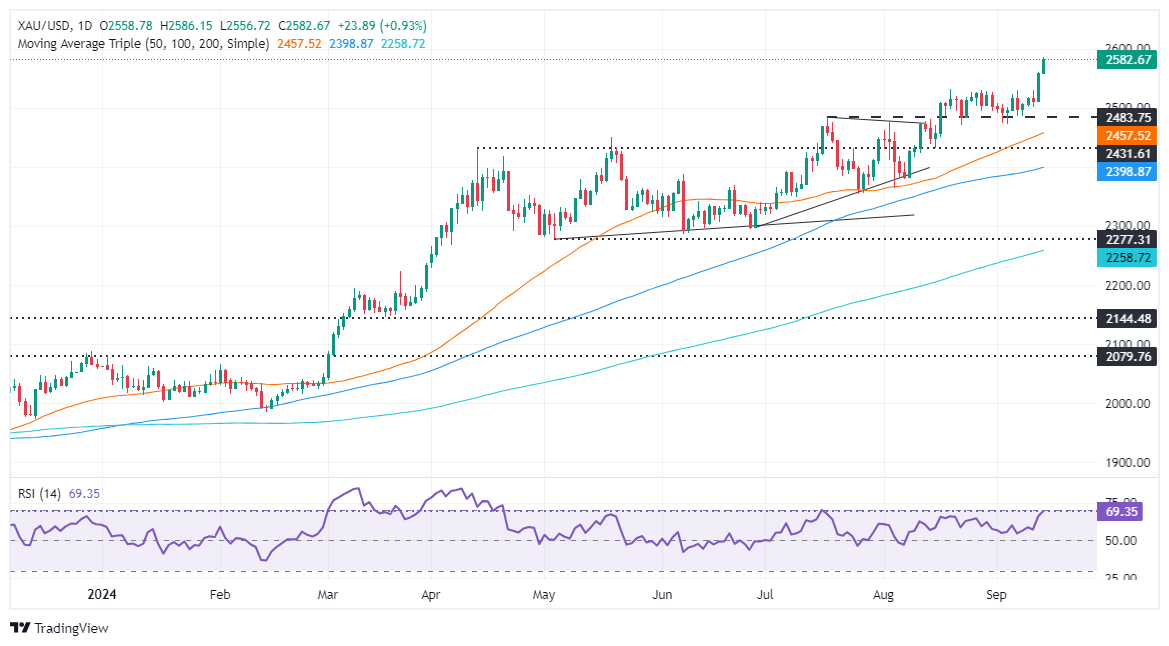
Gold prices surged to a new all-time high (ATH) of $2,586 and are set to extend their gains as the US Dollar weakens on Friday. Expectations for a bigger interest rate cut by the Federal Reserve (Fed) boosted the non-yielding metal, with talks that it could hit the $3,000 milestone. The XAU/USD trades at $2,582 at the time of writing, posting gains of almost 1%.
According to CME FedWatch Tool data, traders have increased the odds for a 50-basis-point (bps) rate cut by the Fed. A news article by Fed watcher Nick Timiraous at The Wall Street Journal, along with comments from former New York Fed President William Dudley, sparked a jump from 27% to 43%, while estimates for a 25 bps cut dropped from 73% to 57%.
Therefore, US Treasury yields tumbled and undermined the Greenback. The US Dollar Index (DXY), which measures the buck’s performance against another six currencies, dropped 0.15% to 101.09.
Bullion prices are expected to extend their gains as global Gold ETFs saw a fourth consecutive month of inflows in August, based on data from the World Gold Council last week.
The US economic schedule on Friday revealed the Consumer Sentiment Index for September from the University of Michigan. This index showed an improvement compared to August. Alongside this, inflation expectations dipped, fueling speculation for Fed rate cuts.
Daily digest market moves: Gold price skyrockets above $2,550
- University of Michigan Consumer Sentiment Index rose from 67.9 to 69.0, exceeding estimates of 68.
- Inflation expectations improved from 2.8% to 2.7% for the one year, while long-term expectations increased from 3% to 3.1%.
- Greenback remained under pressure after the US Bureau of Labor Statistics revealed mixed August PPI data. Meanwhile, the number of Americans filing for unemployment benefits rose as expected, surpassing the previous week's reading.
- Data from the Chicago Board of Trade suggests the Fed will cut at least 98 basis points this year, down from 108 a day ago, according to the fed funds rate futures contract for December 2024.
Technical outlook: Gold price surges as buyers eye $2,600
Gold price uptrend remains intact, backed by solid demand and momentum. The Relative Strength Index (RSI) is bullish and, due to the trend's strength, remains shy of hitting 80, which traders usually seek as the “most extreme” overbought level.
With that said, the XAU/USD path of least resistance is upward. The first resistance would be the September 13 peak at $2,586. Once cleared, the next stop would be the $2,600 figure.
Conversely, Gold sellers must drive prices below $2,550 if they want to regain control. The following key support levels that need to be cleared are the August 20 high at $2,531 before aiming at $2,500.
Gold FAQs
Gold has played a key role in human’s history as it has been widely used as a store of value and medium of exchange. Currently, apart from its shine and usage for jewelry, the precious metal is widely seen as a safe-haven asset, meaning that it is considered a good investment during turbulent times. Gold is also widely seen as a hedge against inflation and against depreciating currencies as it doesn’t rely on any specific issuer or government.
Central banks are the biggest Gold holders. In their aim to support their currencies in turbulent times, central banks tend to diversify their reserves and buy Gold to improve the perceived strength of the economy and the currency. High Gold reserves can be a source of trust for a country’s solvency. Central banks added 1,136 tonnes of Gold worth around $70 billion to their reserves in 2022, according to data from the World Gold Council. This is the highest yearly purchase since records began. Central banks from emerging economies such as China, India and Turkey are quickly increasing their Gold reserves.
Gold has an inverse correlation with the US Dollar and US Treasuries, which are both major reserve and safe-haven assets. When the Dollar depreciates, Gold tends to rise, enabling investors and central banks to diversify their assets in turbulent times. Gold is also inversely correlated with risk assets. A rally in the stock market tends to weaken Gold price, while sell-offs in riskier markets tend to favor the precious metal.
The price can move due to a wide range of factors. Geopolitical instability or fears of a deep recession can quickly make Gold price escalate due to its safe-haven status. As a yield-less asset, Gold tends to rise with lower interest rates, while higher cost of money usually weighs down on the yellow metal. Still, most moves depend on how the US Dollar (USD) behaves as the asset is priced in dollars (XAU/USD). A strong Dollar tends to keep the price of Gold controlled, whereas a weaker Dollar is likely to push Gold prices up.
Economic Indicator
Michigan Consumer Sentiment Index
The Michigan Consumer Sentiment Index, released on a monthly basis by the University of Michigan, is a survey gauging sentiment among consumers in the United States. The questions cover three broad areas: personal finances, business conditions and buying conditions. The data shows a picture of whether or not consumers are willing to spend money, a key factor as consumer spending is a major driver of the US economy. The University of Michigan survey has proven to be an accurate indicator of the future course of the US economy. The survey publishes a preliminary, mid-month reading and a final print at the end of the month. Generally, a high reading is bullish for the US Dollar (USD), while a low reading is bearish.
Read more.Last release: Fri Sep 13, 2024 14:00 (Prel)
Frequency: Monthly
Actual: 69
Consensus: 68
Previous: 67.9
Source: University of Michigan
Consumer exuberance can translate into greater spending and faster economic growth, implying a stronger labor market and a potential pick-up in inflation, helping turn the Fed hawkish. This survey’s popularity among analysts (mentioned more frequently than CB Consumer Confidence) is justified because the data here includes interviews conducted up to a day or two before the official release, making it a timely measure of consumer mood, but foremost because it gauges consumer attitudes on financial and income situations. Actual figures beating consensus tend to be USD bullish.
Author

Christian Borjon Valencia
FXStreet
Markets analyst, news editor, and trading instructor with over 14 years of experience across FX, commodities, US equity indices, and global macro markets.