Gold trends upward amid falling US yields, US data eyed
- Gold prices rise as US 10-year Treasury yield drops to 4.03%, enhancing the appeal of non-yielding assets.
- The New York Empire State Manufacturing Index shows weakness, but inflation expectations revised upward in September.
- Geopolitical tensions add to Gold’s safe-haven allure as investors brace for key US economic data later this week.

Gold prices advanced Tuesday as US Treasury bond yields retreated, capping US Dollar gains. A light economic docket featured the New York Empire State Manufacturing Index and the release of the NY Fed Consumers Expectations Survey. The XAU/USD trades at $2,664.
The New York Fed revealed the Empire State Manufacturing Index for September, which printed a dismal figure. Meanwhile, inflation expectations were upwardly revised in September, according to the latest NY Fed Consumers Expectations Survey.
The yield of the US 10-year Treasury note dropped eight basis points (bps) down to 4.03%, making the non-yielding metal more appealing while signaling increasing demand for US Treasury bonds.
Bullion prices extended their gains after bouncing off a daily low of $2,638, although the buck remains firm. The US Dollar Index (DXY), which tracks the Greenback’s value against a basket of six currencies, is virtually unchanged at 103.25.
Aside from this, Federal Reserve (Fed) officials continued to grab the headlines. San Francisco Fed President Mary Daly said the Fed’s dual mandate risks are now in balance and that the labor market is not a source of inflation. She added that she’s cautiously optimistic about the economic outlook and foresees one or two rate cuts “if forecasts are met.”
The XAU/USD tends to fare well amidst times of geopolitical risks. Israel revealed that it would target military targets as retaliation against Iran and Hezbollah following the October 1 missile raid.
The Market’s attention turns to upcoming US Retail Sales, Industrial Production data, and Initial Jobless Claims due later this week.
Daily digest market movers: Gold price climbs as investors eye key US data
- The New York Empire State Manufacturing Index for October plummeted sharply to -11.9, missing the consensus of 2.3, well below September’s 11.3.
- The NY Fed Consumer Expectations Survey in September showed that inflation expectations for one year were unchanged at 3%, while for three years they edged up from 2.5% to 2.7%. For five years, inflation is forecasted to rise from the prior 2.8% to 2.9%.
- According to the CME FedWatch tool, traders see a 97.5% chance of a 25-basis-point cut in November.
- Data from the Chicago Board of Trade, based on the December fed funds rate futures contract, indicates that investors are pricing in 50 basis points (bps) of easing by the Fed in the last two months of 2024.
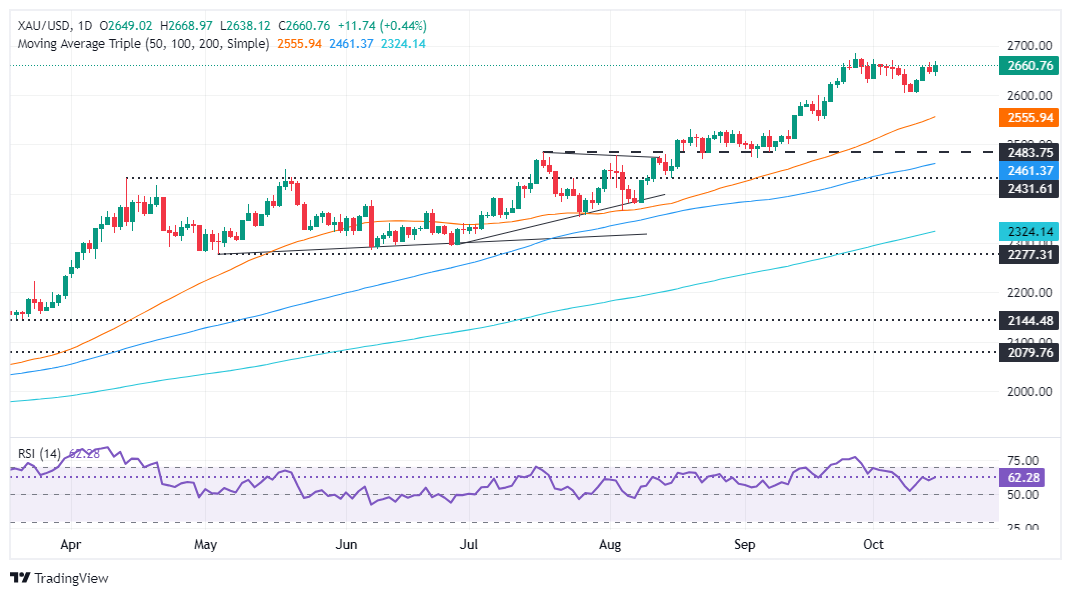
XAU/USD technical outlook: Gold price surges above $2,660, eyes on YTD peak
Gold price uptrend remains intact after climbing above the $2,660 area. Momentum is bullish, as shown by the Relative Strength Index (RSI). With the RSI aiming higher, this indicates that buyers remain in charge.
If XAU/USD clears the October 4 high at $2,670, it would pave the way to challenge the YTD high of $2,685, which is ahead of the $2,700 mark.
On the flip side, once Gold drops below $2,650, it would pave the way for further downside. The next key support level would be $2,600. A breach of the latter would expose the 50-day Simple Moving Average (SMA) at $2,555.
Gold FAQs
Gold has played a key role in human’s history as it has been widely used as a store of value and medium of exchange. Currently, apart from its shine and usage for jewelry, the precious metal is widely seen as a safe-haven asset, meaning that it is considered a good investment during turbulent times. Gold is also widely seen as a hedge against inflation and against depreciating currencies as it doesn’t rely on any specific issuer or government.
Central banks are the biggest Gold holders. In their aim to support their currencies in turbulent times, central banks tend to diversify their reserves and buy Gold to improve the perceived strength of the economy and the currency. High Gold reserves can be a source of trust for a country’s solvency. Central banks added 1,136 tonnes of Gold worth around $70 billion to their reserves in 2022, according to data from the World Gold Council. This is the highest yearly purchase since records began. Central banks from emerging economies such as China, India and Turkey are quickly increasing their Gold reserves.
Gold has an inverse correlation with the US Dollar and US Treasuries, which are both major reserve and safe-haven assets. When the Dollar depreciates, Gold tends to rise, enabling investors and central banks to diversify their assets in turbulent times. Gold is also inversely correlated with risk assets. A rally in the stock market tends to weaken Gold price, while sell-offs in riskier markets tend to favor the precious metal.
The price can move due to a wide range of factors. Geopolitical instability or fears of a deep recession can quickly make Gold price escalate due to its safe-haven status. As a yield-less asset, Gold tends to rise with lower interest rates, while higher cost of money usually weighs down on the yellow metal. Still, most moves depend on how the US Dollar (USD) behaves as the asset is priced in dollars (XAU/USD). A strong Dollar tends to keep the price of Gold controlled, whereas a weaker Dollar is likely to push Gold prices up.
Author

Christian Borjon Valencia
FXStreet
Markets analyst, news editor, and trading instructor with over 14 years of experience across FX, commodities, US equity indices, and global macro markets.