Gold price sticks to negative bias, remains close to multi-month peak set on Wednesday
- Gold price eases from a near three-month peak touched on Wednesday amid a modest USD uptick.
- Bets for further interest rate cuts by the Fed hold back the USD bulls from placing aggressive bets.
- Concerns about Trump’s tariff plans further contribute to limiting deeper losses for the XAU/USD.

Gold price (XAU/USD) remains depressed through the first half of the European session on Thursday and for now, seems to have snapped a three-day winning streak to its highest level since early November touched the previous day. The US Dollar (USD) gains some positive traction for the second straight day and recovers further from the monthly low. This, along with a stable performance around the equity markets, turn out to be key factors undermining the safe-haven precious metal.
That said, bets that the Federal Reserve (Fed) will cut rates twice this year keep a lid on the US Treasury bond yields, which, in turn, should cap the USD and offer some support to the non-yielding Gold price. Furthermore, uncertainty over US President Donald Trump’s trade policies, which could trigger trade wars and elevate market volatility, should help limit losses for the XAU/USD. This warrants caution before confirming that the one-month-old uptrend has run out of steam.
Gold price retains negative bias amid modest USD strength; downside remains cushioned
- The US Dollar holds steady above its lowest level since late December touched on Wednesday amid a modest rebound in the US Treasury bond yields and prompts some selling around the Gold price on Thursday.
- The lack of details about US President Donald Trump's tariff plans and easing geopolitical tensions remain supportive of the risk-on mood, which is seen as another factor undermining the safe-haven precious metal.
- Trump's proposed policies are broadly regarded as inflationary, which, in turn, might compel the Federal Reserve to stick to its hawkish stance and keep interest rates higher for longer to rein in rising price pressures.
- Investors, however, are still pricing in the possibility that the US central bank will lower borrowing costs at least two times by the end of this year. This might cap the upside for the US bond yields and the Greenback.
- Trump's speech at the World Economic Forum will be looked upon for more concrete announcements on tariffs. Apart from this, the release of the US Weekly Jobless Claims should provide some impetus to the XAU/USD.
- The Bank of Japan is scheduled to announce its decision at the end of a two-day policy meeting on Friday and is expected to raise interest rates from 0.25% to 0.50%, or the highest since the 2008 global financial crisis.
- Rate decisions from the Fed and European Central Bank are scheduled for Wednesday and Thursday next week, respectively, which could infuse volatility and provide some impetus to the non-yielding yellow metal.
Gold price bulls have the upper hand while above the $2,720-2,25 resistance breakpoint
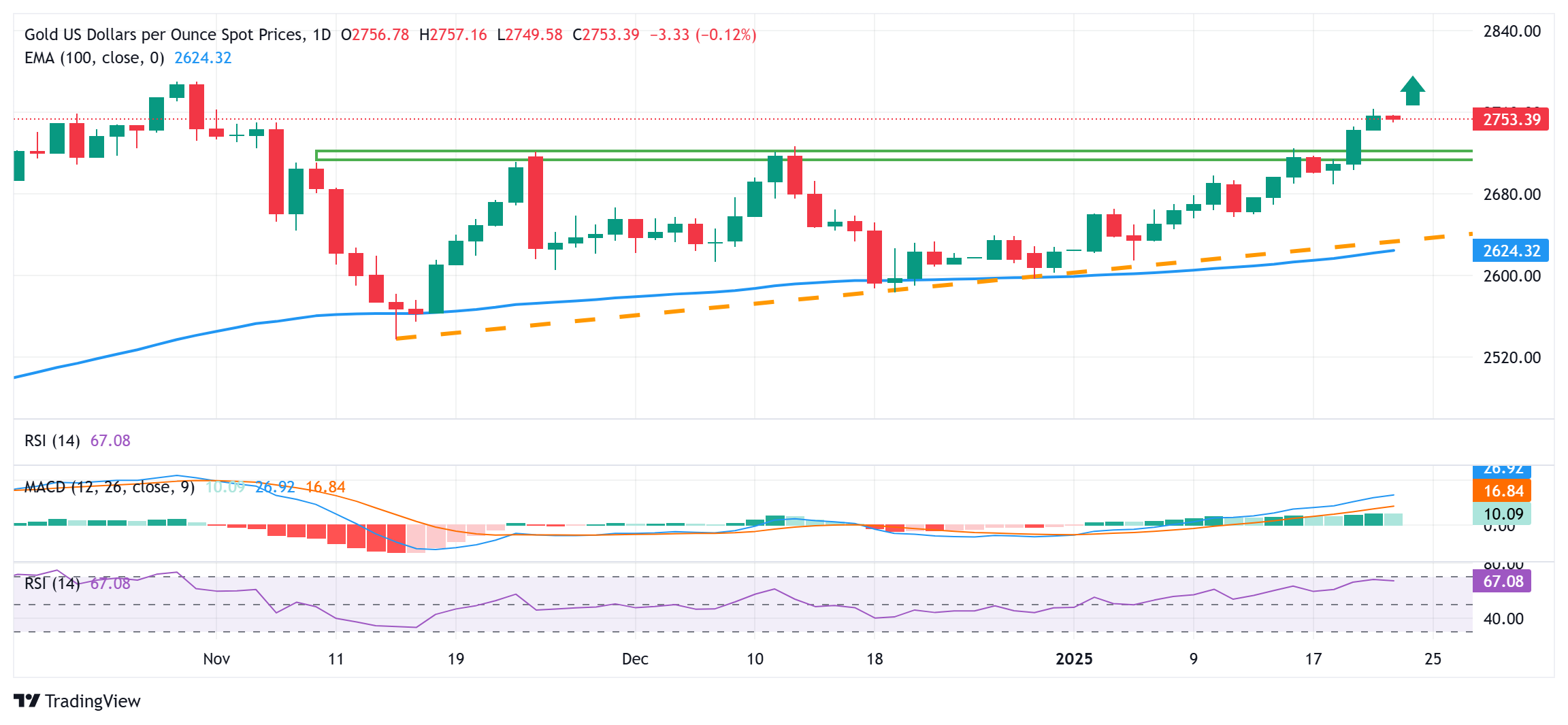
From a technical perspective, any subsequent slide is more likely to find decent support near the $2,625-2,620 strong horizontal resistance breakpoint, now turned support. Some follow-through selling could drag the Gold price to the $2,700 mark, which if broken decisively should pave the way for deeper losses. The XAU/USD might then fall towards the $2,665-2,662 area en route to the 2,627-2,622 confluence. The latter comprises the 100-day Exponential Moving Average (EMA) and a short-term ascending trend line, which, in turn, should act as a key pivotal point for short-term traders.
On the flip side, the overnight swing high, around the $2,763-2,764 area, now seems to offer some resistance, above which the Gold price could aim to challenge the all-time peak, around the $2,790 region touched in October. This is closely followed by the $2,800 mark, which if conquered will be seen as a fresh trigger for bullish trades and set the stage for an extension of the recent well-established uptrend witnessed over the past month or so.
Interest rates FAQs
Interest rates are charged by financial institutions on loans to borrowers and are paid as interest to savers and depositors. They are influenced by base lending rates, which are set by central banks in response to changes in the economy. Central banks normally have a mandate to ensure price stability, which in most cases means targeting a core inflation rate of around 2%. If inflation falls below target the central bank may cut base lending rates, with a view to stimulating lending and boosting the economy. If inflation rises substantially above 2% it normally results in the central bank raising base lending rates in an attempt to lower inflation.
Higher interest rates generally help strengthen a country’s currency as they make it a more attractive place for global investors to park their money.
Higher interest rates overall weigh on the price of Gold because they increase the opportunity cost of holding Gold instead of investing in an interest-bearing asset or placing cash in the bank. If interest rates are high that usually pushes up the price of the US Dollar (USD), and since Gold is priced in Dollars, this has the effect of lowering the price of Gold.
The Fed funds rate is the overnight rate at which US banks lend to each other. It is the oft-quoted headline rate set by the Federal Reserve at its FOMC meetings. It is set as a range, for example 4.75%-5.00%, though the upper limit (in that case 5.00%) is the quoted figure. Market expectations for future Fed funds rate are tracked by the CME FedWatch tool, which shapes how many financial markets behave in anticipation of future Federal Reserve monetary policy decisions.
Author

Haresh Menghani
FXStreet
Haresh Menghani is a detail-oriented professional with 10+ years of extensive experience in analysing the global financial markets.
















