Gold Price Forecast: XAU/USD battles $1810 amid renewed buying interest
- Gold remains confined within a narrow range around $1800 mark.
- Risk-off flows subside, Treasury yields rebound while USD slips.
- Gold Weekly Forecast: XAU/USD fails to clear key resistance at $1,790

Update: Gold price has finally managed to break the ongoing range play around the $1800 mark, having caught a fresh bid on the London fix and Fed’s semi-annual Monetary Policy Report. The Fed report highlighted that the upside risks to the inflation outlook in the near term have increased. Among other factors at play, nothing seems to have changed in the American session, as the risk-on mood prevails, keeping the Treasury yields uplifted while downing the US dollar. At the time of writing, gold price is rising 0.40% on the day, trading near $1810. Gold traders now look forward to the next week’s US consumer data for a fresh trading impetus.
Read: Forex This Week: Inflation and consumption differentials, Delta variant to catch market attention
Gold price is keeping its sluggish momentum intact so far this Friday, wavering a narrow range around $1800. Gold price fails to find a clear directional bias amid mixed clues, as risk-on flows return to markets and lift the Treasury yields, exerting downside pressure on the metal. The Fed’s tapering expectations also push the gold bulls on the sidelines.
Meanwhile, the positive market mood dents the US dollar’s safe-haven appeal, helping keep a floor under gold price. The downside also remains cushioned, as the underlying theme of concerns over slowing global economic recovery remains intact. Investors remain unnerved about the economic rebound, in light of the spread of the highly contagious Delta covid variant.
Amid a data-light US docket and upbeat market mood, gold is likely to extend its range play. Gold price is set for the third straight weekly gain, with traders now shifting their focus on the next week’s US CPI and Retail Sales data for fresh cues on the Fed’s next policy move.
Read: Gold Price Forecast: Thursday’s Doji keeps sellers hopeful amid dollar’s rebound
Gold Price: Key levels to watch
The Technical Confluences Detector shows that gold price is facing stiff resistance at $1807, which is the convergence of the Fibonacci 38.2% one-day, pivot point one-week R1 and the previous high four-hour.
The Fibonacci 61.8% one-day at $1810 will be next on the buyers’ radars.
Any follow-through buying interest would see gold price taking on the powerful barrier at $1813, which is the Bollinger Band four-hour Upper.
The bulls will then yearn to recapture the Fibonacci 38.2% one-month at $1816.
Alternatively, immediate cushion is seen at $1798, the previous low four-hour
Strong support awaits at $1796, which is the intersection of the previous week’s high and SMA5 one-day.
Further south, the last line of defense for gold bulls is aligned at $1791, where the Fibonacci 23.6% one-month and SMA100 one-day coincide.
Here is how it looks on the tool
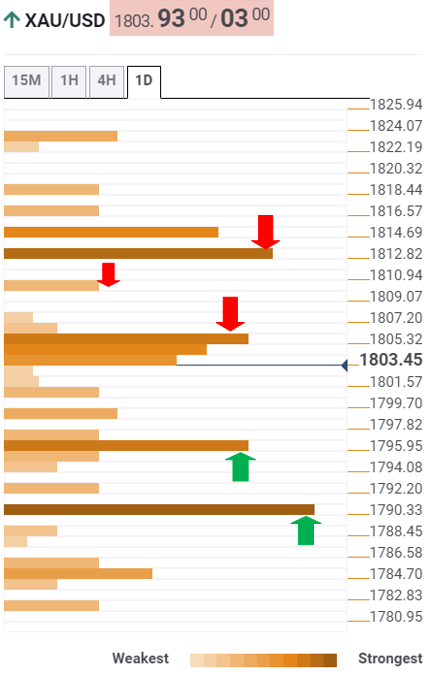
About Technical Confluences Detector
The TCD (Technical Confluences Detector) is a tool to locate and point out those price levels where there is a congestion of indicators, moving averages, Fibonacci levels, Pivot Points, etc. If you are a short-term trader, you will find entry points for counter-trend strategies and hunt a few points at a time. If you are a medium-to-long-term trader, this tool will allow you to know in advance the price levels where a medium-to-long-term trend may stop and rest, where to unwind positions, or where to increase your position size.
Author

Dhwani Mehta
FXStreet
Residing in Mumbai (India), Dhwani is a Senior Analyst and Manager of the Asian session at FXStreet. She has over 10 years of experience in analyzing and covering the global financial markets, with specialization in Forex and commodities markets.
















