Gold Price Forecast: XAU/USD looks set to fill price gap below $2,010 – Confluence Detector
- Gold Price remains firmer at the highest levels in nine weeks, traders successfully beyond $1,970 support confluence.
- US Dollar weakness, China’s efforts to lure global investors allow XAU/USD to remain firmer.
- Mixed concerns about Federal Reserve (Fed), light calendar underpin the Gold Price run-up.
- XAU/USD braces for next week’s FOMC even as July’s 0.25% rate hike is almost given.

Gold Price (XAU/USD) renews a two-month high, despite recently easing from the daily top, as it cheers the broad US Dollar retreat amid the sluggish markets. Adding strength to the XAU/USD run-up could be the price-positive headlines from China, as well as downbeat yields.
That said, the People’s Bank of China’s (PBoC) efforts to ease controls over international investments into the nation and readiness to push back the geopolitical tension with the US, if Washington agrees, allow the Gold Price to remain firmer. On the other hand, the recent downbeat prints of US housing and consumer-spending data bolster the market’s call for the Federal Reserve’s (Fed) policy pivot after July’s 25 basis points (bps) rate hike.
On a different page, chatters about the optimism at the US banks and the BRICS countries (including Brazil, Russia, India, China, and South Africa) readiness for using gold-backed currency also favor the XAU/USD bulls.
However, the fears of witnessing higher rates for longer at the major central banks and the Asia-Pacific market’s lack of optimism seem to prod the Gold buyers of late, especially amid a light calendar ahead of the next week’s Federal Open Market Committee (FOMC) monetary policy meeting announcements.
Also read: Gold Price Forecast: XAU/USD on its way to $2,000 ahead of mid-tier US data
Gold Price: Key levels to watch
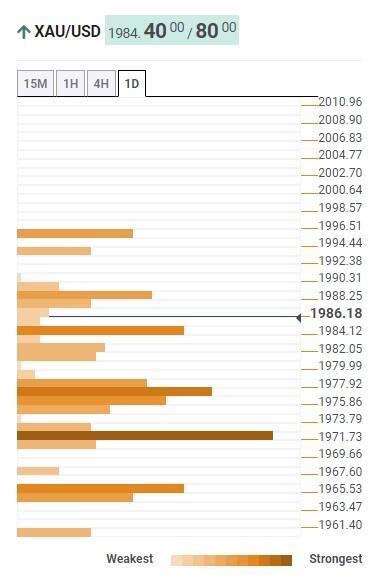
Our Technical Confluence indicator signals that the Gold Price edges higher past the $1,970 support confluence comprising the Pivot Point one-day S1, one-month R1 and Fibonacci 23.6% on one-day.
That said, the upper band of the Bollinger on the daily formation joins the Fibonacci 61.8% on one-day to highlight $1,978 as the nearby key support.
It should be noted that the XAU/USD weakness past $1,970 will have an additional downside filter of around $1,965 comprising the Pivot Point one-day S2 and the 5-DMA before welcoming the bears.
Alternatively, Fibonacci 161.8% on one-day joins the upper band of the Bollinger on the four-hour play to highlight the $1,990 as an immediate resistance.
Following that, the Pivot Point one-week R2 can challenge the Gold buyers around $1,996 before directing them towards filling the upside gap to the $2,010 hurdle.
Here is how it looks on the tool
About Technical Confluences Detector
The TCD (Technical Confluences Detector) is a tool to locate and point out those price levels where there is a congestion of indicators, moving averages, Fibonacci levels, Pivot Points, etc. If you are a short-term trader, you will find entry points for counter-trend strategies and hunt a few points at a time. If you are a medium-to-long-term trader, this tool will allow you to know in advance the price levels where a medium-to-long-term trend may stop and rest, where to unwind positions, or where to increase your position size
Author

Anil Panchal
FXStreet
Anil Panchal has nearly 15 years of experience in tracking financial markets. With a keen interest in macroeconomics, Anil aptly tracks global news/updates and stays well-informed about the global financial moves and their implications.