Gold Price Forecast: XAU/USD keeps its sight on $1,850 bullish target – Confluence Detector
- Gold price remains at the hands of US Treasury yields’ price action.
- Inflation concerns and Fed speculation to the lead the way.
- Gold 2022 Outlook: Correlation with US T-bond yields to drive yellow metal.

Gold price briefly disconnected from the price action in the Treasury yields on Wednesday but has returned to its negative relationship with the US rates this Thursday. Gold price has stalled its upsurge, consolidating below two-month highs amid firmer yields. China’s policy easing driven risk-on mood also limits gold’s gains. Although decade-high inflation rates globally have gold bulls covered while Russia-Ukraine crisis also helps keep the buoyant tone intact around the safe-haven.
Read: Gold Price Forecast: ‘Buy the dips’ amid inflation and geopolitical concerns
Gold Price: Key levels to watch
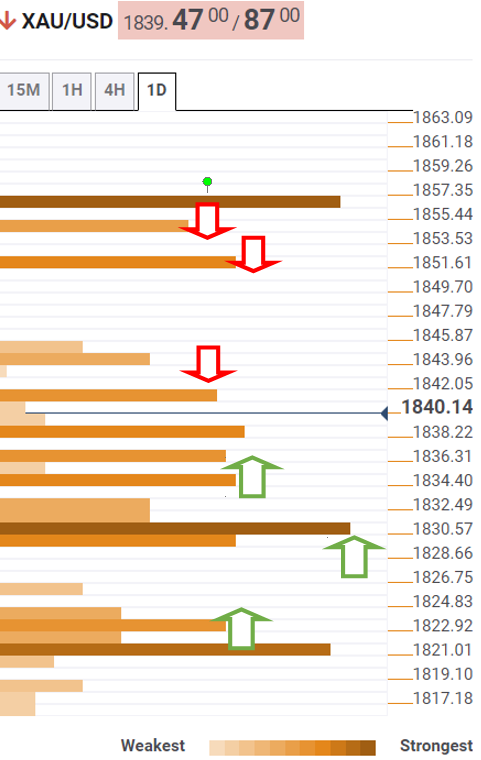
The Technical Confluences Detector shows that the gold price is likely to face a dense cluster of healthy support levels around $1,835, which is the convergence of the Fibonacci 23.6% one-day, pivot point one-week R1 and SMA5 four-hour.
If the downside pressure intensifies, then bears could challenge critical support at $1,831. The previous month’s high coincides with the Fibonacci 38.2% one-day at that point.
The next powerful support is seen around $1,821, which is the intersection of the SMA5 one-day, pivot point one-day S1 and Fibonacci 23.6% one-week.
Alternatively, immediate resistance aligns at the two-month highs of $1,844, above which the pivot point one-week R2 at $1,850.
The pivot point one-day R1 at $1,854 will be the next upside target for gold bulls.
Here is how it looks on the tool
About Technical Confluences Detector
The TCD (Technical Confluences Detector) is a tool to locate and point out those price levels where there is a congestion of indicators, moving averages, Fibonacci levels, Pivot Points, etc. If you are a short-term trader, you will find entry points for counter-trend strategies and hunt a few points at a time. If you are a medium-to-long-term trader, this tool will allow you to know in advance the price levels where a medium-to-long-term trend may stop and rest, where to unwind positions, or where to increase your position size.
Author

Dhwani Mehta
FXStreet
Residing in Mumbai (India), Dhwani is a Senior Analyst and Manager of the Asian session at FXStreet. She has over 10 years of experience in analyzing and covering the global financial markets, with specialization in Forex and commodities markets.