Gold Price Forecast: ‘Buy the dips’ amid inflation and geopolitical concerns
- Gold price is slightly off the two-month highs but the upside remains intact.
- Hotter global inflation and Russia-Ukraine tensions underpin gold price.
- Firmer yields could trigger pullbacks, which could be a good buying opportunity.

Gold price jumped as much as $40 to clinch fresh two-month highs of $1,843 on Wednesday amid a sudden turnaround in the investors’ sentiments. The ongoing rally in the US Treasury yields on aggressive Fed’s tightening expectations failed to deter gold bulls, as they cheered 30-year high inflation rates in the UK and Germany. Investors rushed to the inflation-hedge gold, as worries over the economic impact of rising price pressures spooked markets. Additionally, risks of escalating Russia-Ukraine geopolitical tensions also underpinned gold’s safe-haven appeal and bolstered the rebound.
Gold price is retreating this Thursday after renewing two-month highs at $1,844, as the risk sentiment has recovered on monetary policy easing from China. The People’s Bank of China (PBOC) announced mortgage loan rate cuts to support the faltering economic growth. The firming up of the US rates also temper gold’s bullish momentum. However, US President Joe Biden's concerns on rising inflation, as well as, warnings over a potential Russian invasion of Ukraine and ruling out lifting tariffs on Chinese imports will continue to offer support to gold bulls. On the data front, the Eurozone final inflation reading, US weekly Jobless Claims and Existing Homes Sales data will be eyed for fresh trading opportunities in the sessions ahead.
Gold Price Chart - Technical outlook
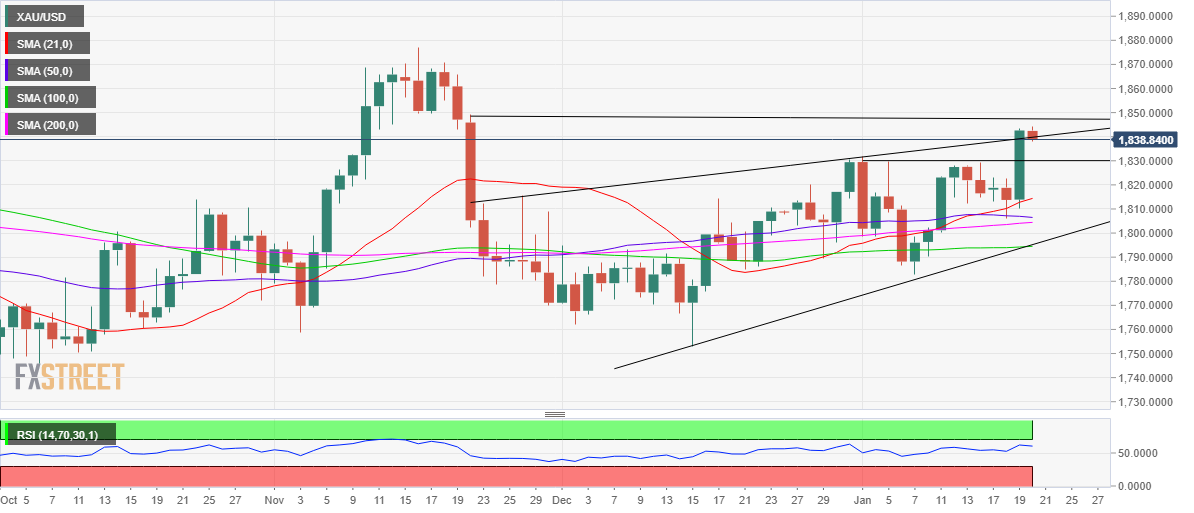
Gold: Daily chart
Gold price finally broke to the upside from a two-month-old rising wedge formation on Wednesday, defying the bullish wedge’s natural tendency to yield a downside break.
The metal closed Wednesday above the rising trendline support at $1,839, where it now wavers.
If the corrective decline picks up pace, then gold price could drop further to test the previous critical resistance level around $1,831.
Failure to defend the latter could put the bullish 21-Daily Moving Average (DMA) support of $1,815 at risk.
Ahead of the 21-DMA cap, the $1,820 round figure could challenge the bullish commitments.
The 14-Relative Strength Index (RSI) has turned slightly lower, but still holds comfortably above the midline, suggesting that every dip in the price could be a good buying opportunity.
On the other side, bulls need to retest the two-month highs before it readies to take on the November 22 high of $1,849.
Daily closing above that level could initiate a fresh uptrend in gold price, with the $1,900 mark back in sight.
Author

Dhwani Mehta
FXStreet
Residing in Mumbai (India), Dhwani is a Senior Analyst and Manager of the Asian session at FXStreet. She has over 10 years of experience in analyzing and covering the global financial markets, with specialization in Forex and commodities markets.















