Gold Price Forecast: XAU/USD faces rejection once again at $2,000 amid improved mood
- Gold is hamstrung by the strength of the US dollar.
- Technically, the bulls might have a hard time pulling away from the hourly W-formation.
- ECB and Fed divergence should underpin the greenback while oil prices cripple the euro.

Update: Gold (XAU/USD) looks to extend its oscillation in a narrow range of $1,961.07-2,002.67 going forward amid the absence of any fundamental trigger in the market. The precious metal is trading lackluster despite an improved market mood, as the $2,000 level once again acted as a stiff reisstance. Markets in the Asia domain are following the cues in the US markets. A bloodbath has been recorded in the S&P500 on Monday as the index nosedived almost 3%.
Meanwhile, the US dollar index (DXY) is also facing headwinds near the psychological figure of 100.00. It would be justified to claim some caution in the DXY before the disclosure of US Consumer Price Index (CPI) numbers on Thursday. The US inflation numbers are likely to print at 7.9% higher than the earlier print at 7.8%. Although, to some extent, the market has also discounted a 50-basis point (bps) rate hike as it has remained in traction for a decent time. Therefore, the safe-haven assets require a potential trigger to improve the safe-haven appeal.
Meanwhile, the 10-year US Treasury yields have inched near 1.8% on rising expectations of a tightening policy by the Federal Reserve (Fed).
End of Update
The price of gold is firm in Tokyo and eyes the $2,000 level. However, the hourly structure on the charts is not conducive at this point for sustained gains and the focus, from a technical stance, is on the hourly W-formation#s neckline near $1,984 as illustrated below.
Meanwhile, XAU/USD has been, for the most part, a US dollar story at the start of the week. The greenback rose on Monday, lifted by safe-haven flows, which hamstrung the precious metal to some extent. The markets weighed the effects on the global economic growth of skyrocketing oil prices that hit 14-year highs. Both the EU and US are considering banning Russian crude imports. Brent, the globe's benchmark oil price, rallied to as high as $138bbls as a consequence.
Meanwhile, the dollar index, DXY, which measures the value of the greenback against six global peers, was moving in in the 100 level marking a high of 99.418. Across the Atlantic, the euro was down 0.7% against the dollar at $1.08575 on concerns that higher energy prices will spark stagflation in the European economy. The consensus is that the higher prices pose less threat to the Us than it does to the Eurozone. While Russian crude represents only 3% of domestic energy imports, for Europe, Russia is a key provider. Russia provides 25% of the EU's crude and 40% of its natural gas.
Additionally, the central bank divergence is driving the US dollar. The week is absent of Fed speakers due to the media embargo ahead of next week’s FOMC meeting. However, with the European Central Bank this week, traders will be reminded that the Fed is moving forward whereas the ECB is not and that should be USD favorable ad a weight for the gold price despite the risk-off environment.
The market is fully priced for a 25 bp hike on March 16 as the start of the tightening cycle. ''Looking ahead, 150 bp of tightening is priced in over the next 12 months, followed by another 25 bp in the following 12 months that would see the Fed Funds rate peak near 1.75%,'' analysts at Brown Brothers Harriman said.
''We continue to believe that the terminal rate will have to be much higher than this, but the Ukraine crisis has pushed Fed tightening expectations lower. January consumer credit is the only US data report today and is expected at $24.5 bln vs. $18.9 bln in December.''
As for those that believe the Fed will not be able to make a move due to the uncertainties relating to the war, analysts at TD securities had this to say: ''Geopolitical tensions would be unlikely to derail the Fed's plans to hike and to withdraw liquidity using quantitative tightening if inflation expectations show additional signs of de-anchoring. However, if the shock simultaneously dents consumer sentiment, the Fed will have to walk a tight-rope between its unemployment and inflation targets.''
Gold technical analysis

The W-formation's neckline and support area come in at around $1,985 from where the price could be drawn for the session ahead. However, should this area fail to support, then there will be a focus on the downside as per the daily chart's market structure as follows:
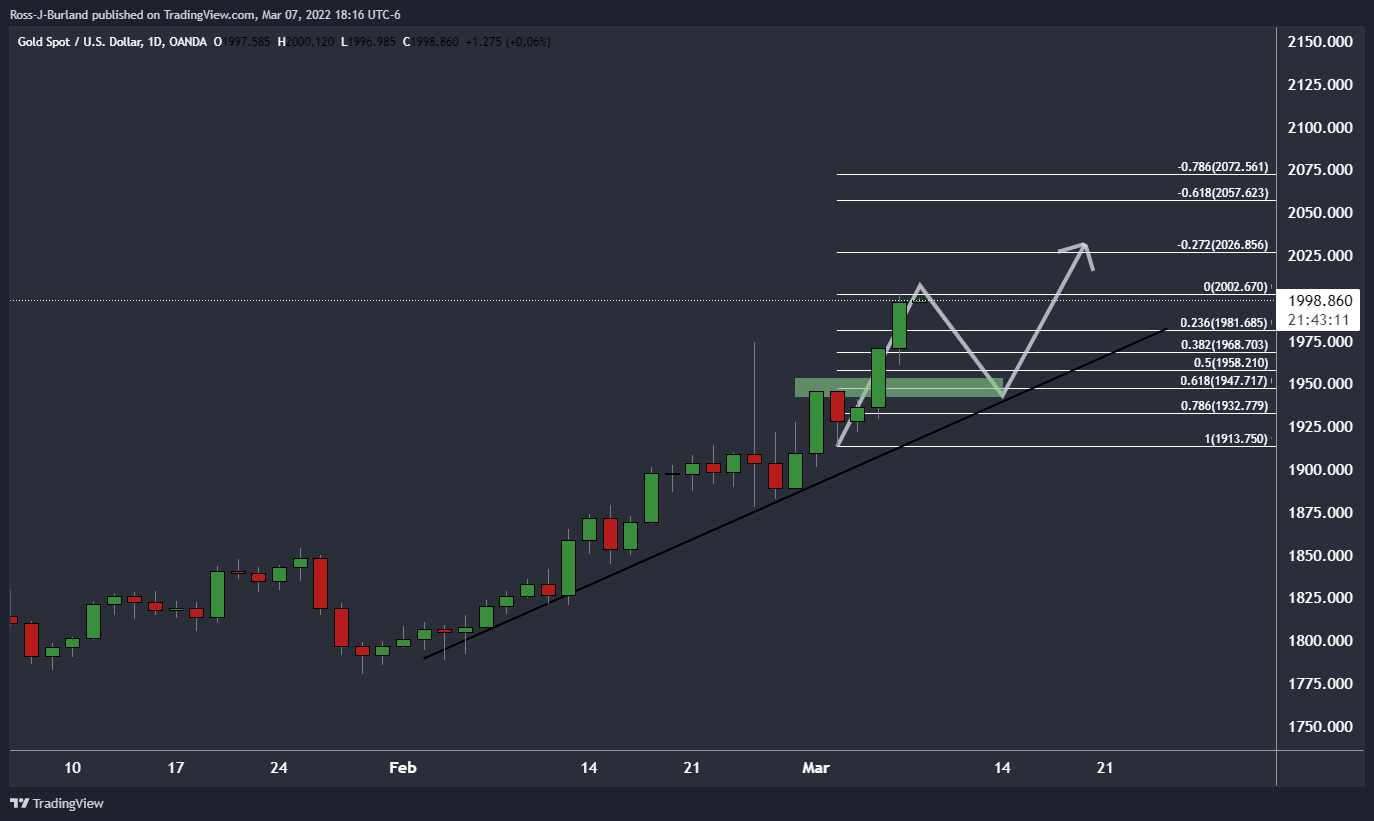
$1,950 meets the old resistance and a 61.8% golden ratio target. However, $1,975 as the 24 Feb. hoghs could price to be firm as could the 23.6% and 38.2% ratios at $1,981 and $1,968 respectively.
On the other hand, should the price break $2,000, it could be blue skies for the foreseeable future to target the 2020 summer highs of $2,075.
Author

Ross J Burland
FXStreet
Ross J Burland, born in England, UK, is a sportsman at heart. He played Rugby and Judo for his county, Kent and the South East of England Rugby team.