Gold Price Forecast: XAU/USD eases below $2,050 hurdle ahead of US inflation – Confluence Detector
- Gold price pares weekly gains, snaps two-day winning streak ahead of US CPI.
- Mixed sentiment, sluggish US Dollar prods XAU/USD bulls amid light calendar elsewhere.
- Easing US inflation pressure can help the Gold price to cross $2,050 key hurdle.

Gold price (XAU/USD) struggles to defend its three-week uptrend as US inflation data looms. Also challenging the XAU/USD buyers are the mixed concerns about the US default and banking fallouts, as well as the market’s disbelief in the hawkish Fed talks and recently downbeat US data. Above all, the precious metal’s traditional risk-safety allure joins the US Dollar’s retreat to keep the Gold buyers despite the latest corrective move.
Apart from the US inflation data, progress on the US debt ceiling negotiations will also be crucial to watch for the Gold traders, especially amid the first failure to seal the deal and Moody’s concerns citing a “real” threat of default. Meanwhile, optimism surrounding Asia, one of the biggest customers of Gold, joins the mildly bid equities to underpin the XAU/USD run-up.
Also read: Gold Price Forecast: XAU/USD could retake $2,050 and beyond on soft United States inflation data
Gold Price: Key levels to watch
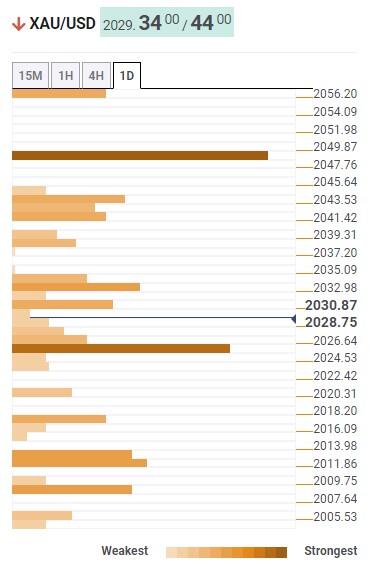
As per our Technical Confluence Indicator, the Gold price justifies the failure to cross the $2,050 hurdle while printing the first daily loss in three. That said, the upper band of the Bollinger on the daily chart joins Pivot Point one-day R2 and the previous monthly high to cite the aforementioned level as an important upside hurdle for the XAU/USD.
It’s worth noting that the latest Gold price retreat needs validation from the $2,025 support confluence including Fibonacci 23.6% on one month, Fibonacci 61.8% on one-day and the lower band of the Bollinger on hourly chart.
Should the Gold price drops below $2,025 key support, it can quickly drop to $2,010 level comprising the Fibonacci 38.2% on monthly, Pivot Point one-day S2 and 10-DMA, a break of which won’t hesitate to challenge the $2,000 round figure.
Alternatively, 5-DMA joins Fibonacci 23.6% on one-day to guard the immediate upside of the Gold price near $2,035, a break of which could direct the Gold price toward the s$2,045 hurdle including the Pivot Point one-month R1.
Following that, the all-important $2,050 resistance confluence, including upper band of the Bollinger on one-day, Pivot Point one-day R2 and previous monthly high, will be the key to watch for the Gold buyers.
In a case where the Gold price remains firmer past $2,050, the recently reported all-time high of around $2,080 will be in the spotlight.
Here is how it looks on the tool
About Technical Confluences Detector
The TCD (Technical Confluences Detector) is a tool to locate and point out those price levels where there is a congestion of indicators, moving averages, Fibonacci levels, Pivot Points, etc. If you are a short-term trader, you will find entry points for counter-trend strategies and hunt a few points at a time. If you are a medium-to-long-term trader, this tool will allow you to know in advance the price levels where a medium-to-long-term trend may stop and rest, where to unwind positions, or where to increase your position size.
Author

Anil Panchal
FXStreet
Anil Panchal has nearly 15 years of experience in tracking financial markets. With a keen interest in macroeconomics, Anil aptly tracks global news/updates and stays well-informed about the global financial moves and their implications.