Gold Price Forecast: XAU/USD ascents gradually amidst high US bond yields, post solid US data
- US economic strength shown by the latest round of data raises prospects of a June Fed rate hike, boosting the US Dollar.
- Wall Street climbs despite a rise in Fed’s gauge for inflation, with Core PCE hitting 4.7% YoY.
- Rising US Treasury bond yields and Fed hawkish commentary could hurt Gold’s recovery.

Gold price recovers some ground but remains shy of reclaiming the $1950 figure after solid economic data in the United States (US) suggests the Federal Reserve (Fed) could opt to hike again in June. Consequently, US Treasury bond yields are rising, while the US Dollar (USD) hits new two-month highs vs. a basket of peers. The XAU/USD is trading at $1940.21, still up by a minuscule 0.03%.
Wall Street rides high despite inflationary concerns; consumer and business spending showcase resilience
Wall Street registered solid gains, even though the Federal Reserve’s (Fed) preferred gauge for inflation, the Core Personal Consumption Expenditure (PCE), which strips volatile items like food and energy, exceeded estimates of 4.6% and rose by 4.7% YoY in April. Following suit, headline inflation climbed from 4.2% to 4.4% YoY after the Fed released its May meeting minutes, which showed the US central bank’s openness to pause its tightening cycle.
In another data, the final reading of the University of Michigan Consumer Sentiment for May, beat estimates of 57.7 at 59.2 but trailed the 63.5 prior’s reading. The same poll revealed that American citizens’ inflation expectations for one year eased from 4.5% to 4.1% by year’s end, while for a 5-year horizon, they came at 3.1% above April’s 3.0%.
Earlier, Durable Good Orders in April rose by 1.1% MoM, above estimates of a 1% plunge but trailed the staggering March’s 3.3%, indicating that consumer and business spending remains resilient, another reason that justifies Jerome Powell and Co. to continue to lift rates, as the economy opposes resistance to higher interest rates.
Consequently, US Treasury bond yields continued to rise, with the 10-year benchmark note rate at 3.851%, its highest level since March 10, putting a lid on Gold recovery. Another factor that could dent appetite for XAU/USD is US real yields, which stand at 1.60%, higher than Thursday’s close of 1.57%.
Recently, the Cleveland Fed President Loretta Mester stood to her hawkish stance and confirmed that inflation is too high in an interview on CNBC. She said that she would revise up her forecast for inflation and that more data would help her to decide on the June meeting while emphasizing that “everything is on the table” for the next FOMC.
XAU/USD Price Analysis: Technical outlook
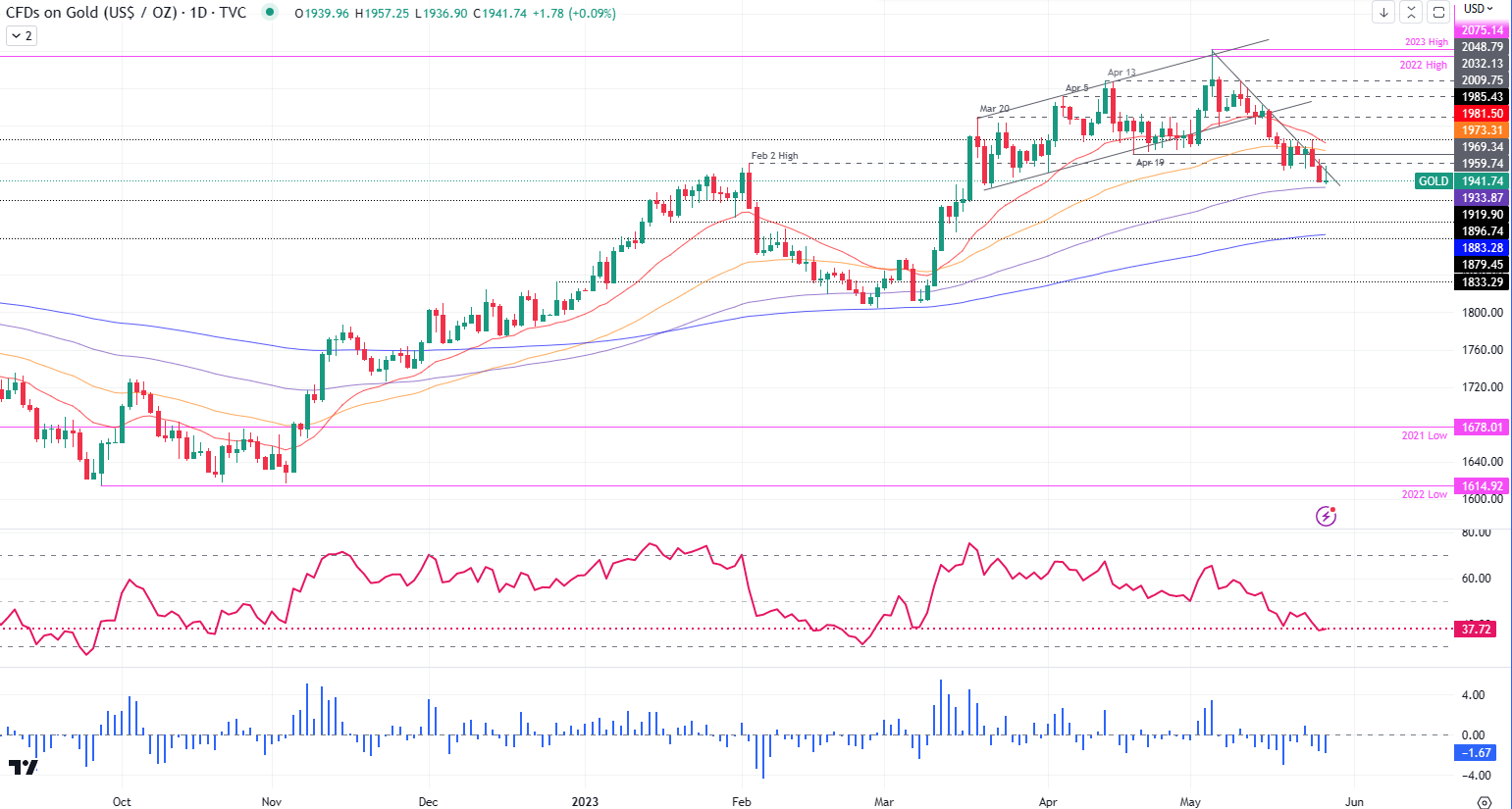
XAU/USD is neutral to downward biased, though it remains trading within the boundaries of important support and resistance levels. As support, the 100-day Exponential Moving Average (EMA) at $1933.85 keeps cushioning God’s fall while the psychological price level of $1950 keeps price action restricted in a $17 range. If XAU/USD sellers claim the former, that could open the door to test the $1900 figure before threatening the 200-day EMA at $1883.27. On the other hand, if XAU/USD buyers conquer the $1950 figure, the yellow metal could be on its way to challenge the $1973.32 area, where the 50-day EMA rests.
Author

Christian Borjon Valencia
FXStreet
Markets analyst, news editor, and trading instructor with over 14 years of experience across FX, commodities, US equity indices, and global macro markets.















