Gold slumps and braces around $2,150.00 as US inflation reaccelerates
- Gold retreats from the $2,180 mark, reacting to hot US inflation data and Fed's cautious stance on policy easing.
- Rise in US Treasury yields post-PPI data release dampens XAU/USD’s appeal despite risk-off market sentiment.
- Gold remains subdued as Treasury yields inch higher and the US Dollar strengthens.
Gold spot retreated from around the $2,180 area on Friday, printing back-to-back negative sessions as market players' hope for the beginning of the US Federal Reserve's easing cycle has been delayed due to strong US economic data. Hotter-than-expected inflation figures justify Fed Chair Jerome Powell's remarks to be patient and stick to the current monetary policy stance until the disinflation process evolves. The XAU/USD trades at $2,157.66, down 0.20%.
Wall Street is set to finish Friday’s session on the back foot, reflecting a risk-off mood. Although the Gold price usually capitalizes on it, the rise of US Treasury yields after Thursday’s Producer Price Index (PPI) data kept XAU/USD offered in the European session and toward the end of the trading day.
The yellow metal remained under pressure even though US economic data failed to move the needle. The Fed revealed that Industrial Production improved in February. After that, University of Michigan Consumer Sentiment showed that Americans remain optimistic about the economic outlook.
The XAU/USD treads water as the US 10-year Treasury bond yield surges one basis point to 4.308%, while the US Dollar Index (DXY), a gauge of the buck’s performance versus other currencies, climbs 0.09% to 103.45.
Daily digest market movers: Gold retreats as US yields rise
- Friday’s economic data revealed that Industrial Production was 0.1% MoM, up from -0.5% contraction in January, and exceeded the consensus.
- Separately, the University of Michigan Consumer Sentiment on its preliminary reading was 76.5, below estimates and the previous reading of 76.9. Americans expect inflation to remain at 3% in the 12 months from March and for five years at 2.9%.
- The PPI was strong, at 1.6% YoY, up from 0.9%, while the core PPI stood at 2%, unchanged, with both figures exceeding the consensus.
- The US Department of Commerce revealed that Retail Sales missed estimates of 0.8% MoM and rose 0.6%, still an improvement compared to the prior month’s reading of -1.1%.
- The labor market remained tight as Initial Jobless Claims for the week ending March 9 dipped from 210K to 209K, below estimates of 218K.
- Given the backdrop of consumer and producer price indices in the US showcasing reaccelerating inflation, Fed officials should refrain from easing monetary policy.
- During last week's testimony at the US Congress, Fed Chairman Jerome Powell said that inflation is cooling while acknowledging that they could ease policy late in the year. However, he emphasized that it would depend on incoming data reassuring policymakers that inflation is sustainably moving toward the Fed’s 2% goal. The Fed’s next meeting is scheduled for March 19-20 next week.
- According to the CME FedWatch Tool, expectations for a May rate cut remain low, having dropped to 11% from 22%. However, the odds for June stand at 64%, down from 72%.
Technical analysis: Gold buyers take a breather below $2,170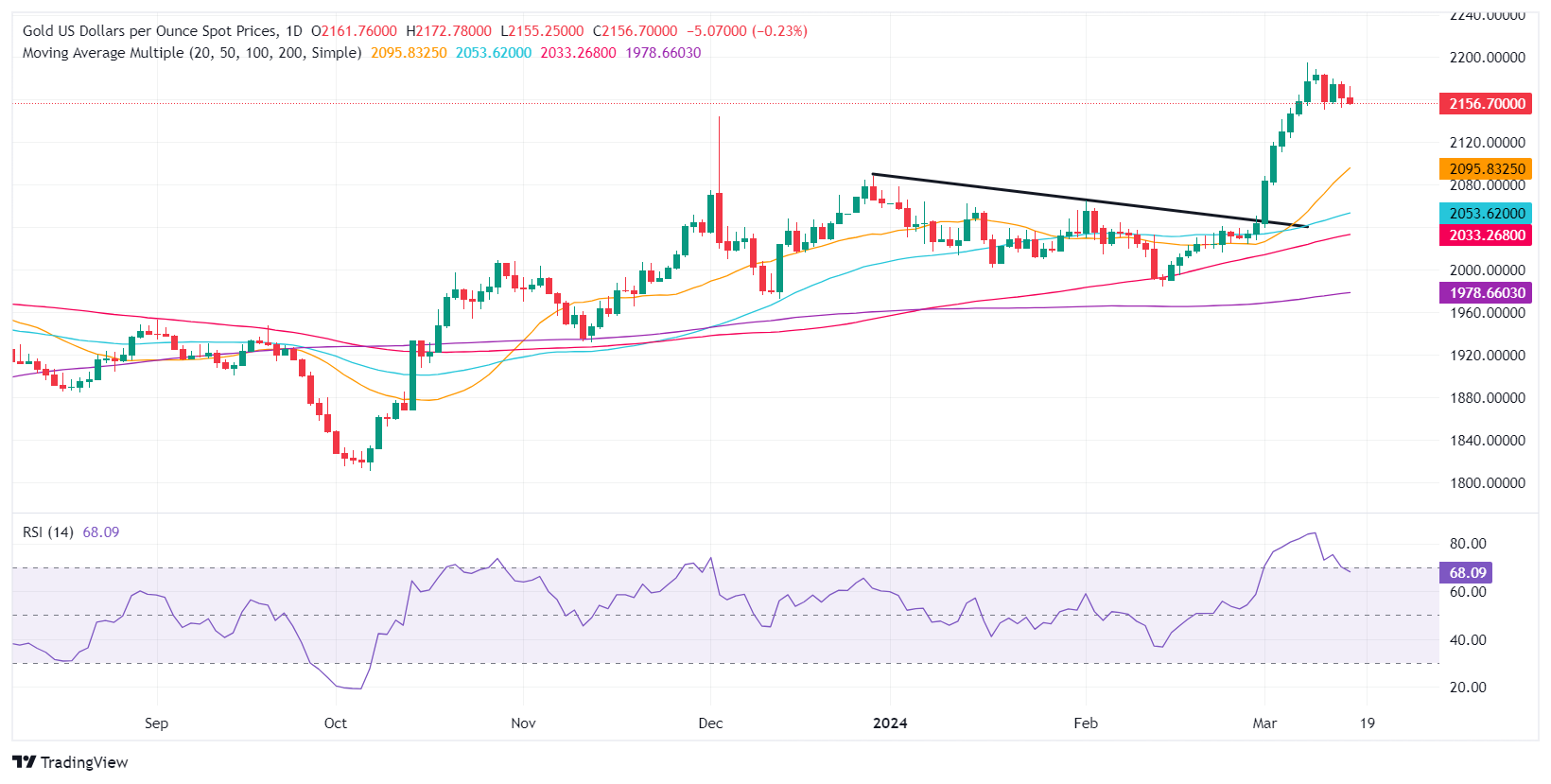
Gold’s uptrend remains intact with the pair consolidating near the $2,160-$2,180 area. As a symmetrical triangle forms, expectations for an upside break could lift the XAU/USD toward the $2,200 figure. However, the Relative Strength Index (RSI) indicator exiting from overbought conditions suggests that buyers are taking a breather.
If buyers break the top of the range, they would challenge the current year-to-date (YTD) high of $2,195.15. Once surpassed, the $2,200 is up next. Otherwise, a drop below $2,160 might pave the way for a pullback. The first key support level would be the March 6 low of $2,123.80, followed by $2,100, followed by the December 28 high at $2,088.48 and the February 1 high at $2,065.60.
Gold FAQs
Gold has played a key role in human’s history as it has been widely used as a store of value and medium of exchange. Currently, apart from its shine and usage for jewelry, the precious metal is widely seen as a safe-haven asset, meaning that it is considered a good investment during turbulent times. Gold is also widely seen as a hedge against inflation and against depreciating currencies as it doesn’t rely on any specific issuer or government.
Central banks are the biggest Gold holders. In their aim to support their currencies in turbulent times, central banks tend to diversify their reserves and buy Gold to improve the perceived strength of the economy and the currency. High Gold reserves can be a source of trust for a country’s solvency. Central banks added 1,136 tonnes of Gold worth around $70 billion to their reserves in 2022, according to data from the World Gold Council. This is the highest yearly purchase since records began. Central banks from emerging economies such as China, India and Turkey are quickly increasing their Gold reserves.
Gold has an inverse correlation with the US Dollar and US Treasuries, which are both major reserve and safe-haven assets. When the Dollar depreciates, Gold tends to rise, enabling investors and central banks to diversify their assets in turbulent times. Gold is also inversely correlated with risk assets. A rally in the stock market tends to weaken Gold price, while sell-offs in riskier markets tend to favor the precious metal.
The price can move due to a wide range of factors. Geopolitical instability or fears of a deep recession can quickly make Gold price escalate due to its safe-haven status. As a yield-less asset, Gold tends to rise with lower interest rates, while higher cost of money usually weighs down on the yellow metal. Still, most moves depend on how the US Dollar (USD) behaves as the asset is priced in dollars (XAU/USD). A strong Dollar tends to keep the price of Gold controlled, whereas a weaker Dollar is likely to push Gold prices up.
Author

Christian Borjon Valencia
FXStreet
Markets analyst, news editor, and trading instructor with over 14 years of experience across FX, commodities, US equity indices, and global macro markets.