Gold price consolidates amid choppy trading ahead US NFP
- Gold prices edge up 0.15% amid thin trading on US Independence Day.
- XAU/USD reached a two-week high of $2,365 Wednesday, driven by weak US jobs data and heightened Fed rate cut expectations.
- Traders shift focus to Friday's Nonfarm Payrolls report, following the US holiday closure.

Gold prices registers minimal gains on Thursday amid thin liquidity conditions during the North American session, as US traders are off their desks in observance of Independence Day. Recent economic data from the US augmented expectations that the Fed might begin to ease policy sooner than expected, yet policymakers remain vigilant and would like to see the disinflation process evolve further.
The XAU/USD trades at $2,356, up 0.15%, after hitting a two-week high at $2,365 on Wednesday.
Bullion rallied more than 1% on Wednesday on softer-than-expected jobs reports, led by last week’s Initial Jobless Claims and ADP data showing that private hiring deteriorated in June compared with May. Additionally, business activity in the services sector, tanked to contractionary territory as measured by the ISM Services PMI.
Meanwhile, the Federal Open Market Committee (FOMC) revealed June’s meeting minutes, which showed that most participants estimated that the current policy is restrictive but had opened the door for rate increases. Policymakers acknowledged the economy is cooling and could react to unexpected economic weakness.
Traders' focus shifts to Friday’s Nonfarm Payrolls (NFP) report, as US markets remain closed due to the Independence Day holiday.
Daily digest market movers: Gold price stays firm above $2,350
- Earlier in the week, Fed Chair Powell remarked that the disinflation process has resumed but emphasized the need for further progress before considering any interest rate cuts. He added, “Because the US economy is strong and the labor market is strong, we can take our time and get this right.”
- On Friday, the US Nonfarm Payrolls report for June is expected to show that the economy added 190K jobs to the workforce, below May’s 272 K.
- The Unemployment Rate is expected to remain at 4% unchanged compared to previous readings, while Average Hourly Earnings (AHE) are projected to decelerate from 4.1% to 3.9% YoY.
- According to the CME FedWatch Tool, odds for a 25-basis-point Fed rate cut in September are at 66%, up from 63% on Tuesday.
- December 2024 fed funds rate futures contract implies that the Fed will ease policy by just 38 basis points (bps) toward the end of the year.
Technical analysis: Gold price fluctuates near Head-and-Shoulders neckline
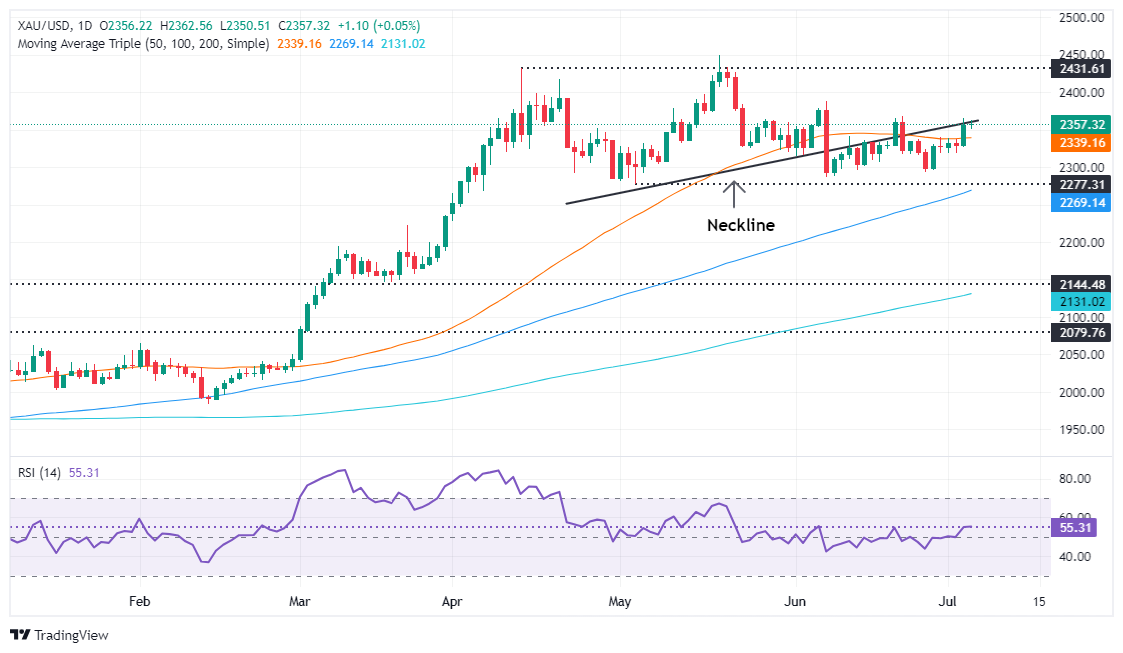
Gold prices consolidate on Thursday due to thin volumes in the financial markets. Although the yellow metal remains bullish, the Head-and-Shoulders chart pattern is In the play, which began its formation in April 2024.
From a price action perspective, XAU/USD shows a near-term downward bias, but the overall bullish trend remains intact, supported by a bullish Relative Strength Index (RSI).
If the gold price breaks above the pattern's neckline, it could rise to $2,400, invalidating the Head-and-Shoulders chart formation and potentially leading to further gains toward the year-to-date high of $2,450.
On the other hand, if sellers drive the spot price below $2,350, further declines could target the $2,300 level. If this support fails, the next demand zone would be the May 3 low of $2,277, followed by the March 21 high of $2,222.
Nonfarm Payrolls FAQs
Nonfarm Payrolls (NFP) are part of the US Bureau of Labor Statistics monthly jobs report. The Nonfarm Payrolls component specifically measures the change in the number of people employed in the US during the previous month, excluding the farming industry.
The Nonfarm Payrolls figure can influence the decisions of the Federal Reserve by providing a measure of how successfully the Fed is meeting its mandate of fostering full employment and 2% inflation. A relatively high NFP figure means more people are in employment, earning more money and therefore probably spending more. A relatively low Nonfarm Payrolls’ result, on the either hand, could mean people are struggling to find work. The Fed will typically raise interest rates to combat high inflation triggered by low unemployment, and lower them to stimulate a stagnant labor market.
Nonfarm Payrolls generally have a positive correlation with the US Dollar. This means when payrolls’ figures come out higher-than-expected the USD tends to rally and vice versa when they are lower. NFPs influence the US Dollar by virtue of their impact on inflation, monetary policy expectations and interest rates. A higher NFP usually means the Federal Reserve will be more tight in its monetary policy, supporting the USD.
Nonfarm Payrolls are generally negatively-correlated with the price of Gold. This means a higher-than-expected payrolls’ figure will have a depressing effect on the Gold price and vice versa. Higher NFP generally has a positive effect on the value of the USD, and like most major commodities Gold is priced in US Dollars. If the USD gains in value, therefore, it requires less Dollars to buy an ounce of Gold. Also, higher interest rates (typically helped higher NFPs) also lessen the attractiveness of Gold as an investment compared to staying in cash, where the money will at least earn interest.
Nonfarm Payrolls is only one component within a bigger jobs report and it can be overshadowed by the other components. At times, when NFP come out higher-than-forecast, but the Average Weekly Earnings is lower than expected, the market has ignored the potentially inflationary effect of the headline result and interpreted the fall in earnings as deflationary. The Participation Rate and the Average Weekly Hours components can also influence the market reaction, but only in seldom events like the “Great Resignation” or the Global Financial Crisis.
Author

Christian Borjon Valencia
FXStreet
Markets analyst, news editor, and trading instructor with over 14 years of experience across FX, commodities, US equity indices, and global macro markets.