Gold price consolidates intraday gains to one-week high amid mixed cues
- Gold price scales higher for the second straight day as geopolitical risks drive some haven flows.
- Bets for less aggressive Fed rate cuts underpin the USD and cap gains for the precious metal.
- Geopolitical risks offer support to the safe-haven XAU/USD and warrant caution for bears.

Gold price (XAU/USD) trims a part of its modest intraday gains to a one-week top and trades around the $2,620 level during the first half of the European session on Tuesday, still up for the second straight day. The US Dollar (USD) attracts some dip-buyers and for now, seems to have stalled its retracement slide from the year-to-date touched last week amid expectations for a less dovish Federal Reserve (Fed). This, along with a generally positive tone around the equity markets, acts as a headwind for the non-yielding yellow metal.
Furthermore, the market conviction that US President-elect Donald Trump's expansionary policies could boost inflation and limit the scope for further interest rate cuts by the Fed keep the US Treasury bond yields elevated. This turns out to be another factor capping the upside for the Gold price. That said, geopolitical risks stemming from the protracted Russia-Ukraine war and the ongoing conflicts in the Middle East continue to offer some support to the safe-haven precious metal, warranting some caution before placing fresh bearish bets.
Gold price bulls turn cautious amid the emergence of some USD dip-buying
- US President Joe Biden's decision to authorize Ukraine to use long-range American missiles against military targets inside Russia prompted some haven flows and benefited the Gold price on Monday.
- The US Dollar extended its profit-taking slide from the year-to-date high touched last week on the back of retreating US Treasury bond yields and provided an additional boost to the XAU/USD.
- The precious metal attracts some follow-through buying for the second straight day on Tuesday, though reduced bets for more aggressive rate cuts by the Federal Reserve might cap the upside.
- US President-elect Donald Trump's incoming administration is expected to focus on lowering taxes and raising tariffs, which could stoke inflation and limit the Fed's ability to ease monetary policy.
- A slew of influential FOMC members, including Fed Chair Jerome Powell, recently suggested caution in cutting rates, which, in turn, favors the USD bulls and should cap the non-yielding yellow metal.
- Tuesday's US economic docket features the release of Building Permits and Housing Starts. Adding to this, a speech by Kansas Fed President Jeffrey Schmid will drive the USD later during the US session.
- The focus, however, will remain glued to manufacturing and service sector PMI data on Friday, which could offer early cues on how companies are reacting to the threat of Trump's proposed trade tariffs.
Gold price remains vulnerable while below the $2,634-$2,635 resistance
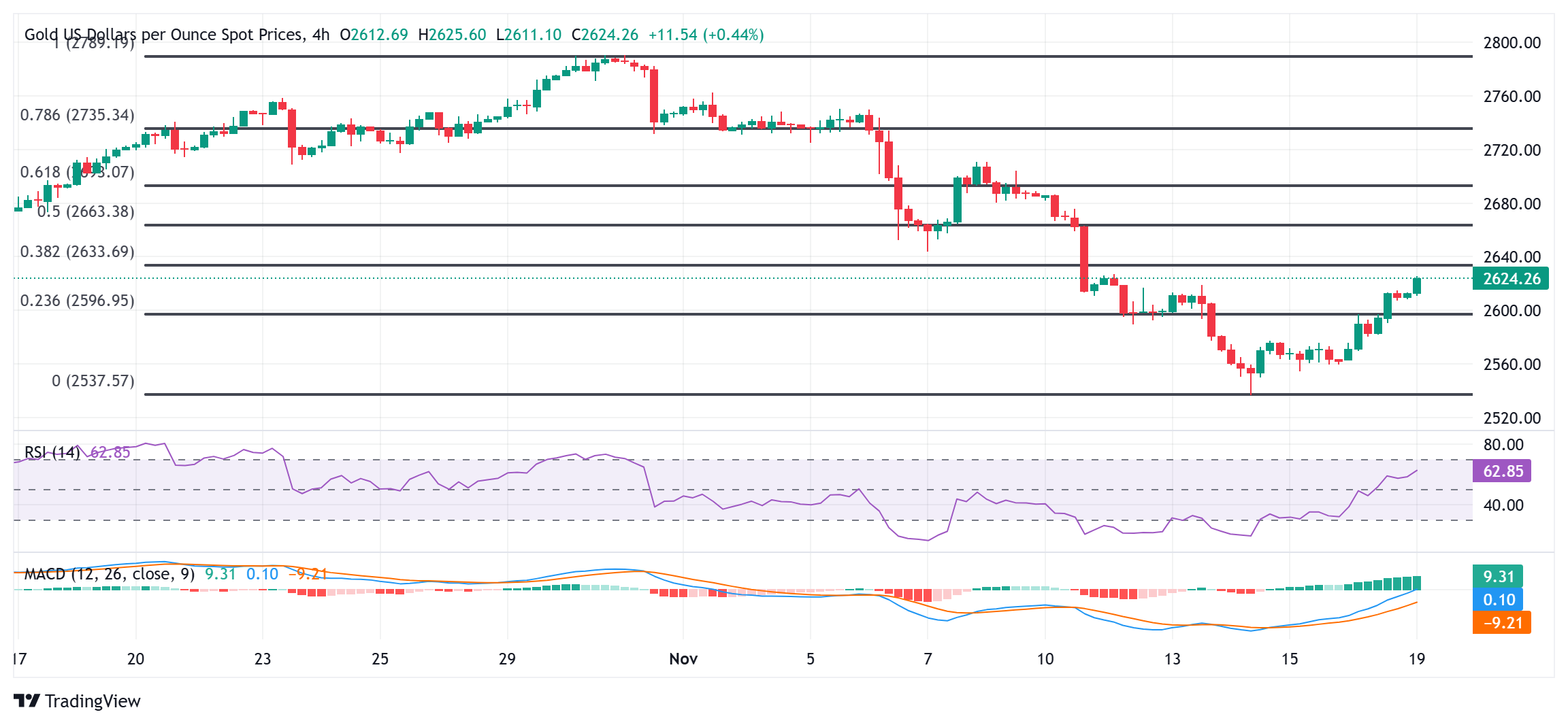
The overnight strong move up comes on the back of last week's resilience below the 100-day Simple Moving Average (SMA). Moreover, the momentum pushed the Gold price beyond the 23.6% Fibonacci retracement level of the recent corrective decline from the all-time peak and underpins prospects for additional intraday gains. That said, oscillators on the daily chart – though they have been recovering from lower levels – are yet to confirm a positive bias. Hence, any subsequent strength is more likely to face stiff resistance near the $2,634-2,635 region or the 38.2% Fibo. level. Some follow-through buying, however, could trigger a short-covering rally towards the $2,655-2,657 congestion zone en route to the $2,664-2,665 area.
On the flip side, the $2,600 mark, which coincided with the 23.6% Fibo. level, now seems to protect the immediate downside. A convincing break might expose the next relevant support near the $2,569-2,568 region and eventually drag the Gold price to the 100-day SMA, currently pegged near the $2,551-2,550 area. Some follow-through selling below last week's swing low, around the $2,536 zone, will be seen as a fresh trigger for bearish traders and pave the way for a fall towards the $2,500 psychological mark.
Gold FAQs
Gold has played a key role in human’s history as it has been widely used as a store of value and medium of exchange. Currently, apart from its shine and usage for jewelry, the precious metal is widely seen as a safe-haven asset, meaning that it is considered a good investment during turbulent times. Gold is also widely seen as a hedge against inflation and against depreciating currencies as it doesn’t rely on any specific issuer or government.
Central banks are the biggest Gold holders. In their aim to support their currencies in turbulent times, central banks tend to diversify their reserves and buy Gold to improve the perceived strength of the economy and the currency. High Gold reserves can be a source of trust for a country’s solvency. Central banks added 1,136 tonnes of Gold worth around $70 billion to their reserves in 2022, according to data from the World Gold Council. This is the highest yearly purchase since records began. Central banks from emerging economies such as China, India and Turkey are quickly increasing their Gold reserves.
Gold has an inverse correlation with the US Dollar and US Treasuries, which are both major reserve and safe-haven assets. When the Dollar depreciates, Gold tends to rise, enabling investors and central banks to diversify their assets in turbulent times. Gold is also inversely correlated with risk assets. A rally in the stock market tends to weaken Gold price, while sell-offs in riskier markets tend to favor the precious metal.
The price can move due to a wide range of factors. Geopolitical instability or fears of a deep recession can quickly make Gold price escalate due to its safe-haven status. As a yield-less asset, Gold tends to rise with lower interest rates, while higher cost of money usually weighs down on the yellow metal. Still, most moves depend on how the US Dollar (USD) behaves as the asset is priced in dollars (XAU/USD). A strong Dollar tends to keep the price of Gold controlled, whereas a weaker Dollar is likely to push Gold prices up.
Author

Haresh Menghani
FXStreet
Haresh Menghani is a detail-oriented professional with 10+ years of extensive experience in analysing the global financial markets.