Gold price struggles to find acceptance above $2,700; looks to US data for fresh impetus
- Gold price attracts buyers for the third straight day, though it lacks follow-through.
- Concerns about Trump’s trade tariff plans and Fed rate cut bets lend some support.
- The emergence of some USD dip-buying and the risk-on mood caps the XAU/USD.

Gold price (XAU/USD) touches a fresh one-month high during the first half of the European session on Thursday, though it seems to struggle to build on the momentum beyond the $2,700 mark. Growing acceptance that the Federal Reserve (Fed) will pause its rate-cutting cycle late this month assists the US Dollar (USD) to move away from a one-week low touched on Wednesday. This, along with the prevalent risk-on mood, turns out to be a key factors acting as a headwind for the safe-haven precious metal.
Meanwhile, signs of abating inflationary pressures in the US suggest that the Fed may not necessarily exclude the possibility of cutting rates further by the end of this year. This led to the overnight slump in the US Treasury bond yields, which might cap the USD and lend some support to the non-yielding Gold price. Moreover, uncertainties around Trump's tariff plan and its potential impact on global growth should help limit the downside for the commodity as traders now look to the US macro data for some meaningful impetus.
Gold price bulls seem reluctant amid reviving USD demand, positive risk tone
- Bloomberg reported earlier this week that the incoming US President Donald Trump's economic advisers are considering a program to gradually increase tariffs month by month.
- Moreover, cooler-than-expected inflation data from the US revived expectations that the Federal Reserve's policy easing cycle may not be over yet and underpins the Gold price.
- The US Bureau of Labor Statistics (BLS) reported that the headline CPI rose 0.4% in December and the yearly rate accelerated to 2.9% from 2.7% recorded in the previous month.
- Meanwhile, the core gauge, which excludes volatile food and energy prices, rose 3.2% on a yearly basis as compared to the 3.3% increase in November and consensus estimates.
- The markets were quick to react and now expect the Fed to deliver 40 basis points (bps) rate cuts by year-end, compared with about 31 bps before the December inflation data.
- The yield on the benchmark 10-year US government bond retreated further away from the 14-month high touched on Monday, dragging the US Dollar to a fresh one-week low.
- Investors, however, seem convinced that the Fed will pause its rate-cutting cycle later this year, which helps revive the USD demand and caps the upside for the XAU/USD.
- Richmond Fed President Tom Barkin said that fresh inflation data show progress on lowering inflation to the central bank's 2% goal, but added that rates should remain restrictive.
- Ukraine carried out its most massive attack, targeting military and oil facilities deep inside Russia, with drones and missiles, including US-made ATACMS ballistic missiles.
- In response, Russia launched its own bombardment, predominantly targeting Ukraine’s gas infrastructure and energy facilities with more than 40 missiles and 70 attack drones.
- Qatar’s Prime Minister said on Wednesday that Israel and Hamas agreed to a ceasefire in Gaza and exchange Israeli hostages for Palestinian prisoners after 15 months of war.
- Traders now look to the US economic docket – featuring monthly Retail Sales and the usual Weekly Initial Jobless Claims – for a fresh impetus later during the North American session.
Gold price bulls have the upper hand, might aim to test $2,715-2,720 hurdle
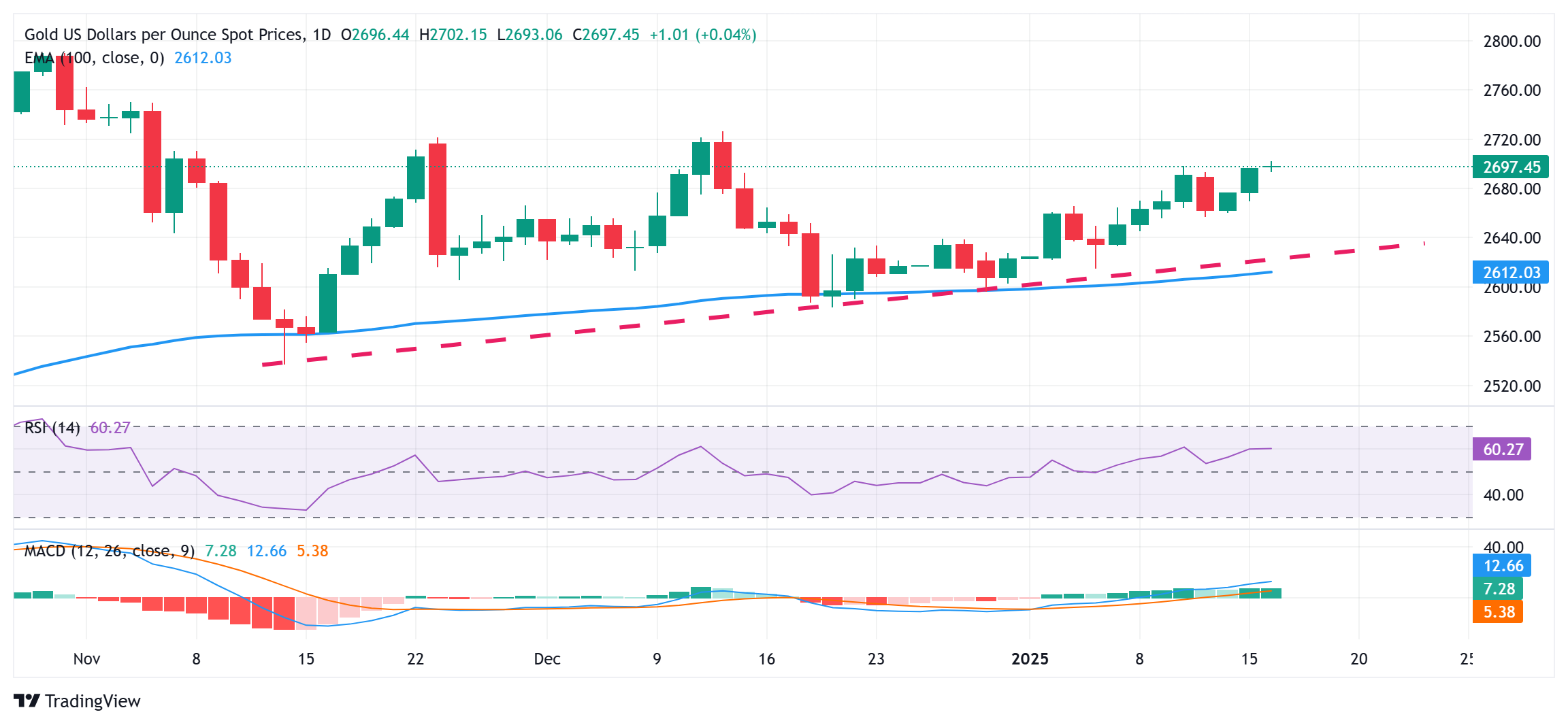
From a technical perspective, positive oscillators on the daily chart support prospects for a further move-up towards the $2,715-2,720 supply zone. Some follow-through buying should pave the way for additional gains towards the next relevant hurdle near the $2,748-2,750 region, above which the Gold price could aim to retest the all-time peak, around the $2,790 area touched in October 2024.
On the flip side, any meaningful pullback now seems to find decent support and attract fresh buyers around the $2,678 region. This should help limit the downside near the $2,664-2,663 horizontal zone. Failure to defend the said support levels could make the Gold price vulnerable to accelerate the fall towards the $2,635 area en route to the $2,615 confluence – comprising a short-term ascending trend line and the 100-day Exponential Moving Average (EMA).
Interest rates FAQs
Interest rates are charged by financial institutions on loans to borrowers and are paid as interest to savers and depositors. They are influenced by base lending rates, which are set by central banks in response to changes in the economy. Central banks normally have a mandate to ensure price stability, which in most cases means targeting a core inflation rate of around 2%. If inflation falls below target the central bank may cut base lending rates, with a view to stimulating lending and boosting the economy. If inflation rises substantially above 2% it normally results in the central bank raising base lending rates in an attempt to lower inflation.
Higher interest rates generally help strengthen a country’s currency as they make it a more attractive place for global investors to park their money.
Higher interest rates overall weigh on the price of Gold because they increase the opportunity cost of holding Gold instead of investing in an interest-bearing asset or placing cash in the bank. If interest rates are high that usually pushes up the price of the US Dollar (USD), and since Gold is priced in Dollars, this has the effect of lowering the price of Gold.
The Fed funds rate is the overnight rate at which US banks lend to each other. It is the oft-quoted headline rate set by the Federal Reserve at its FOMC meetings. It is set as a range, for example 4.75%-5.00%, though the upper limit (in that case 5.00%) is the quoted figure. Market expectations for future Fed funds rate are tracked by the CME FedWatch tool, which shapes how many financial markets behave in anticipation of future Federal Reserve monetary policy decisions.
Author

Haresh Menghani
FXStreet
Haresh Menghani is a detail-oriented professional with 10+ years of extensive experience in analysing the global financial markets.