Gold Price Analysis: XAU/USD continues to wrestle with $2,000
- Spot Gold is bidding lower, testing back beneath the $2,000 key handle.
- XAU/USD is trimming back some gains as investors weigh their options post-US data.
- Gold remains well-bid, but $2,000 is proving to be a challenging level.

XAU/USD tipped back into a daily high above the $2,000 mark, at $2,006.48, but the key handle is proving a difficult target to nail down.
Gold is bidding back towards the downside as investor sentiment rolls over on the day and exposure goes uneven.
US Treasury yields saw another spike on Wednesday, with the 10-year T-note briefly climbing back into 4.445% before slipping back to 4.42%.
US investor sentiment is going mixed on the day after US Initial Jobless Claims unexpectedly dipped to a five-week low of 209K versus the forecast 225K, revealing some ongoing tightness in the labor market.
Meanwhile, the University of Michigan Consumer Inflation Expectations showed that US consumers still see an elevated inflation outlook, with consumers expecting inflation to remain around 3.2% over the next five years.
With price growth being something of a self-fulfilling prophecy, elevated consumer inflation expectations means the Federal Reserve (Fed) is less likely to accelerate the path towards rate cuts, much to the chagrin of investors who have broadly been increasing bets on a sooner rather than later rate cut cycle.
XAU/USD Technical Outlook
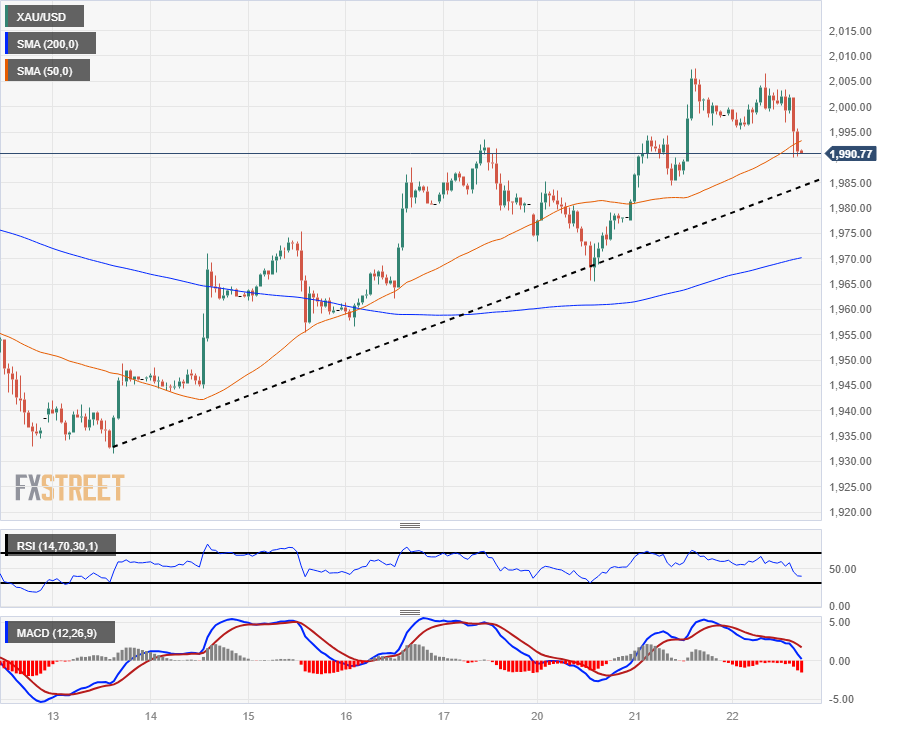
Gold's snap decline in intraday Wednesday trading sees the XAU/USD slipping back from the $2,000 handle to challenge $1,990, descending into the 50-hour Simple Moving Average (SMA).
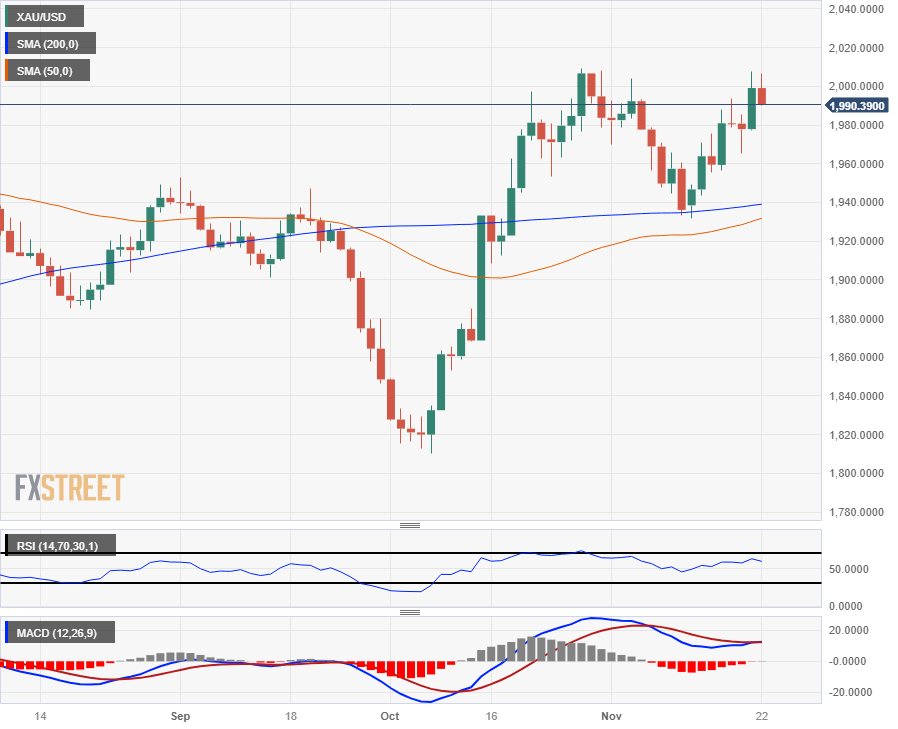
Despite the Wednesday backslide, Gold remains elevated, with XAU/USD up over 3% from the last swing low into the 200-day SMA near $1,931. $2,000 is proving to be a bit of a technical cap, and Spot Gold's near-term trading range will be defined by whether or not the 200-day SMA can again support any declines into $1,940.
XAU/USD Hourly Chart
XAU/USD Daily Chart
Author

Joshua Gibson
FXStreet
Joshua joins the FXStreet team as an Economics and Finance double major from Vancouver Island University with twelve years' experience as an independent trader focusing on technical analysis.

















