|

Gold Price Analysis: Pulls back amid overbought RSI, multiple upside barriers ahead

  • Gold prices step back from the multi-month top.
  • Early-month high acts as the immediate support, March 2013 top offers nearby resistance.
  • A downside break of $1,572 will confirm broad bearish formation.

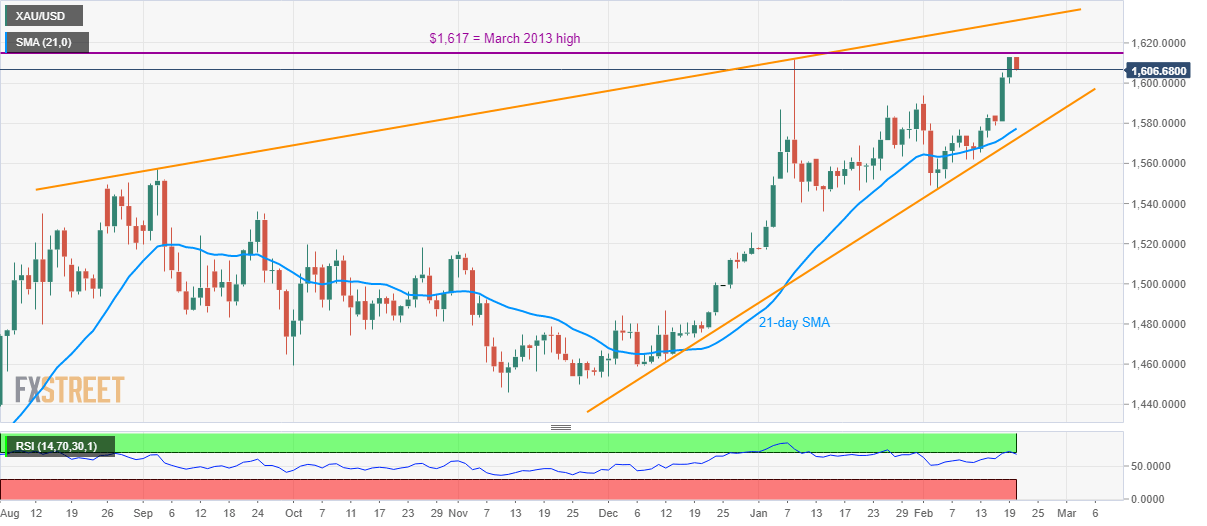
Gold prices decline to $1,606 during the early Thursday. The yellow metal surged to the highest since March 2013 the previous day but failed to hold onto gains due to the overbought RSI conditions.

As a result, sellers are now awaiting a downside break of $1,600 to aim for the early-month high nearing $1,594.

However, 21-day SMA and an upward sloping trend line from December 2019, around $1,577 and $1,572 respectively, will limit the bullion’s further declines.

It should be noted that the precious metal’s downside past-$1,572 will confirm a broad bearish rising wedge formation and can trigger a fresh down-leg towards the late-2019 area.

On the upside, March 2013 high near $1,617 acts as the immediate resistance ahead of the rising trendline connecting highs marked during September 20119 and January 2020, close to $1630/31.

Gold daily chart
Trend: Pullback expected

Additional important levels

Overview
Today last price1606.76
Today Daily Change-6.21
Today Daily Change %-0.39%
Today daily open1612.97
 
Trends
Daily SMA201575.88
Daily SMA501544.59
Daily SMA1001512.65
Daily SMA2001470.88
 
Levels
Previous Daily High1613
Previous Daily Low1599.56
Previous Weekly High1584.36
Previous Weekly Low1561.99
Previous Monthly High1611.53
Previous Monthly Low1517.1
Daily Fibonacci 38.2%1607.87
Daily Fibonacci 61.8%1604.69
Daily Pivot Point S11604.02
Daily Pivot Point S21595.07
Daily Pivot Point S31590.58
Daily Pivot Point R11617.46
Daily Pivot Point R21621.95
Daily Pivot Point R31630.9

Author

Anil Panchal

Anil Panchal

FXStreet

Anil Panchal has nearly 15 years of experience in tracking financial markets. With a keen interest in macroeconomics, Anil aptly tracks global news/updates and stays well-informed about the global financial moves and their implications.


More from Anil Panchal
Share:

Editor's Picks

Japanese Yen gains ground as traders await Fed rate decision

The USD/JPY pair loses ground to near 160.25 during the early European trading hours. Traders prefer to wait on the sidelines ahead of the US Federal Reserve interest rate decision under new Chair Kevin Warsh later on Wednesday.

AUD/USD stays pressured; holds above 0.7050 as traders await Fed decision

The AUD/USD pair struggles to capitalize on the previous day's hawkish Reserve Bank of Australia-inspired bounce and trades with a negative bias for the second consecutive day on Wednesday. Spot prices, however, hold above the 0.7050 level as traders opt to wait for the outcome of a two-day FOMC policy meeting before placing fresh directional bets.

Gold extends intraday slide towards $4,250

Gold turned negative by the end of Wednesday and trades in the $4,260 price zone. The US Federal Reserve left rates unchanged, but delivered a hawkish message, even though Chair Kevin Warsh refused to provide forward guidance.

Two altcoins to watch as DeFi market cap nears $70B
Decentralized Finance (DeFi) tokens exhibit mixed signals on Wednesday, with Uniswap (UNI) slightly pulling back from an early-week rally to highs around $3.73, while Aster (ASTER) extends its recovery near $0.80. Bitcoin (BTC) holds above $65,000 following a rejection at June highs around $67,000.
Federal Reserve set to hold interest rates in Warsh's debut as chair

The United States Federal Reserve announces its interest rate decision on Wednesday, another pivotal meeting for markets to gauge the stance of policymakers and new Chair Kevin Warsh as energy prices retreat after the United States and Iran reached a framework deal to reopen the Strait of Hormuz.

Why a hawkish RBA is no longer enough to lift the Australian Dollar

The Reserve Bank of Australia delivered more than what markets expected: a hawkish hold that should have supported the Aussie. But markets widely ignored it, focusing instead on slowing economic growth and proving that central bank messaging alone isn’t always enough to drive currencies.