Gold Price Analysis: Bulls press-on towards key 61.8% golden ratio
- Gold is firmly bid and riding weekly dynamic trendline support.
- Inflation concerns are being weighed by investors and priced into the markets.
- US dollar finding support on rising US yields and prospects of higher highs.

The price of gold on Thursday remains in familiar ranges, consolidated in the region of $1.780 and supported as investors weigh the probabilities of the Federal Reserve tapering and the likely hood of earlier than first anticipated rate hikes from the US central bank. At the time of writing, XAU/USD is trading at $1,779.81 and has travelled in a narrow range between $1,776.55 and $1,789.46.
US 10-yields in focus
In prior analysis, it was explained the 10-year US yields were on the verge of a break higher: ''...they could be about to surge to the upside from a technical perspective as the yield spikes from the 21-50 hour SMMA cloud.''
Prior analysis:
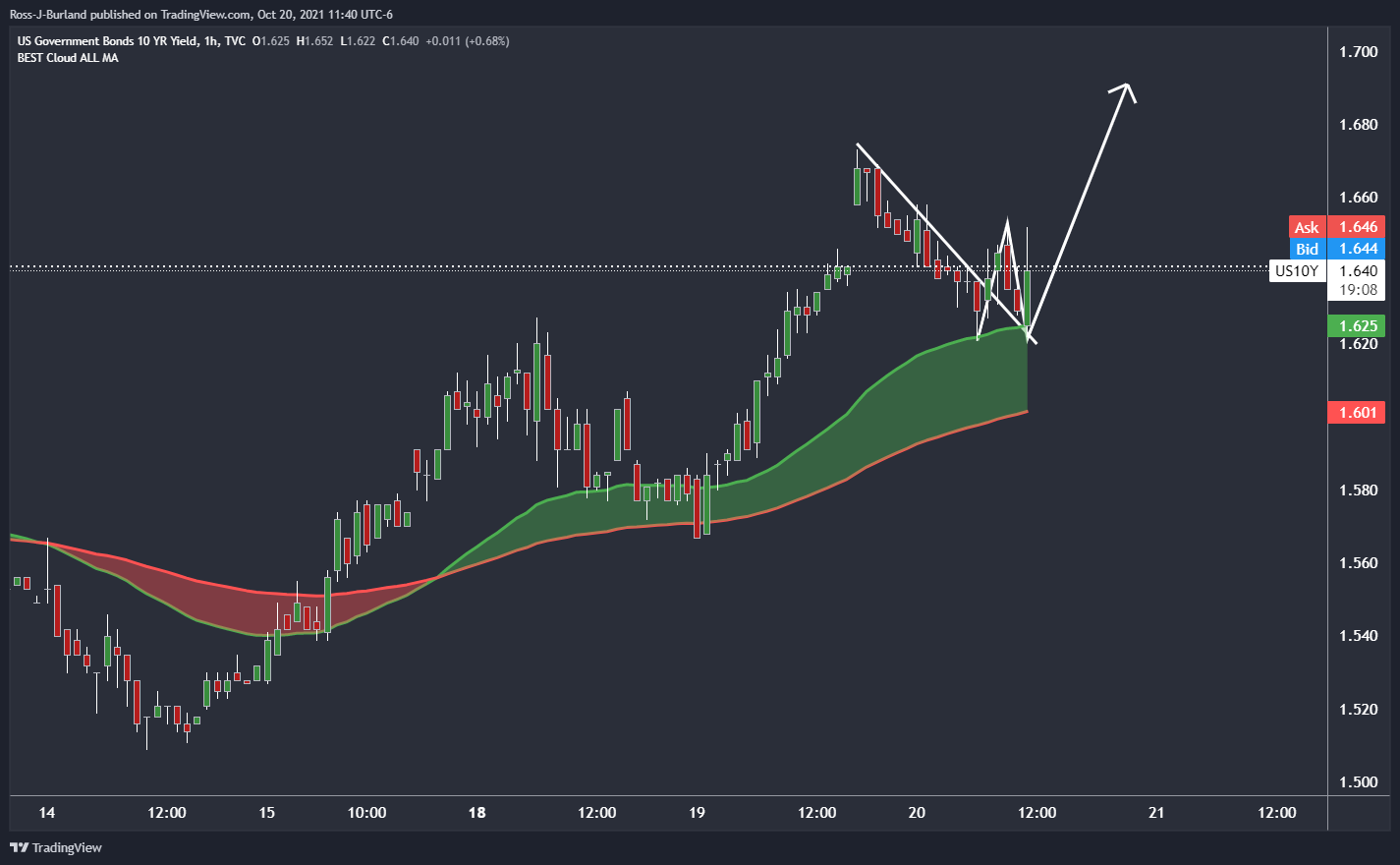
US yields on Thursday have indeed moved higher on Thursday with the 10-year printing a fresh 1.682% high on the approach to the March highs of 1.774% from a technical perspective:
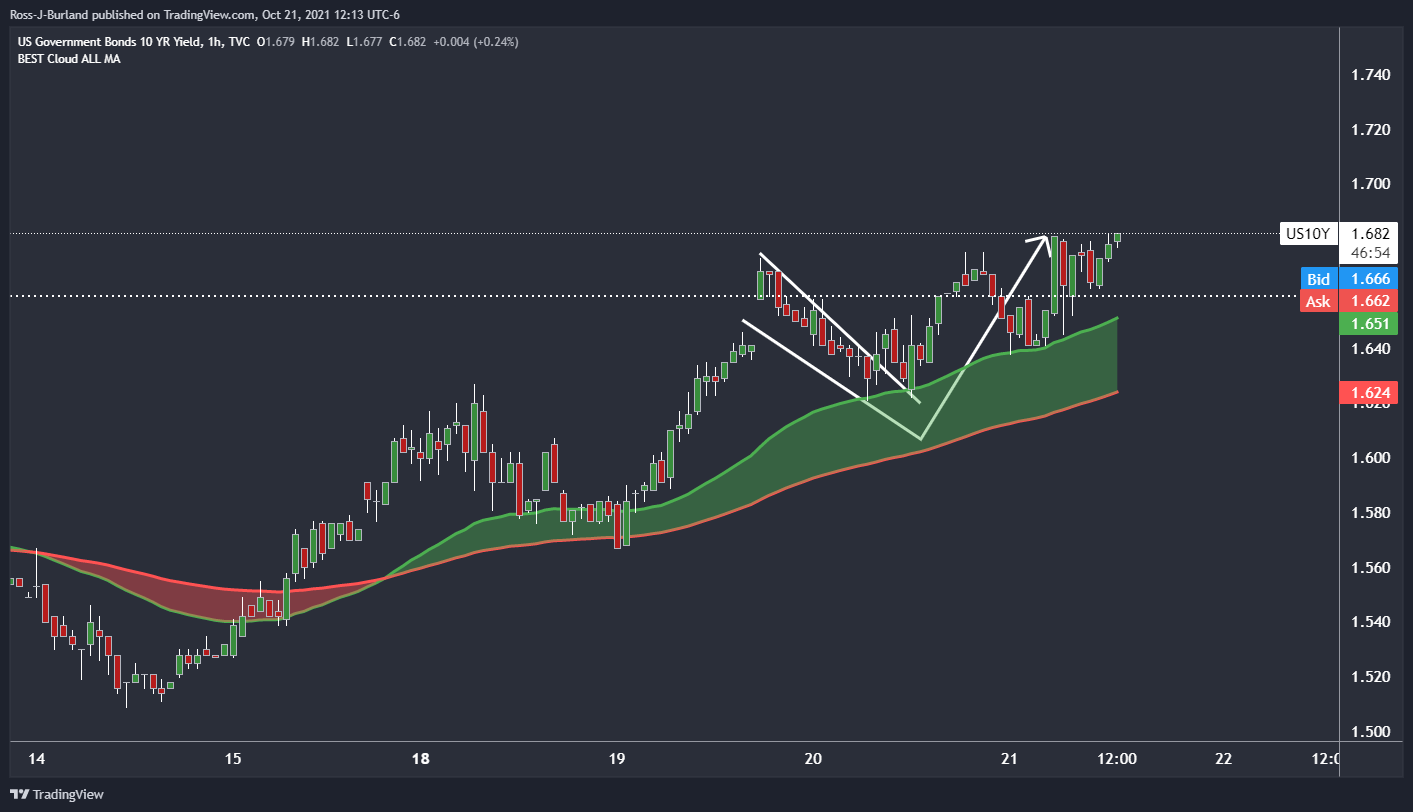
From a daily perspective, there are prospects of a move beyond the daily highs towards a -272% Fibonacci retracement of the current daily flag's range:

In turn, the US dollar is finding support and the combination of prospects of the Federal Reserve raising rates sooner for fear of prolonged and sticky inflation is proving to be a headwind for gold prices.
US dollar on tenterhooks
The US dollar index was 0.15% higher at the time of writing around the highs of the day at 93.72 and holding nicely above Tuesday's three-week low of 93.501. However, it has declined 1.1% from a 15-month peak that hit last week. Expectations that the Fed could soon scale back pandemic-era stimulus has underpinned the dollar over the past few months. However, in recent times, other central banks have been sounding the inflation alarms.
Central banks, such as the Bank of England and the Reserve Bank of New Zealand, are seemingly about to put peddle to the metal and deal with inflation headwinds by raising rates, jumping the queue in front of the Fed. This has given rise to strength elsewhere and enabled precious metals to advance over the past couple of weeks.
Moreover, the Federal Reserve, while widely expected to announce the tapering of its bond purchase at a policy meeting in early November, it is expected to distance itself from future rate hikes for now. Money markets are pricing in just one US rate hike in 2022 after the Fed is expected to have finished its tapering process in the middle of next year.
''While gold prices remain relatively range-bound, they are facing tremendous pressure as market pricing for Fed hikes continue to firm into 2022,'' analysts at TD Securities said. ''Yet, we argue that market pricing for Fed hikes remains far too hawkish, as it fails to consider that a rise in inflation tied to a potential energy shock and lingering supply chain shortages would be unlikely to elicit a Fed response,'' the analysts argued.
''The market is increasingly pricing in a policy mistake which is unlikely to take place, considering that central banks are likely to look past these disruptions as their reaction functions have been historically more correlated to growth than inflation. Reasons to own the yellow metal are growing more compelling as Fed pricing is likely to unwind.''
Gold technical analysis
For an in-depth technical analysis of gold, see here: Gold Chart of the Week: XAU hit the $1,800 target, now what?
The price rides the dynamic trendline support towards the resistance as illustrated below. However, a move beyond $1,800 is required if the bulls are going to take charge again, or otherwise, a break below the trendline support and then $1,750 will open the risk of a downside continuation.
This can be illustrated better from a weekly perspective, as follows:
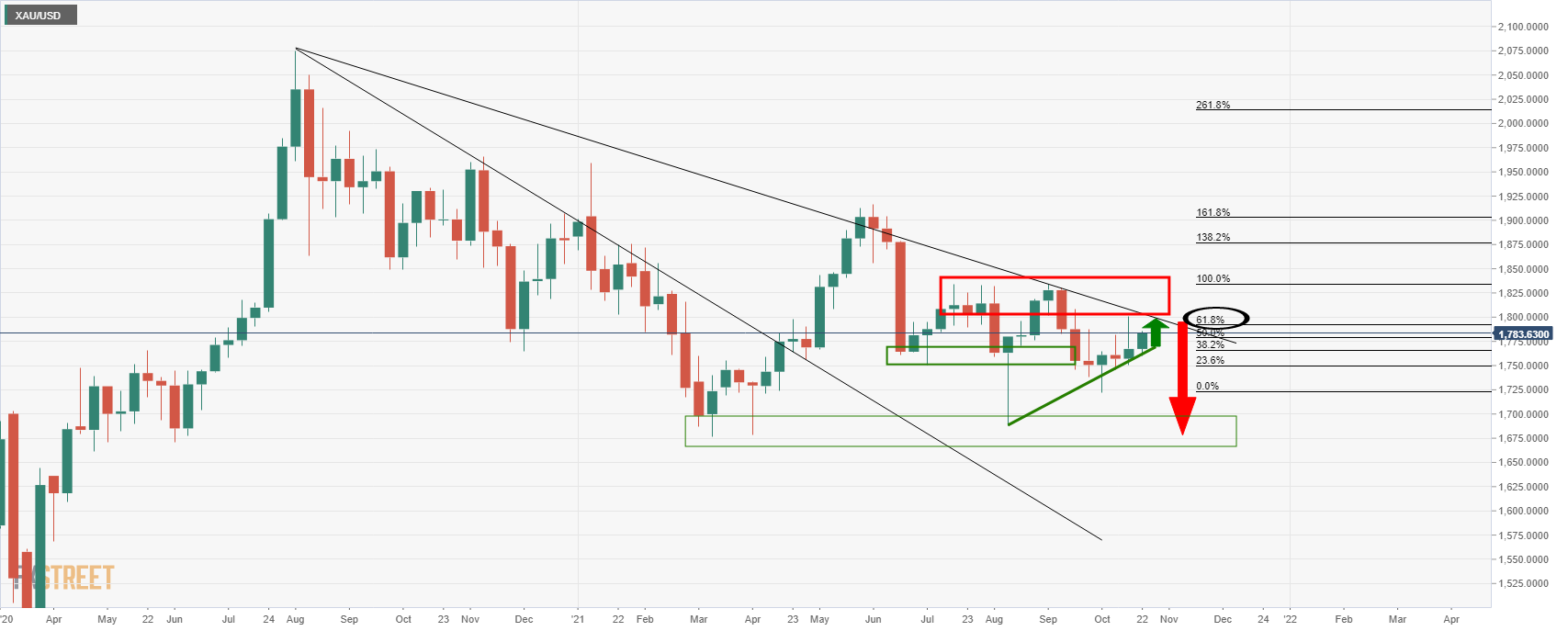
The price has met a 61.8% Fibonacci retracement of the prior bearish impulse but stays bid for another attempt.
Author

Ross J Burland
FXStreet
Ross J Burland, born in England, UK, is a sportsman at heart. He played Rugby and Judo for his county, Kent and the South East of England Rugby team.