|

Gold Price Analysis: Bears below key support

  • Gold prices remain in the hands of the bears, targetting structure around $1,806.
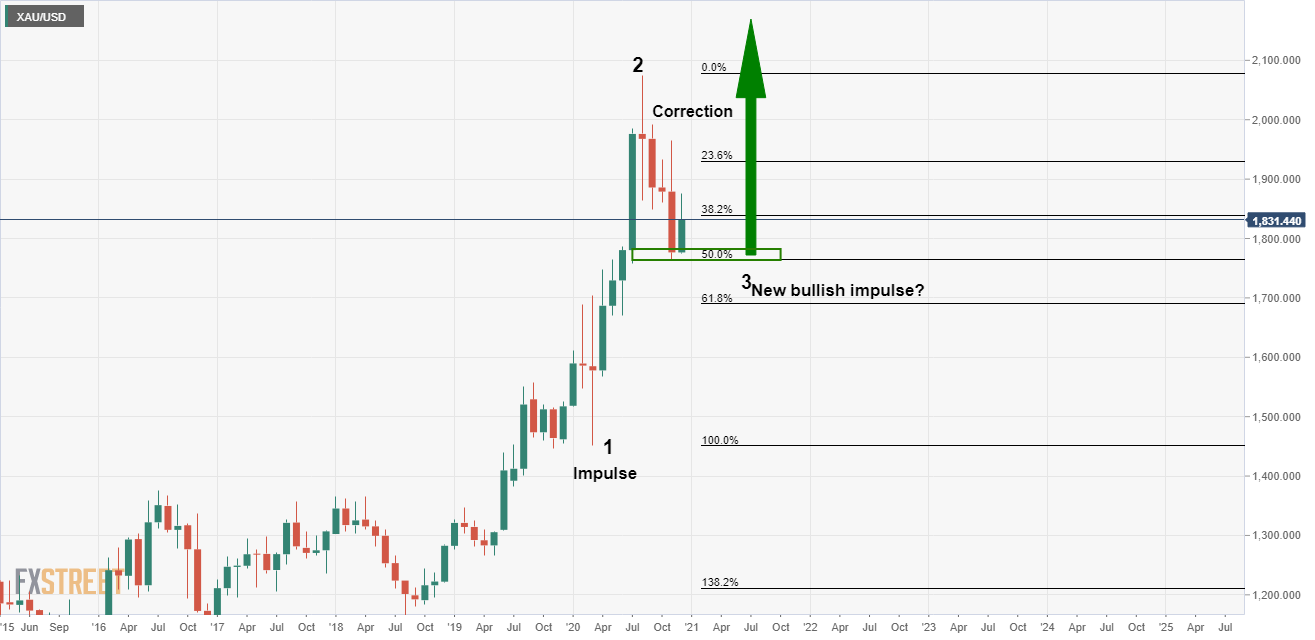
  • Hedge funds have added longs and monthly impulse-correction-impulse scenario is compelling. 

Further to yesterday's analysis, the price continues to paint a bearish bias, for the near term, towards a test of the W-formation's nose at $1,818 with a naked 24th Nov session volume's point of control at $1,805.90. 

For a recap of the prior analysis, see here: Gold Price Analysis: Bears in control, but hedge funds are piling back in

What is most compelling is that we have already seen a major liquidity hunt on the weekly time frame:
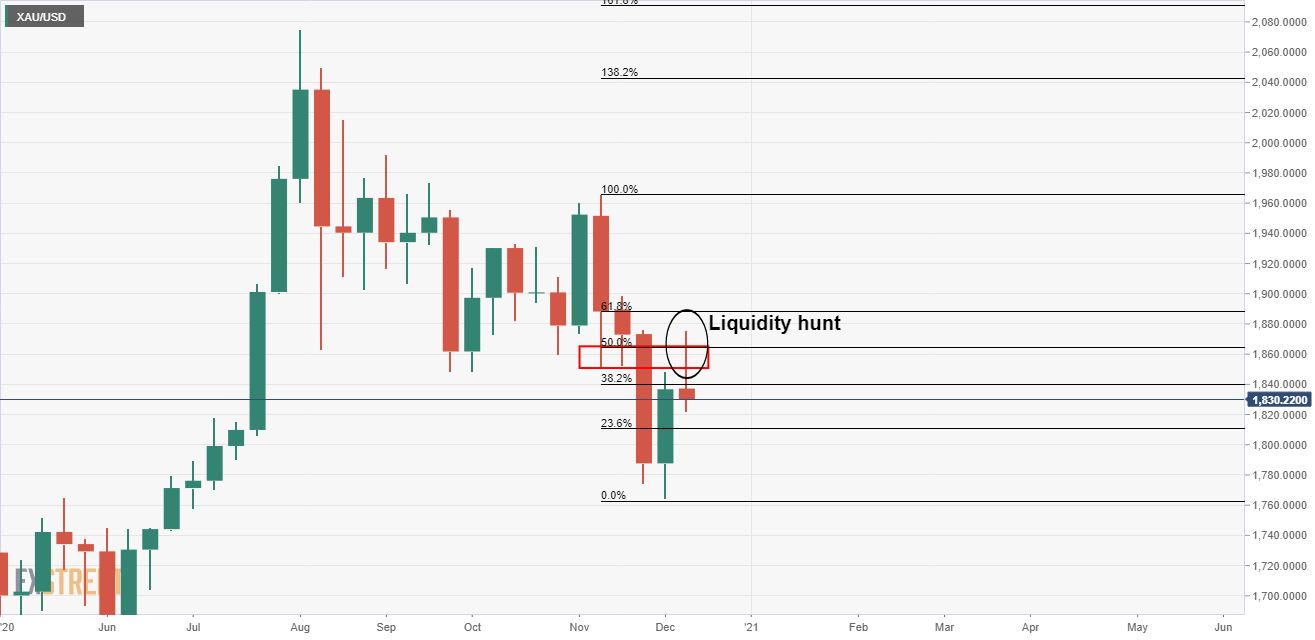
This means that the market has eaten up the buy stops and driven the price lower on selling volumes.

Daily chart
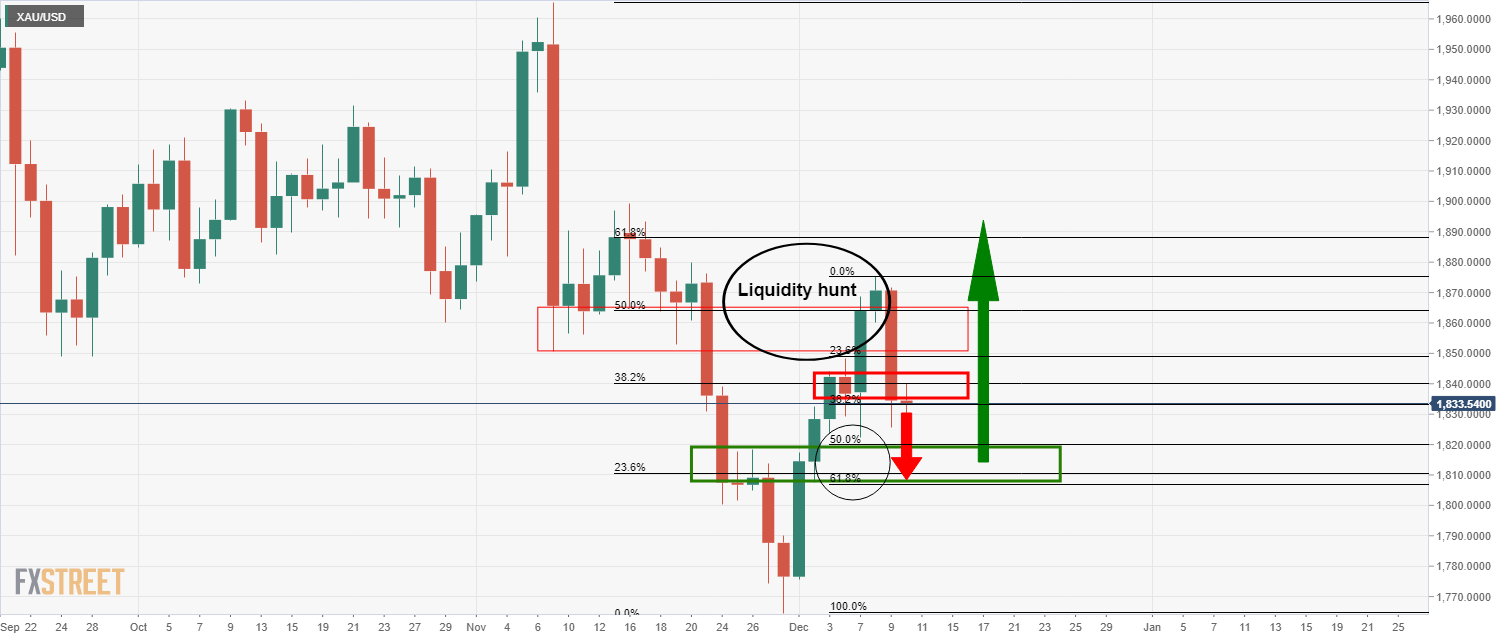
As illustrated between these two daily charts, today's (above) and the prior day's, (below), we can see that the price action is moving according to the analysis's expectations.

With less than three hours until this current bearish daily candle's close, the bias is still weighted towards the downside and target of the confluence of a 61.8% Fibonacci retracement, structure and volume. 
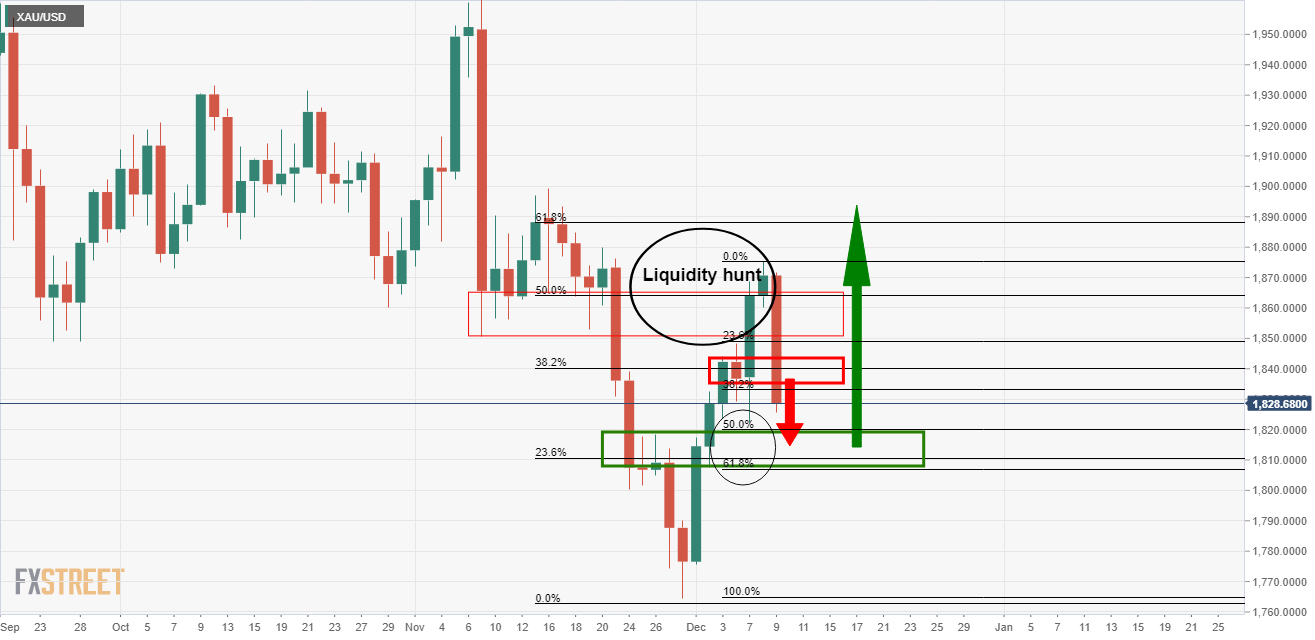
As explained in the prior analysis, there are prospects for an upside trend from the $1,806 structure based on the latest positioning data. 

However, a break below the structure opens the 30th November naked point of control at $1,771.

This volume node has not been re-traded since. It is, therefore, a compelling level where the highest numbers of transactions were agreed around the current bearish cycles lows.

Monthly chart
Author

Ross J Burland

Ross J Burland, born in England, UK, is a sportsman at heart. He played Rugby and Judo for his county, Kent and the South East of England Rugby team.


More from Ross J Burland
Share:

Editor's Picks

GBP/USD keeps the firm tone above 1.3600

GBP/USD clings to its daily gains, although it gives back some of them and recedes toward the 1.3630-1.3620 band on Thursday. Cable’s uptick comes despite the modest bounce in the Greenback, while investors gear up for key data releases on the UK calendar on Friday.

EUR/USD treads water near 1.1670

EUR/USD gives away all its initial gains and receded to the sub-1.1700 region. The US Dollar’s late recovery has dragged the pair lower, leaving it practically unchanged following the NA session on Thursday. In the meantime, investors gear up for the release of preliminary S&P Global Manufacturing and Services PMIs on both sides of the Atlantic on Friday.

Gold consolidates above $4,500 as rising bond yields offset reduced Fed hike bets

Gold holds steady above $4,500 during the Asian session on Friday amid a combination of diverging forces. Reduced Fed rate-hike bets keep US Dollar bulls on the back foot and support the non-yielding bullion. However, higher US bond yields, bolstered by inflation risks stemming from volatile oil prices due to the US-Iran standoff, could limit USD losses and cap the commodity. Nevertheless, XAU/USD remains on track to register gains for the third straight week.

Bitcoin demand turns positive across spot and perpetual markets as price rebounds above $70K
Bitcoin (BTC) demand has turned positive across both spot and perpetual futures markets for the first time since its October 2025 all-time high, according to CryptoQuant founder Ki Young Ju on Thursday. The shift comes as Bitcoin rebounded past $70,000 over the past 24 hours.
Why long bonds have repriced the cost of money
The 30-year Treasury is 12 basis points below its highest level since before the financial crisis. Not its highest since 2023, or since the tightening cycle, but since June 12, 2007, the last time the longest bond in the world's deepest market yielded what it yields on Thursday. Getting there took two attempts and most of the year.
$20 billion offered, $2 billion taken: Why Treasury doubled its buyback cap

The US Treasury moved off its own calendar on Wednesday, and that is the part worth sitting with. At 12:32 GMT, the department said it would at least double the size of liquidity support buyback operations in the 10-year to 20-year and 20-year to 30-year sectors, lifting the maximum from $2 billion per operation to at least $4 billion, effective September 9 and running to November 4.