Gold Price aims to recapture $1,700 as DXY hopes for a rebound, US Michigan CSI eyed
- Gold price is likely to resume the downside move amid a broader strength in the DXY.
- Inflation rate and lower earnings to trim demand for durable goods.
- The US Michigan CSI is likely to trim to 49.9 from the prior release of 50.

Gold Price (XAUUSD) is displaying a lackluster performance in the Asian session after witnessing a firmer rebound below the psychological support of $1,700.00 on Thursday. The precious metal is oscillating in a minute range after a responsive buying action. Usually, a responsive buying action dictates that the market participants are considering the asset a value bet and have infused significant bets. However, it doesn’t warrant a bullish reversal.
The US dollar index (DXY) is in a short-term correction phase after hitting a fresh 19-year high of 109.30 on Thursday. The asset is continuously refreshing its highs, which displays the strength of the DXY bulls. The DXY has slipped to near the crucial support of 108.60 and may resume its upward journey after reclaiming the round-level resistance of 109.00.
Also Read: Gold Price Forecast: Bears are not done as the global crisis is just starting

Fed chair Jerome Powel to sound extremely hawkish in July monetary policy
1% rate hike to hurt the growth prospects
The rumor that is buzzing in the investing community is the expectation of a 1% rate hike by the Federal Reserve (Fed), which could hurt the growth prospects of the US economy. The Fed is expected to make the historic move as an elevation of a rate hike by 100 basis points (bps) is not a usual event. There is no denying the fact that a rate hike by 100 bps will squeeze liquidity from the economy significantly. And, the corporate sector will be left with costly funds to cater to their investment opportunities. No doubt, the costly liquidity will force the corporate to use more filters while the scrutiny of the investment opportunities.
Labor market could be out of gas
It is not logical to deny that the upbeat labor market has supported the Fed to sound extremely hawkish unhesitatingly. The US economy has generated employment opportunities vigorously. Also, the Unemployment Rate has remained lower for a tad longer period. The achievement of full employment levels has been a major catalyst to support the Fed’s hawkish commentary. In case, the Fed elevates its interest rates by 100 bps in its July monetary policy, the burden will be shifted to the labor market, which could go out of gas if price pressures persist longer.
-637934436416144166.png)
Consensus for US Michigan CSI is 49.9
In today’s session, the entire focus will remain on the release of the US Michigan Consumer Sentiment Index (CSI) data. As per the market consensus, the economic data is seen at 49.9, minutely lower than the prior release of 50. It is worth noting that the prior release of 50 was the lowest in the past 15 years and even an expectation of a minute slippage this time may bolster the statements of critics.
The economic data resembles the confidence of the consumers in the financial prospects of the country. A slippage in the economic data dictates a drop in the buying conditions for real estate and durable goods in the economy. No doubt, the persistent price rise has trimmed the demand for durable goods and higher interest rates are becoming a nightmare for home buyers.
-637934435741758230.png)
Aggregate demand to suffer principally
Persistent price pressures, lower Consumer Confidence, and accelerating interest rates; all catalysts are indicating that the aggregate demand is likely to suffer principally. The US Bureau of Labor Statistics reported the annual inflation rate at 9.1%, higher than the prior release of 8.6% and the estimates of 8.8%. This is going to trim the value of ‘paychecks’ received by US households. A very large real income shock to the US households will display its multiplier effects on the aggregate demand and growth forecasts.
Apart from that, wages are not displaying upward signals, which may keep demand for durable goods lower. Last week, the Average Hourly Earnings slipped to 5.1% from the prior release of 5.3% on an annual basis.
Gold technical analysis
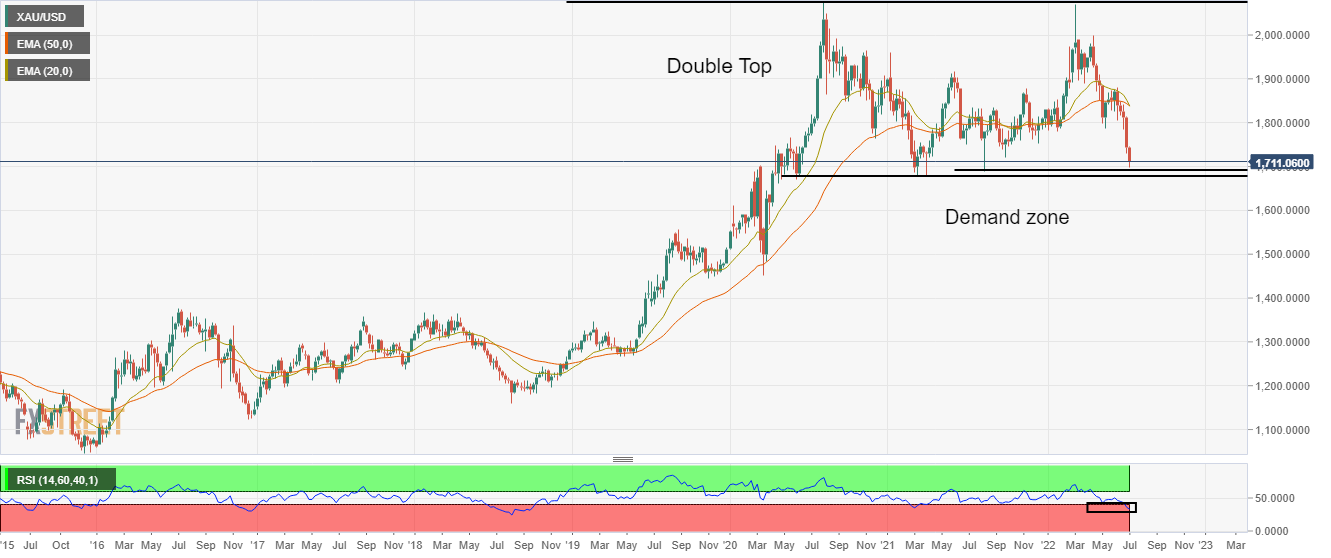
Gold prices are declining towards the demand zone, which is placed in a narrow range of $1,680.67-1,687.68 on the weekly scale. The sheer downside move on Thursday was expected to drag the precious metal further, however, the gold prices remained shy of the potential demand zone. The bright metal shifted into the bearish trajectory after failing to overstep the all-time highs at $2,075.32 and formed a textbook-copied Double Top.
It is worth noting that the 20- and 50-period Exponential Moving Averages (EMAs) are on the verge of displaying a bearish crossover at $1,840.36, which will weaken gold bulls further.
Also, the Relative Strength Index (RSI) (14) has tumbled into the bearish range of 20.00-40.00 for the first time after a period of 16 months, which adds to the downside filters. The momentum oscillator is not displaying any sign of divergence and oversold scenario.
Gold weekly chart
Can gold prices hold above $1700 as focus shifts to inflation data?
Author

Sagar Dua
FXStreet
Sagar Dua is associated with the financial markets from his college days. Along with pursuing post-graduation in Commerce in 2014, he started his markets training with chart analysis.