Gold price refreshes two-week high, looks to build on momentum beyond $2,700 mark
- Gold price scales higher for the fifth straight day and touches a nearly two-week high on Friday.
- The worsening Russia-Ukraine conflict continues to drive haven flows toward the XAU/USD.
- Bets for a less dovish Fed, elevated US bond yields, bullish USD does little to hinder the move up.

Gold price (XAU/USD) hits a fresh two-week top during the first half of the European session on Friday, with bulls now looking to build on the momentum further beyond the $2,700 mark. This marks the fifth successive day of a positive move and is fueled by the global flight to safety amid persistent geopolitical tensions stemming from the intensifying Russia-Ukraine war. Furthermore, expectations that US President-elect Donald Trump's expansionary policies could reignite inflationary pressures further benefit the commodity's appeal as a hedge against inflation.
Meanwhile, higher inflation could limit the scope for the Federal Reserve (Fed) to cut interest rates further. This, along with worries over a possible rise in the US fiscal deficit led by Trump's expansionary plans, remains supportive of elevated US Treasury bond yields and lifts the US Dollar (USD) to its highest level since October 2023. Sustained USD buying, however, does little to dent the bullish sentiment surrounding the Gold price, which has now reversed last week's heavy losses to a two-month low and remains on track to register strong weekly gains.
Gold price weekly uptrend remains uninterrupted despite elevated US bond yields and stronger USD
- Mounting Russia-Ukraine tensions continue to drive haven flows and assist the Gold price to scale higher for the fifth straight day on Friday, despite a bullish US Dollar.
- Russian forces fired a new intermediate-range ballistic missile at Ukraine in response to the latter's use of US and UK-made missiles in attacks on targets in Russia.
- The USD Index, which tracks the Greenback against a basket of currencies, advanced to its highest level since October 2023 amid bets for a less dovish Federal Reserve.
- Investors remain concerned that US President-elect Donald Trump's policies could reignite inflation and force the Fed to take a slower course in its rate-cut path.
- A slew of influential FOMC members, including Fed Chair Jerome Powell, recently warned about inflationary shocks and cautioned on further policy easing.
- According to the CME Group's FedWatch Tool, traders are pricing around a 55% chance that the Fed will lower borrowing costs by 25 basis points in December.
- Meanwhile, Chicago Fed President Austan Goolsbee said that the inflation is on its way down to 2% and that it may make sense to slow the pace of interest rate cuts.
- Adding to this, New York Fed President John Williams noted that the labor market is in balance and not providing any upward pressure on inflation.
- On the economic data front, US Weekly initial jobless claims dropped by 6K last week, to 213K, or a seven-month low against expectations for a reading of 220 K.
- US Existing Home Sales rebounded sharply after September's slump to the lowest since October 2010 and posted the first annual gain since mid-2021 in October.
- The Philly Fed Manufacturing Index indicated that manufacturing activity in the Philadelphia region unexpectedly contracted in November and fell to -5.5 from +10.3.
- Friday's release of flash PMIs will be looked for a fresh insight into the health of the global economy, which, in turn, should provide a fresh impetus to the XAU/USD.
Gold price sustained strength beyond $2,700 could be seen as fresh trigger for bullish traders
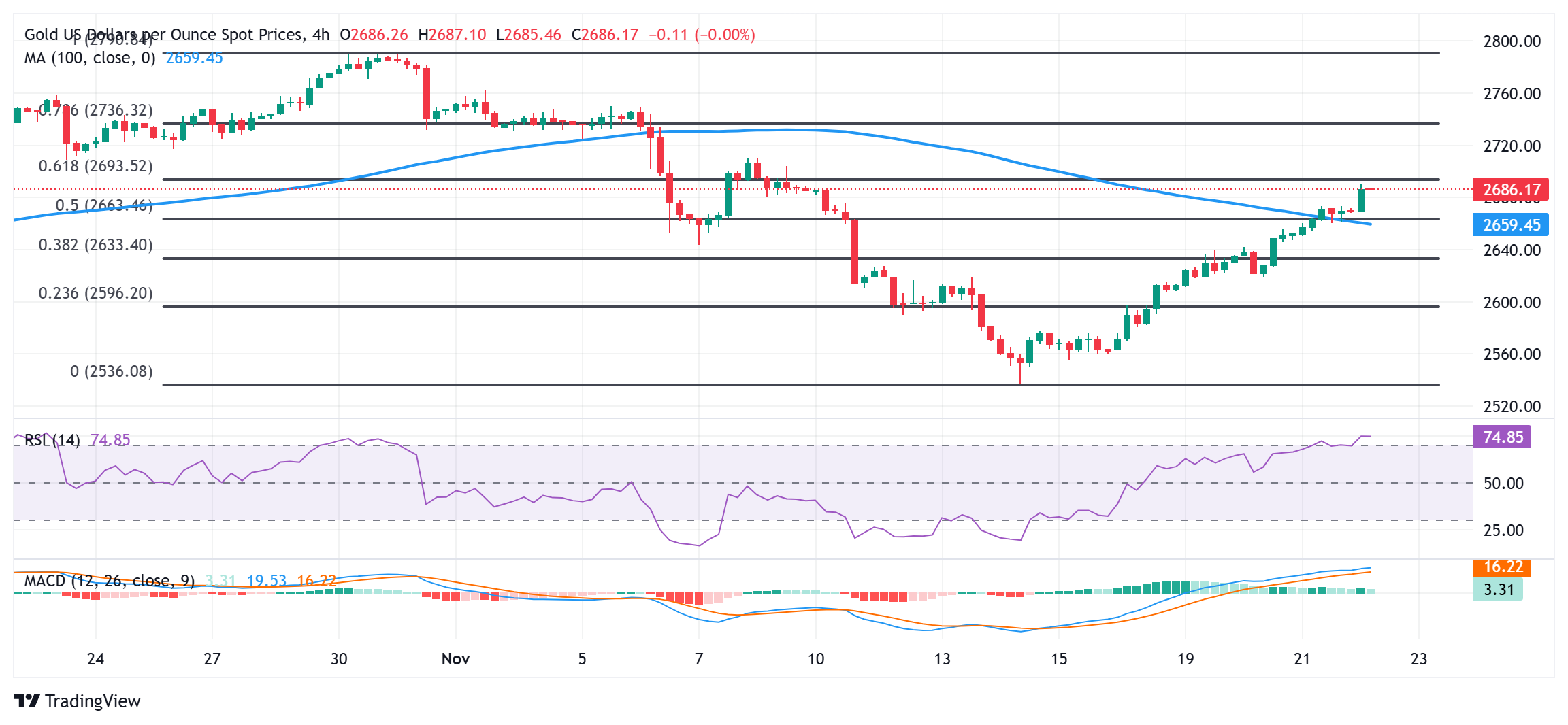
The overnight breakout above the $2,665 confluence – comprising the 50% retracement level of the recent pullback from the all-time peak and the 100-period Simple Moving Average (SMA) on the 4-hour chart – was seen as a key trigger for bulls. Adding to this, technical indicators on the daily chart have again started gaining positive traction and support prospects for a further appreciating move for the Gold price. Hence, some follow-through strength beyond the $2,700 mark, towards the $2,710-2,711 supply zone, looks like a distinct possibility. Acceptance above the said barriers will reaffirm the positive bias and lift the XAU/USD towards the next relevant hurdle near the $2,736-2,737 region.
On the flip side, the $2,665 confluence hurdle breakpoint might now protect the immediate downside ahead of the $2,635-2,634 area, or the 38.2% Fibonacci retracement level. This is followed by the $2,622-2,620 intermediate support and the $2,600 round figure. A convincing break below the latter could make the Gold price vulnerable to accelerate the fall towards the 100-day SMA, around the $2,560 region, en route to last week’s swing low, around the $2,537-2,536 area. Failure to defend the said support levels will shift the bias back in favor of bearish traders and set the stage for deeper losses.
Gold FAQs
Gold has played a key role in human’s history as it has been widely used as a store of value and medium of exchange. Currently, apart from its shine and usage for jewelry, the precious metal is widely seen as a safe-haven asset, meaning that it is considered a good investment during turbulent times. Gold is also widely seen as a hedge against inflation and against depreciating currencies as it doesn’t rely on any specific issuer or government.
Central banks are the biggest Gold holders. In their aim to support their currencies in turbulent times, central banks tend to diversify their reserves and buy Gold to improve the perceived strength of the economy and the currency. High Gold reserves can be a source of trust for a country’s solvency. Central banks added 1,136 tonnes of Gold worth around $70 billion to their reserves in 2022, according to data from the World Gold Council. This is the highest yearly purchase since records began. Central banks from emerging economies such as China, India and Turkey are quickly increasing their Gold reserves.
Gold has an inverse correlation with the US Dollar and US Treasuries, which are both major reserve and safe-haven assets. When the Dollar depreciates, Gold tends to rise, enabling investors and central banks to diversify their assets in turbulent times. Gold is also inversely correlated with risk assets. A rally in the stock market tends to weaken Gold price, while sell-offs in riskier markets tend to favor the precious metal.
The price can move due to a wide range of factors. Geopolitical instability or fears of a deep recession can quickly make Gold price escalate due to its safe-haven status. As a yield-less asset, Gold tends to rise with lower interest rates, while higher cost of money usually weighs down on the yellow metal. Still, most moves depend on how the US Dollar (USD) behaves as the asset is priced in dollars (XAU/USD). A strong Dollar tends to keep the price of Gold controlled, whereas a weaker Dollar is likely to push Gold prices up.
Author

Haresh Menghani
FXStreet
Haresh Menghani is a detail-oriented professional with 10+ years of extensive experience in analysing the global financial markets.