Gold recovers after US Job Openings fall more than expected in July
- Gold rebounds after the release of US JOLTS Job Openings data shows a fall in openings in July.
- Overcrowded long positioning could be the reason for Gold's lack of bullish momentum despite negative sentiment.
- Technically, Gold has broken below the key $2,500 level – a bearish sign for the precious metal.

Gold (XAU/USD) recovers after the release of US Job Openings data shows a lower-than-expected number of openings in July. The precious metal is exchanging hands in the $2,490s during the US session on Wednesday, following the data which increases the probabilities of the Federal Reserve (Fed) cutting interest rates by a larger 0.50% at its September meeting, as opposed to the usual 0.25% reduction. The lower interest rates are the more positive it is for Gold price since lower interest rates reduce the opportunity cost of holding the non interest-paying asset.
Gold recovers after JOLTS Job Openings surpises to the downside
JOLTS Job Openings fell to 7.673 million in July from a downwardly-revised 7.91 million in June according to data from the US Bureau of Labor Staistics. The result also fell below economists' expectations of 8.100 million. It suggests the job market is shrinking and could indicate a coming recession if backed up by negative employment data from other sources. The US Dollar (USD) sees weakness after the release in most of its pairs, helping Gold rise since the yellow metal is cheifly priced and traded in USD.
A greater-than-expected growth in US Factory Orders which rose by 5.0% in July after declining 3.3% in June may limit downside for the US Dollar, however, and cap Gold's gains.
More US employment metrics are scheduled for release during the remainder of the week and these could further impact the outlook for US interest rates and Gold. This is particularly the case given recent comments by Federal Reserve (Fed) Chairman Jerome Powell, who highlighted risks to the labor market as now being more important than inflation in his speech at Jackson Hole. This week the data will put his remarks to the test.
ADP Employment Change and Jobless Claims are out on Thursday, but the main event on the calendar will be US Nonfarm Payrolls (NFP) on Friday. If NFPs increase less than expected it would further support the case of the larger cut.
On the geopolitical front, there are no major flare-ups that could pass through to increased demand for Gold. Although Russia launched a large missile and drone attack on Ukraine on Tuesday, killing 50 people in Poltava, it follows days of similar bombardments.
Out of Gaza, meanwhile, the Israeli populace continues to protest for a ceasefire to allow the safe release of hostages and the US criminally charged Hamas’s leaders for organizing the October 7 attacks.
Broad market sentiment remains negative after the global sell-off triggered by the release of weak US manufacturing data on Tuesday, and fears about the Artificial Intelligence (AI) tech bubble bursting.
Technical Analysis: Continues oscillating in a messy range
Gold (XAU/USD) continues meandering within a messy range below its previous all-time highs of $2,531.
It has now broken below the key $2,500 support level – a bearish turn of events from a technical perspective – but remains above the next key level at $2,470-$2,460, the top of the old range formed in July and early August.
XAU/USD Daily Chart
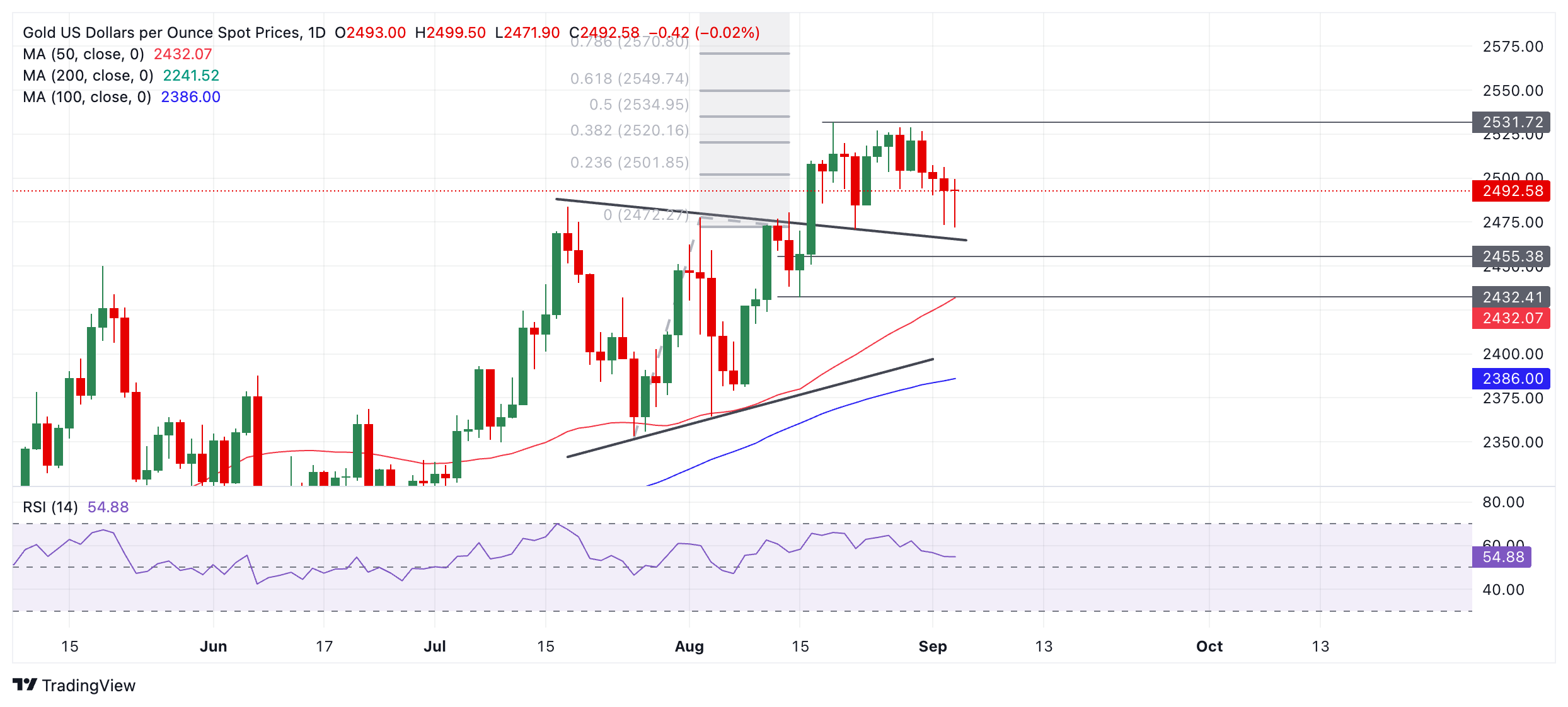
An as yet un-met upside target for Gold sits at $2,550 and remains active. This was generated after the original breakout from the July-August range on August 14.
Gold’s medium and long-term trends also remain bullish, which, given “the trend is your friend,” means the odds still favor an eventual breakout higher materializing.
A break above the August 20 all-time high of $2,531 would provide more confirmation of a continuation higher toward the $2,550 target.
If Gold continues steadily weakening, however, it is likely to next find support at the $2,470-$2,460 level. A decisive break below that level would change the picture for Gold and suggest that the commodity might be starting a more pronounced downtrend.
Economic Indicator
JOLTS Job Openings
JOLTS Job Openings is a survey done by the US Bureau of Labor Statistics to help measure job vacancies. It collects data from employers including retailers, manufacturers and different offices each month.
Read more.Last release: Wed Sep 04, 2024 14:00
Frequency: Monthly
Actual: 7.673M
Consensus: 8.1M
Previous: 8.184M
Source: US Bureau of Labor Statistics
Author

Joaquin Monfort
FXStreet
Joaquin Monfort is a financial writer and analyst with over 10 years experience writing about financial markets and alt data. He holds a degree in Anthropology from London University and a Diploma in Technical analysis.

















