Gold declines on Fed comments
- Gold weakens after several Federal Reserve officials voice their reluctance to cut interest rates yet.
- The market continues to see a high probability of a cut in September, however.
- XAU/USD pulls back after a break higher invalidates orthodox H&S pattern.

Gold (XAU/USD) edges lower to around $2,310 on Wednesday as investors mull comments from Federal Reserve (Fed) officials, who continue to appear reluctant to cut interest rates amid stubbornly high inflation. The expectation that interest rates will remain elevated is negative for Gold as it keeps the opportunity cost of holding the non-coupon-yielding asset high.
Gold steadily declines on hawkish Fedspeak
Gold ticks marginally lower on Wednesday following an over-half a percent decline on the previous day. Several Fed officials came up to the speakers’ stand one after another and said they think it is still too early to cut interest rates.
Fed Governor Lisa Cook said that “at some point, it will be appropriate to cut rates,” but added that maintaining them at their current level was the right strategy at the moment “to respond to the economic outlook.”
Fed Governor Michelle Bowman said on Tuesday that it was not yet appropriate to cut interest rates. Inflation data would have to be moving more sustainably towards the Fed’s 2.0% target before it was time to “gradually lower policy rate." At the same time, she added that baseline estimates indicated that inflation was on its way down toward the target as long as the Fed keeps policy as it is “for some time."
On Monday, San Francisco Fed President Mary Daly said she did not believe the Fed should cut rates before it was more confident that inflation was headed towards 2.0%. Yet she also cautioned not to focus too heavily on inflation to the detriment of the labor market. If unemployment continued to rise the Fed might have to cut rates to support businesses and maintain employment, according to Reuters.
The market-based probabilities of an interest-rate cut at (or before) the Fed’s September meeting have nudged lower overnight from 67% to 66%, according to the CME FedWatch tool, which calculates chances using Fed Funds futures prices. Such a cut would be a bullish event for Gold.
Of key interest to Gold traders will be the US Personal Consumption Expenditures (PCE) Price Index for May out on Friday, the Federal Reserve’s (Fed) preferred inflation gauge. A lower-than-expected result would increase the chances of the Fed going ahead with an early rate cut and support Gold price. The opposite would be the case if inflation rises.
Technical Analysis: Gold creeps lower towards key support
Gold creeps lower towards key support and the neckline of a possible topping pattern at $2,279 – a break below that would signal a strong down move.
XAU/USD Daily Chart
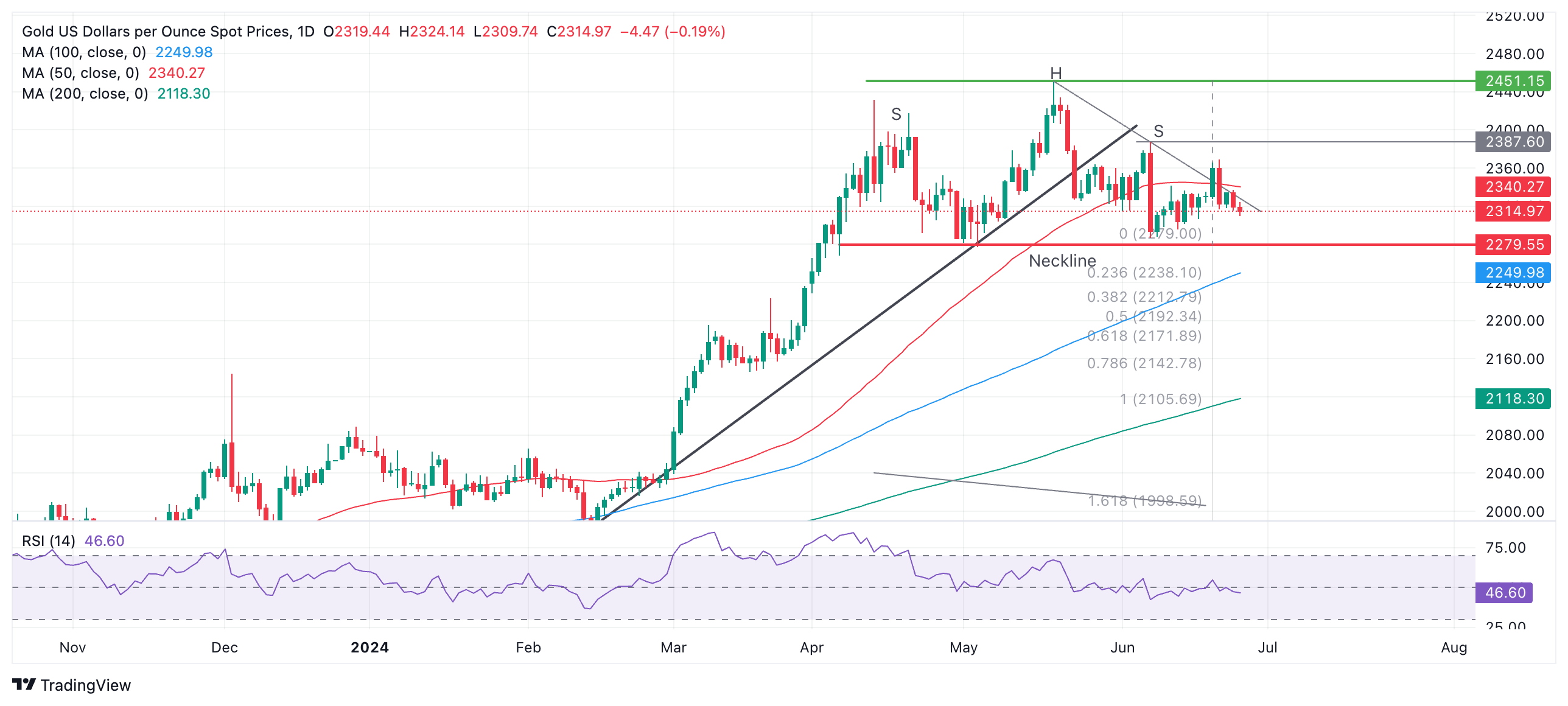
The XAU/USD pair has been forming a bearish Head-and-Shoulders (H&S) pattern over the last three months. However, the upside break on June 20 has brought the validity of the pattern into doubt. That said, a more complex topping pattern that might still prove bearish is still possible.
If so, then a break below the pattern’s neckline at $2,279 would provide confirmation of a reversal lower, with a conservative target at $2,171, and a second target at $2,105.
At the same time, it is also still possible that Gold could find its feet and continue higher. Gold’s original break above the trendline and the 50-day SMA was supposed to reach an initial, conservative target in the mid $2,380s (June 7 high), and it is still possible it could reach that target despite the fallback.
However, it would require a break above $2,350 to confirm a move up to the June 7 high. A further break above that might indicate a continuation up to the May – and all-time – high at $2,450.
A break above that would confirm a resumption of the broader uptrend.
There is a risk that the trend is now sideways in both the short and medium term. In the long term, Gold remains in an uptrend.
Economic Indicator
Personal Consumption Expenditures - Price Index (YoY)
The Personal Consumption Expenditures (PCE), released by the US Bureau of Economic Analysis on a monthly basis, measures the changes in the prices of goods and services purchased by consumers in the United States (US). The YoY reading compares prices in the reference month to a year earlier. Price changes may cause consumers to switch from buying one good to another and the PCE Deflator can account for such substitutions. This makes it the preferred measure of inflation for the Federal Reserve. Generally, a high reading is bullish for the US Dollar (USD), while a low reading is bearish.
Read more.Next release: Fri Jun 28, 2024 12:30
Frequency: Monthly
Consensus: 2.6%
Previous: 2.7%
Source: US Bureau of Economic Analysis
Author

Joaquin Monfort
FXStreet
Joaquin Monfort is a financial writer and analyst with over 10 years experience writing about financial markets and alt data. He holds a degree in Anthropology from London University and a Diploma in Technical analysis.