Gold price drops amid higher US yields awaiting next week's US inflation
- Gold trades steadily above $2,300, minor shift despite rising US Treasury yields and strong USD.
- Focus on upcoming US data: unemployment claims, University of Michigan Consumer Sentiment, Fed speeches.
- China's central bank boosts Gold reserves for 18th consecutive month, reflecting continued demand amid global economic uncertainty.

Gold price hovers around familiar levels on Wednesday during the North American session amid rising US Treasury yields and a strong US dollar. The economic docket in the United States remains scarce, with traders awaiting unemployment claims on Thursday, followed by the University of Michigan (UoM) Consumer Sentiment survey on Friday.
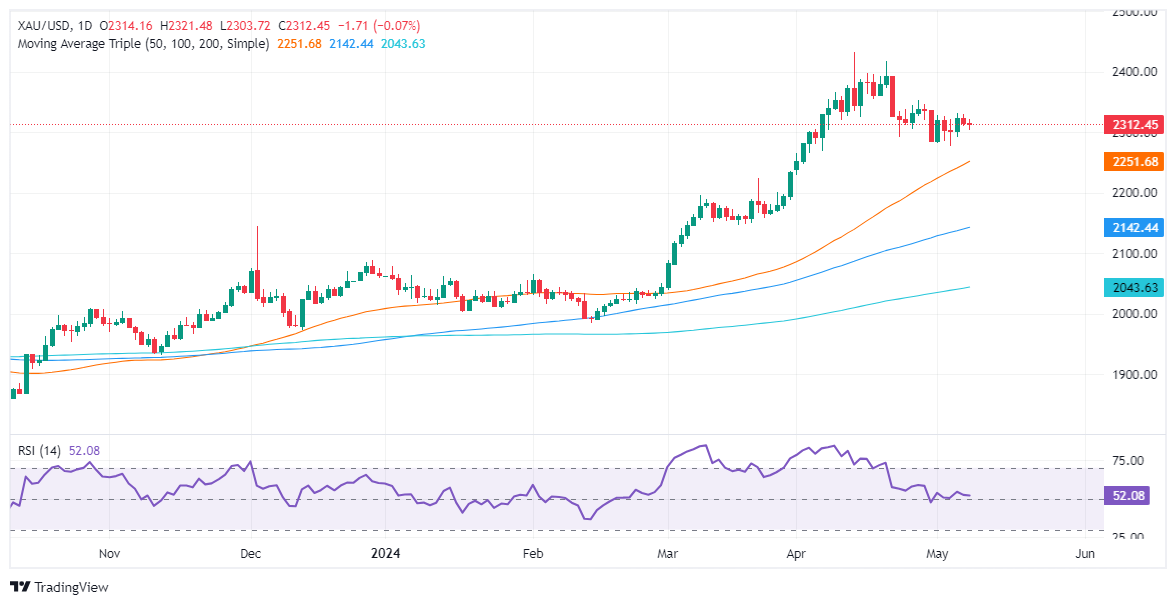
The XAU/USD trades at $2,312, down a minimal 0.02% and virtually unchanged. During the week, market players remained laser-focused on speeches by Federal Reserve (Fed) officials amid growing speculation that the US central bank would lower interest rates. Lower interest rates usually benefit the golden metal, which remains trading above the $2,300 threshold.
Boston Fed President Susan Collins said she expects demand to slow down to bring inflation to 2%, adding that there are risks of cutting rates “too soon.” She said that the current policy is well-positioned and that it is “moderately restrictive.”
The latest US employment report was softer than expected, reigniting fears that the economy would be weighed down and spur faster-than-expected rate cuts. This followed last Wednesday’s Fed decision to hold rates, in which the Fed acknowledged that the dual mandate risks had become more balanced.
Meanwhile, physical demand continues as reports emerged that China’s central bank continued to stock up its Gold inventories, adding 1.9 metric tonnes for 18 straight months of expanding its reserves.
Daily digest market movers: Gold price tumbles below $2,320 as US yields climb
- Gold prices fell amid lower US Treasury yields and a strong US Dollar. The US 10-year Treasury note is yielding 4.49%, up seven basis points (bps) from its opening level. The US Dollar Index (DXY), which tracks the Greenback's performance against six other currencies, is up 0.16% to 105.55.
- Last Friday, April's US NFP missed estimates and trailed March's figures. The Institute for Supply Management (ISM) PMIs in the manufacturing and services sectors entering contractionary territory might undermine the US Dollar, a tailwind for the golden metal.
- Nevertheless, recent hawkish comments by Minneapolis Fed President Neel Kashkari, who said that the Fed might stay put on interest rates and opened the door to raising the fed funds rate if inflation doesn’t resume its downtrend, bolstered the Greenback.
- Gold has advanced more than 12% so far in 2024, courtesy of expectations that major central banks will begin to reduce rates. Renewed fears that the Middle East conflict could resume between Israel and Hamas can sponsor a leg up in XAU/USD prices.
- According to Reuters, the People’s Bank of China (PBoC) continued to accumulate Gold for the 18th straight month, adding 60,000 troy ounces to its reserves amid higher prices.
- Following the US NFP data release, the CME FedWatch Tool shows that odds for a quarter-percentage-point cut in September increased from 55% before the report to 85%.
- After the data release, Fed rate cut probabilities increased with traders expecting 36 basis points of rate cuts toward the end of the year.
Technical analysis: Gold price stays bullish despite slumping below $2,320
Gold is upwardly biased despite registering modest losses. Momentum still favors buyers as the Relative Strength Index (RSI) remains in bullish territory. That would benefit Gold buyers who could “buy the dip.”
XAU/USD buyers need to clear the April 26 high, the latest cycle high at $2,352, if they want to remain hopeful of challenging all-time highs. A breach of the latter will expose the $2,400 figure, followed by the April 19 high at $2,417 and the all-time high of $2,431.
Conversely, further losses are seen if Gold slides beneath the $2,300 mark. The next support would be the 50-day Simple Moving Average (SMA) at $2,249.
Gold FAQs
Gold has played a key role in human’s history as it has been widely used as a store of value and medium of exchange. Currently, apart from its shine and usage for jewelry, the precious metal is widely seen as a safe-haven asset, meaning that it is considered a good investment during turbulent times. Gold is also widely seen as a hedge against inflation and against depreciating currencies as it doesn’t rely on any specific issuer or government.
Central banks are the biggest Gold holders. In their aim to support their currencies in turbulent times, central banks tend to diversify their reserves and buy Gold to improve the perceived strength of the economy and the currency. High Gold reserves can be a source of trust for a country’s solvency. Central banks added 1,136 tonnes of Gold worth around $70 billion to their reserves in 2022, according to data from the World Gold Council. This is the highest yearly purchase since records began. Central banks from emerging economies such as China, India and Turkey are quickly increasing their Gold reserves.
Gold has an inverse correlation with the US Dollar and US Treasuries, which are both major reserve and safe-haven assets. When the Dollar depreciates, Gold tends to rise, enabling investors and central banks to diversify their assets in turbulent times. Gold is also inversely correlated with risk assets. A rally in the stock market tends to weaken Gold price, while sell-offs in riskier markets tend to favor the precious metal.
The price can move due to a wide range of factors. Geopolitical instability or fears of a deep recession can quickly make Gold price escalate due to its safe-haven status. As a yield-less asset, Gold tends to rise with lower interest rates, while higher cost of money usually weighs down on the yellow metal. Still, most moves depend on how the US Dollar (USD) behaves as the asset is priced in dollars (XAU/USD). A strong Dollar tends to keep the price of Gold controlled, whereas a weaker Dollar is likely to push Gold prices up.
Author

Christian Borjon Valencia
FXStreet
Markets analyst, news editor, and trading instructor with over 14 years of experience across FX, commodities, US equity indices, and global macro markets.