Gold reverses gains after release of higher-than-expected US PMI data
- Gold pares earlier gains on Friday following the release of higher-than-expected US PMI data.
- The data showed US Manufacturing and Services activity remaining strong, suggesting inflation and interest rates will remain higher for longer.
- XAU/USD’s break above key resistance invalidates the bearish Head-and-Shoulders pattern that formed on the daily chart.
Gold (XAU/USD) has reversed earlier gains and broken back below its 50-day Simple Moving Average (SMA) on an intraday basis after the release of US Purchasing Manager Indices (PMI) data from S&P Global showed activity levels remained robust in both sectors in June.
Gold sells off after the release of US PMI data which showed the flash S&P Global Manufacturing PMI rising to 51.7 in June from 51.3 in May, whilst Services PMI rose to 55.1 from 48.3 previously. Both results were higher than analysts expected.
The data results in Gold dropping off a cliff to trade in the $2,330s on Friday. Higher PMIs indicate inflation will probably remain elevated, resulting in the US Federal Reserve (Fed) having to delay the time when it will be able to cut interest rates – a key determinant of Gold price. Lower interest rates are positive for the yellow metal as they reduce the opportunity cost of holding Gold, which is non-coupon paying, compared to other assets like bonds. Thus any delay in interest-rate cuts weighs on Gold.
Gold supported by central-bank buying
Gold looks like it will continue benefiting from another factor influencing its price, central bank buying, according to a survey of international central bank reserve managers conducted by the World Gold Council (WGC). The survey’s findings found that 81% of respondents thought central banks would increase their holdings in 2024 – the highest percentage since the survey began in 2019.
A large share of the central-bank buying has been by Asian central banks hoarding Gold as a hedge against a strengthening US Dollar. With the Fed dialing back expectations of interest-rate cuts from three to one in 2024, according to the latest Fed dot-plot, the year has seen many Asian currencies depreciate significantly versus the Greenback.
The trend of using Gold as a buffer against the strength of the US Dollar has been magnified by the increasingly partisan division of world trade between BRICS nations and the West. A major policy plank of the BRICS and their allies is to break the dominance of the US Dollar so that it cannot be used as a weapon against their members (which include Russia and now Iran) in sanctions. One of the few realistic replacements to the Dollar would be conducting trade in Gold-denominated financial assets.
The split between the BRICS and the West, moreover, has been accelerated by Russia’s invasion of Ukraine and Israel’s war against Hammas, which has divided the world along ideological and political lines. Given these conflicts are not set to end any time soon, they are likely to continue providing a backdraught of demand for Gold, both as a potential medium of exchange and a safe-haven.
Technical Analysis: Gold break higher invalidates Head-and-Shoulders pattern
Gold decisively breaks above a key resistance level at the 50-day Simple Moving Average (SMA) and a trendline connecting the May 7 and June 20 highs.
The break is critical as it invalidates the bearish Head-and-Shoulders (H&S) pattern that had been forming on the daily chart.
XAU/USD Daily Chart
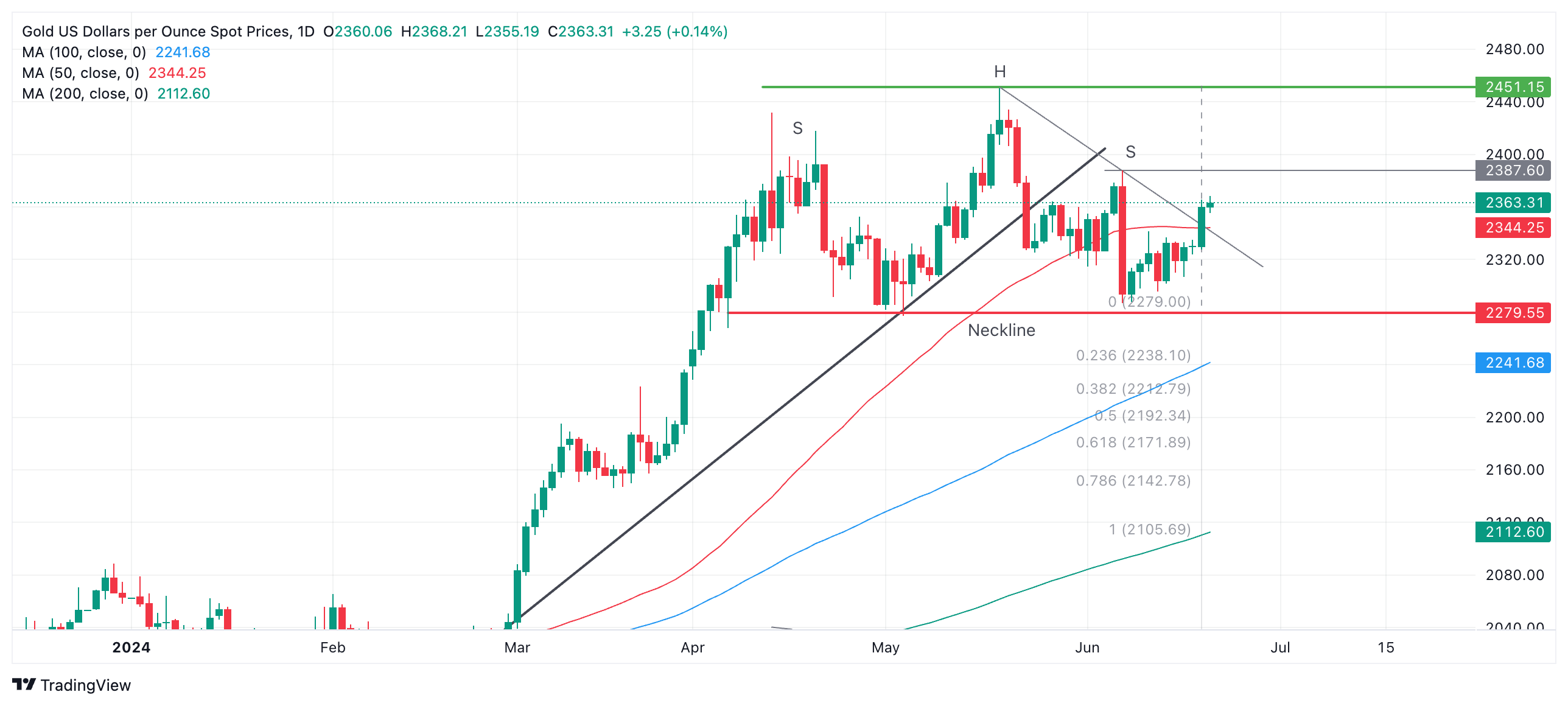
Gold’s follow-through higher after the break is likely to reach an initial target in the mid $2,380s (June 7 high).
A break above the June 7 high would indicate a probable continuation up to the May – and all-time – high at $2,450.
A break above that would confirm a resumption of the broader uptrend.
Interest rates FAQs
Interest rates are charged by financial institutions on loans to borrowers and are paid as interest to savers and depositors. They are influenced by base lending rates, which are set by central banks in response to changes in the economy. Central banks normally have a mandate to ensure price stability, which in most cases means targeting a core inflation rate of around 2%. If inflation falls below target the central bank may cut base lending rates, with a view to stimulating lending and boosting the economy. If inflation rises substantially above 2% it normally results in the central bank raising base lending rates in an attempt to lower inflation.
Higher interest rates generally help strengthen a country’s currency as they make it a more attractive place for global investors to park their money.
Higher interest rates overall weigh on the price of Gold because they increase the opportunity cost of holding Gold instead of investing in an interest-bearing asset or placing cash in the bank. If interest rates are high that usually pushes up the price of the US Dollar (USD), and since Gold is priced in Dollars, this has the effect of lowering the price of Gold.
The Fed funds rate is the overnight rate at which US banks lend to each other. It is the oft-quoted headline rate set by the Federal Reserve at its FOMC meetings. It is set as a range, for example 4.75%-5.00%, though the upper limit (in that case 5.00%) is the quoted figure. Market expectations for future Fed funds rate are tracked by the CME FedWatch tool, which shapes how many financial markets behave in anticipation of future Federal Reserve monetary policy decisions.
Author

Joaquin Monfort
FXStreet
Joaquin Monfort is a financial writer and analyst with over 10 years experience writing about financial markets and alt data. He holds a degree in Anthropology from London University and a Diploma in Technical analysis.















