Gold rallies after US Unemployment Rate unexpectedly rises to 4.1%
- Gold extends its positive run as the probability of the Federal Reserve lowering interest rates increases.
- A run of weak data from the US indicates inflationary pressures are waning, and interest rates could fall.
- Friday's Nonfarm Payrolls report showed mixed outcomes but investors were spooked by the unexpected rise in the Unemployment Rate.
- The US Dollar weakens, adding a backwind to Gold, as counterparts in Europe strengthen on diminishing political risk.

Gold (XAU/USD) rises on Friday, continuing its run of positive days as investors become increasingly optimistic the Federal Reserve (Fed) will lower interest rates sooner than previously thought, and the US Dollar (USD) softens, adding a lift to Gold which is predominantly bought and sold in Dollars.
The release of the US Nonfarm Payrolls (NFP) report on Friday adds further fuel to Gold's rally after the Unemployment Rate showed a rise to 4.1% from 4.0% previously – reaching levels it has not been at since the end of the Covid crisis in November 2021. Economists had not expected the result and it indicates a cooling labor market that could make it even more likely the Fed will cut interest rates in order to stimulate hiring.
Other data from the NFP report was not so negative: Headline Nonfarm Payrolls showed 206K new employees joined the workforce in June when only 190K had been expected from 272K previously.
Average Hourly Earnings, meanwhile, a metric that can influence inflationary pressures and the Fed's policy on interest rates remained unchanged on a monhtly basis, showing 0.3% growth as expected. On a year-over-year basis wage inflation cooled to 3.9% from 4.1% previously as expected, according to data from the US Bureau of Labor Statistics.
Gold rallies as interest rates expected to fall, USD weakens
Gold trades in the $2,360s on Friday, up by more than a third of a percent on the day, as bets increase that the Fed will begin cutting interest rates as soon as its meeting in September.
A string of sub-par data releases from the US has dented confidence in the economy and increased speculation the Fed will move to lower interest rates in an attempt to spur growth. Weak labor market and services sector data has particularly impacted expectations.
The probability of the Fed cutting its principal policy rate, the Fed Funds rate, by 0.25% by September has increased from the mid-60s at the start of the week to 72% on Friday, according to the CME FedWatch tool, which uses the price of the 30-day Fed Funds futures in its calculations. The promise of lower interest rates, in turn, increases Gold’s attractiveness as an investment because it lowers the opportunity cost of holding a non-interest-paying asset.
Gold gets a further backwind from a weaker US Dollar, which is falling because the expectation of lower US interest reduces foreign capital inflows, as well as because of a strengthening of its major counterparts. The Pound Sterling (GBP) is edging higher on Friday after a Labour Party landslide victory in the July 4 general election brings the promise of growth and stability. The Euro (EUR) is recovering on reduced political risk as it becomes increasingly clear the French far-right National Rally party will now probably not achieve a majority in the second round of elections on Sunday.
Gold gains on broader global backdrop
Gold is probably also benefiting from generalized demand as a result of broader geopolitical and macro factors.
The ongoing conflicts in the Middle East and Ukraine, as well as the increased risk of a Trump presidency, are still factors driving nervous investors to store their wealth in Gold.
The expansion of the BRICS trading bloc and its expressed aim to de-dollarize global trade has also increased demand for Gold, which is viewed as the most realistic replacement for countries denied access to Dollar-denominated markets because of sanctions.
Set against this, however, is falling political risk in Europe, which, despite a notable swing to the far right, is likely to remain in the hands of moderate coalitions.
High central bank demand, which accounts for roughly a quarter of the Gold market, might also be easing. Much buying was driven by Asian central banks using Gold as a hedge to support their domestic currencies as they depreciated against the US Dollar when it rallied in the spring, after the Fed had to revise its expectations for policy normalization.
Technical Analysis: Gold reaches resistance
Gold has now established itself comfortably above the 50-day Simple Moving Average (SMA), overcoming a major technical milestone for the yellow metal.
It has, however, reached a resistance level at swing high of the $2,368 June 21 high. A break above this level would add further confidence to a bullish view.
XAU/USD Daily Chart
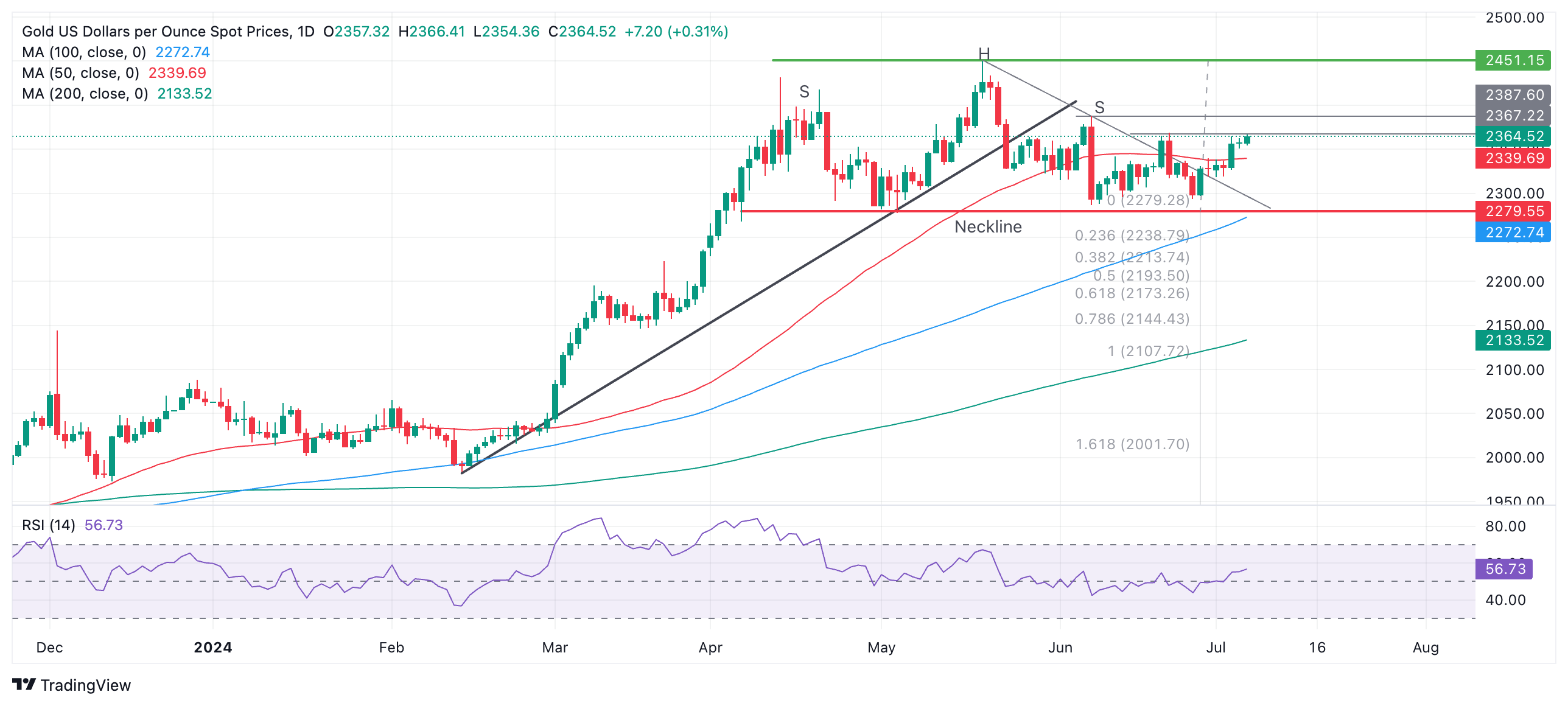
A break above the June 21 high would unlock the next target at $2,388, the June 7 high, followed by the $2,451 all-time-high.
The bearish Head & Shoulders topping pattern that was forming between April and June has been invalidated by the recent recovery, however, that said, there is still a lesser chance that a more complex topping pattern is forming instead. If so – and price suddenly falls to the pattern’s neckline at $2,279 and breaks through it – a reversal lower may still follow, with a conservative target at $2,171, the 0.618 ratio of the height of the pattern extrapolated lower.
The trend is now sideways in both the short and medium term. In the long term, Gold remains in an uptrend.
Economic Indicator
Unemployment Rate
The Unemployment Rate, released by the US Bureau of Labor Statistics (BLS), is the percentage of the total civilian labor force that is not in paid employment but is actively seeking employment. The rate is usually higher in recessionary economies compared to economies that are growing. Generally, a decrease in the Unemployment Rate is seen as bullish for the US Dollar (USD), while an increase is seen as bearish. That said, the number by itself usually can't determine the direction of the next market move, as this will also depend on the headline Nonfarm Payroll reading, and the other data in the BLS report.
Read more.Author

Joaquin Monfort
FXStreet
Joaquin Monfort is a financial writer and analyst with over 10 years experience writing about financial markets and alt data. He holds a degree in Anthropology from London University and a Diploma in Technical analysis.