GBP/USD stays firm amid BoE, Fed commentary and US data
- GBP/USD remains flat, influenced by BoE's Megan Greene remarks and multiple Fed officials emphasizing rate patience.
- US economic updates reveal a decrease in Jobless Claims and a surge in the Philadelphia Fed Index but a drop in home sales.
- Shift in rate cut expectations for the Fed impacts currency strength, with only two cuts now anticipated in 2024.

The Pound Sterling is virtually unchanged against the US Dollar in the mid-North American session, amid a scarce economic docket in the United Kingdom (UK) if not interrupted by Bank of England (BoE) member Megan Greene. A slew of Federal Reserve officials keep pounding the mantra of patience when easing rates. The GBP/USD trades at 1.2456, almost flat.
BoE and Fed officials impact Sterling as US data shows mixed signals
Major central bank policymakers are grabbing the headlines, leaving economic data in the background. Therefore, Fed and BoE speakers are driving GBP/USD price action.
Recently, Atlanta’s Fed President Raphael Bostic said inflation is too high, that the US central bank still has a way to go on inflation, and that they won’t be able to reduce rates. Earlier, the New York Fed President John Williams said the Fed is data dependent and emphasized that monetary policy is in a good place, so he isn’t in a rush to cut rates. His baseline doesn’t consider hiking rates but added that the Fed will hike if needed.
On the BoE’s front, Megan Greene commented that inflation data is too high for the institution to consider cutting the Bank Rate. Greene blamed inflation in wages and services as not being “consistent with a sustainable 2% (consumer price) inflation target.”
Elsewhere, the US Department of Labor revealed that for the week ending April 13, US Initial Jobless Claims fell to 212K, below the predicted 215K. Continuing Jobless Claims for the week of April 6 slightly rose to 1.812 million from 1.810 million but were still below the expected 1.818 million.
Other featured data included the Philadelphia Fed Manufacturing Index, which experienced a significant increase, jumping to 15.5, far surpassing the modest expectation of 1.5. In the housing market, US Existing Home Sales declined by 4.3% month-over-month, falling from 4.38 million to 4.19 million, which was also below the anticipated 4.2 million.
Given the fundamental backdrop, traders expect just two rate cuts by the Fed instead of the six projected at the beginning of 2024. That has witnessed flows to the Greenback, which has been up nearly 4.50% so far this year. Hence, if the BoE cuts before the Fed, the GBP/USD pair could be driven lower.
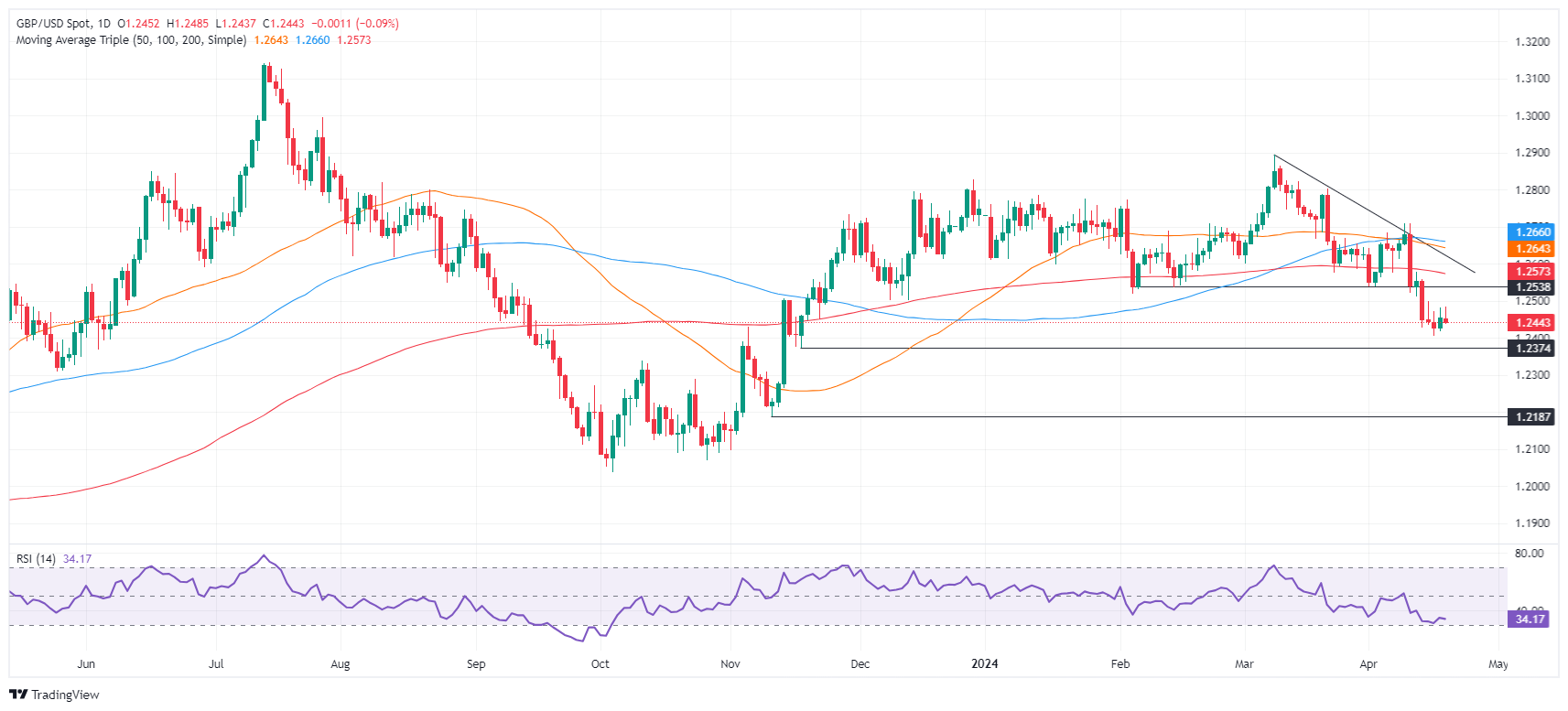
GBP/USD Price Analysis: Technical outlook
The GBP/USD daily chart shifted bearishly once the pair dived below the November 22, 2023, swing low of 1.2448, which exposed the 1.2400 mark. Although buyers had achieved to recover some ground, the latest four candles in the daily chart show that buying pressure is building near the 1.2480/90 area. If the pair dives below 1.2400, further losses remain. The next key support level would be the November 17 daily low at 1.2374, followed by the November 10 low at 1.2187.
On the flip side, if buyers reclaim 1.2500, look for a recovery, but they must conquer the 200-day moving average (DMA) at 1.2575.
Pound Sterling FAQs
The Pound Sterling (GBP) is the oldest currency in the world (886 AD) and the official currency of the United Kingdom. It is the fourth most traded unit for foreign exchange (FX) in the world, accounting for 12% of all transactions, averaging $630 billion a day, according to 2022 data. Its key trading pairs are GBP/USD, aka ‘Cable’, which accounts for 11% of FX, GBP/JPY, or the ‘Dragon’ as it is known by traders (3%), and EUR/GBP (2%). The Pound Sterling is issued by the Bank of England (BoE).
The single most important factor influencing the value of the Pound Sterling is monetary policy decided by the Bank of England. The BoE bases its decisions on whether it has achieved its primary goal of “price stability” – a steady inflation rate of around 2%. Its primary tool for achieving this is the adjustment of interest rates. When inflation is too high, the BoE will try to rein it in by raising interest rates, making it more expensive for people and businesses to access credit. This is generally positive for GBP, as higher interest rates make the UK a more attractive place for global investors to park their money. When inflation falls too low it is a sign economic growth is slowing. In this scenario, the BoE will consider lowering interest rates to cheapen credit so businesses will borrow more to invest in growth-generating projects.
Data releases gauge the health of the economy and can impact the value of the Pound Sterling. Indicators such as GDP, Manufacturing and Services PMIs, and employment can all influence the direction of the GBP. A strong economy is good for Sterling. Not only does it attract more foreign investment but it may encourage the BoE to put up interest rates, which will directly strengthen GBP. Otherwise, if economic data is weak, the Pound Sterling is likely to fall.
Another significant data release for the Pound Sterling is the Trade Balance. This indicator measures the difference between what a country earns from its exports and what it spends on imports over a given period. If a country produces highly sought-after exports, its currency will benefit purely from the extra demand created from foreign buyers seeking to purchase these goods. Therefore, a positive net Trade Balance strengthens a currency and vice versa for a negative balance.
Author
Christian Borjon Valencia
FXStreet
Markets analyst, news editor, and trading instructor with over 14 years of experience across FX, commodities, US equity indices, and global macro markets.