GBP/USD scours fresh highs on Greenback weakness
- GBP/USD lurched into a fresh 29-month peak as the US Dollar recedes.
- Markets continue to tilt into a risk-on stance as Fed rate cut hopes continue.
- UK economic data releases remain thin this week, US PCE inflation looms on Friday.

GBP/USD tested into a fresh multi-year high on Tuesday, easing into a 29-month peak of 1.3266 as the Pound Sterling continues to catch a ride on a broad-market Greenback sell wave. Investors have piled into hopes for a September rate cut from the Federal Reserve (Fed), and US Personal Consumption Expenditure Price Index (PCE) inflation figures not due until Friday leave markets with little meaningful data to chew on until then.
Fed Chair Jerome Powell all but confirmed that the central bank will pivot into a rate-cutting cycle on September 18 during an appearance at the Jackson Hole Economic Symposium last Friday, sending market appetite into the ceiling once again.
Coming up on Wednesday: consolidation session on the cards
Little of note is populating the economic calendar on the UK side, and Wednesday is shaping up to be a quiet session on both sides of the Atlantic. Fedspeak traders will have an eye out for a speech from Fed Board of Governors member Christopher Waller early in the US market session, while central bank watchers will be looking out for a speech from Bank of England (BoE) policymaker Catherine Mann, due after London markets close.
What happened on Tuesday
Mixed prints in US housing price data from June gave investors little to go on. The Federal Housing Finance Agency’s MoM Housing Price Index contracted -0.1% compared to May’s print of 0.0%. Markets expected a print of 0.2%. The S&P/Case-Shiller Home Price Indices, meanwhile, rose 6.5% YoY, less than the previous period’s revised 6.9%, but still more than the expected 6.0%.
Coming up: US GDP, PCE inflation data prints
US Q2 Gross Domestic Product (GDP) figures are slated to print on Thursday, and are expected to hold steady at 2.8% on an annualized basis. However, the key data print this week will be Friday’s US Personal Consumption Expenditure (PCE) Price Index inflation reading for July, which is expected to tick higher YoY to 2.7% from 2.6% and hold flat at 0.2% MoM. Market participants absolutely giddy over hopes for rate cuts will be looking for inflation data to come in below expectations, while an above-forecast print could send fresh jitters through investor risk appetite.
Forex Today: Lack of enthusiasm points to some consolidation
GBP/USD price forecast
Cable’s early-week pullback is already over, with bids tipping once again into a fresh 29-month high. GBP/USD is now on pace to resume a near-term bullish trend that has dragged the pair up 4.75% bottom-to-top from early August’s swing low into 1.2665.
GBP/USD has closed in the green for all but two of the last 14 consecutive trading days, and technical barriers on the high side have drawn thin. Bidders should be cautious of an overbought snap back into the low side, but with price action trading well north of the 50-day Exponential Moving Average (EMA) at 1.2876, it would take a significant drop in value before signs of a bearish trend change even begin to form on the charts.
GBP/USD daily chart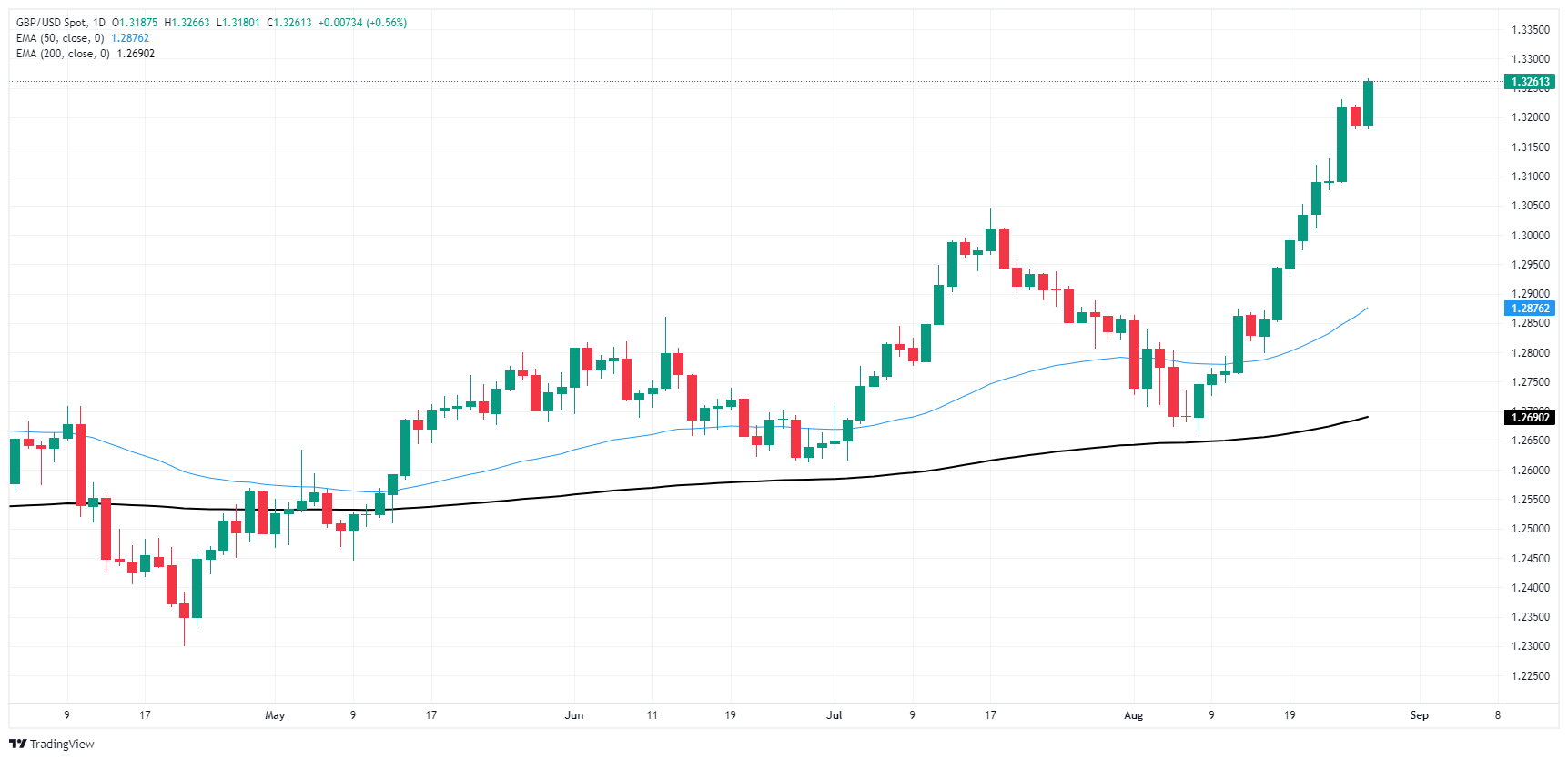
Pound Sterling FAQs
The Pound Sterling (GBP) is the oldest currency in the world (886 AD) and the official currency of the United Kingdom. It is the fourth most traded unit for foreign exchange (FX) in the world, accounting for 12% of all transactions, averaging $630 billion a day, according to 2022 data. Its key trading pairs are GBP/USD, aka ‘Cable’, which accounts for 11% of FX, GBP/JPY, or the ‘Dragon’ as it is known by traders (3%), and EUR/GBP (2%). The Pound Sterling is issued by the Bank of England (BoE).
The single most important factor influencing the value of the Pound Sterling is monetary policy decided by the Bank of England. The BoE bases its decisions on whether it has achieved its primary goal of “price stability” – a steady inflation rate of around 2%. Its primary tool for achieving this is the adjustment of interest rates. When inflation is too high, the BoE will try to rein it in by raising interest rates, making it more expensive for people and businesses to access credit. This is generally positive for GBP, as higher interest rates make the UK a more attractive place for global investors to park their money. When inflation falls too low it is a sign economic growth is slowing. In this scenario, the BoE will consider lowering interest rates to cheapen credit so businesses will borrow more to invest in growth-generating projects.
Data releases gauge the health of the economy and can impact the value of the Pound Sterling. Indicators such as GDP, Manufacturing and Services PMIs, and employment can all influence the direction of the GBP. A strong economy is good for Sterling. Not only does it attract more foreign investment but it may encourage the BoE to put up interest rates, which will directly strengthen GBP. Otherwise, if economic data is weak, the Pound Sterling is likely to fall.
Another significant data release for the Pound Sterling is the Trade Balance. This indicator measures the difference between what a country earns from its exports and what it spends on imports over a given period. If a country produces highly sought-after exports, its currency will benefit purely from the extra demand created from foreign buyers seeking to purchase these goods. Therefore, a positive net Trade Balance strengthens a currency and vice versa for a negative balance.
Author

Joshua Gibson
FXStreet
Joshua joins the FXStreet team as an Economics and Finance double major from Vancouver Island University with twelve years' experience as an independent trader focusing on technical analysis.