GBP/USD rebounds towards 1.2540 following US inflation data and BoE decision
- US PCE data showed softer inflation, reducing Fed's urgency for aggressive rate hikes.
- BoE held rates at 4.75%, with divisions on potential rate cuts in 2025.
- UK Retail Sales missed expectations, with weak demand in clothing.

The GBP/USD pair rebounded towards 1.2540 after the release of US inflation data and the Bank of England's (BoE) monetary policy decision on Thursday. While the pair benefited from softer-than-expected US Personal Consumption Expenditure (PCE) data, the BoE’s cautious stance on rate cuts and weaker UK Retail Sales data kept gains in check.
The US Personal Consumption Expenditure (PCE) data for November revealed softer inflationary pressures. The monthly Headline PCE came in at 0.1%, down from the previous 0.2%, while the yearly measure ticked up slightly to 2.4%, just above the prior 2.3% but below the 2.5% forecast. Meanwhile, the Core PCE monthly measure fell to 0.1% from 0.3%, undershooting the 0.2% estimate, while the yearly reading remained steady at 2.8%, lower than the expected 2.9%.
Following the data, the CME FedWatch Tool projects an 90% likelihood of the Federal Reserve maintaining its policy rate at the upcoming January 29, 2025 meeting, with a smaller 10% probability of a 25 basis point rate cut. Meanwhile, the US 10-year Treasury yield stands at 4.50%, down from its peak of 4.60% reached on Thursday.
In the UK, the BoE held its key borrowing rate unchanged at 4.75%, as widely anticipated. Despite accelerated inflation over the past three months, three policymakers voted for a rate cut, signaling divisions within the central bank. Governor Andrew Bailey emphasized the uncertainty surrounding future rate cuts, stating, “Due to heightened uncertainty in the economy, we can't commit to when or by how much we will cut rates in 2025.” Following the announcement, market participants priced in a 53 basis points (bps) reduction in the BoE’s interest rates for 2025.
On the economic data front, UK Retail Sales for November underwhelmed expectations. Monthly sales rose by 0.2%, below the 0.5% forecast, though recovering from a 0.7% decline in October. Year-over-year growth came in at 0.5%, falling short of the 0.8% projection and marking a significant drop from the previously reported 2%.
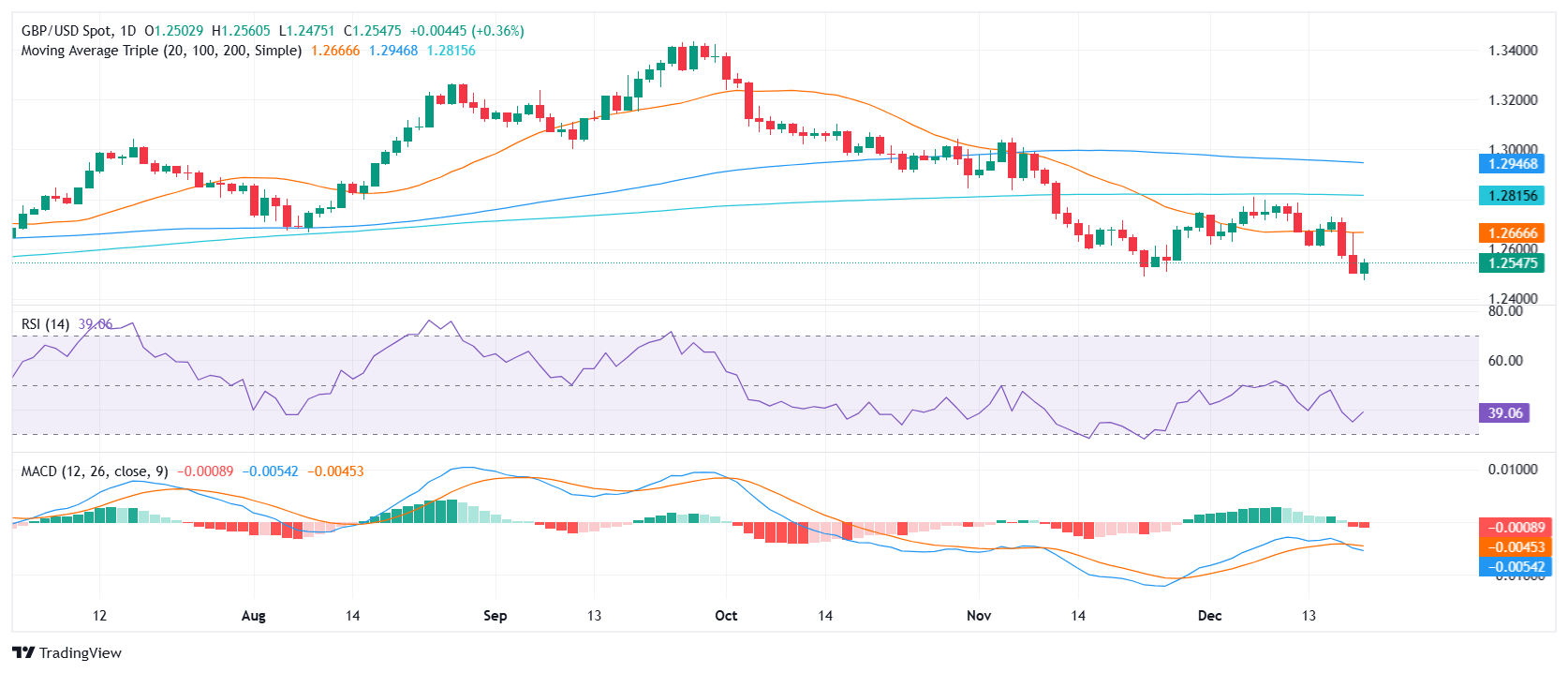
GBP/USD Technical overview
The GBP/USD pair recovered to 1.2540, but technical indicators remain in the negative area despite showing some improvement. The Relative Strength Index (RSI) has risen but continues to indicate bearish momentum, while the Moving Average Convergence Divergence (MACD) histogram remains below the zero line, reflecting sustained selling pressure. Immediate support lies at 1.2500, with a break below this level potentially exposing 1.2460. On the upside, resistance is seen at 1.2560, with a sustained move above this level needed to challenge the next key barrier at 1.2600.
Author

Patricio Martín
FXStreet
Patricio is an economist from Argentina passionate about global finance and understanding the daily movements of the markets.

















