GBP/NZD stabilizes after rising due to New Zealand’s economic woes
- GBP/NZD is consolidating after a strong rally on the previous day.
- Acutely diverging interest rate expectations in the two countries is expected to support the Pound and GBP/NZD.
- The RBNZ is expected to slash rates at Christmas, whilst the Bank of England is not expected to lower them at all.

GBP/NZD is trading back to where it opened, in the 2.1520s on Thursday, after rising over a third of a percent on the previous day. The pair is channeling modestly lower in what looks like a correction of the October rally.
GBP/NZD Daily Chart
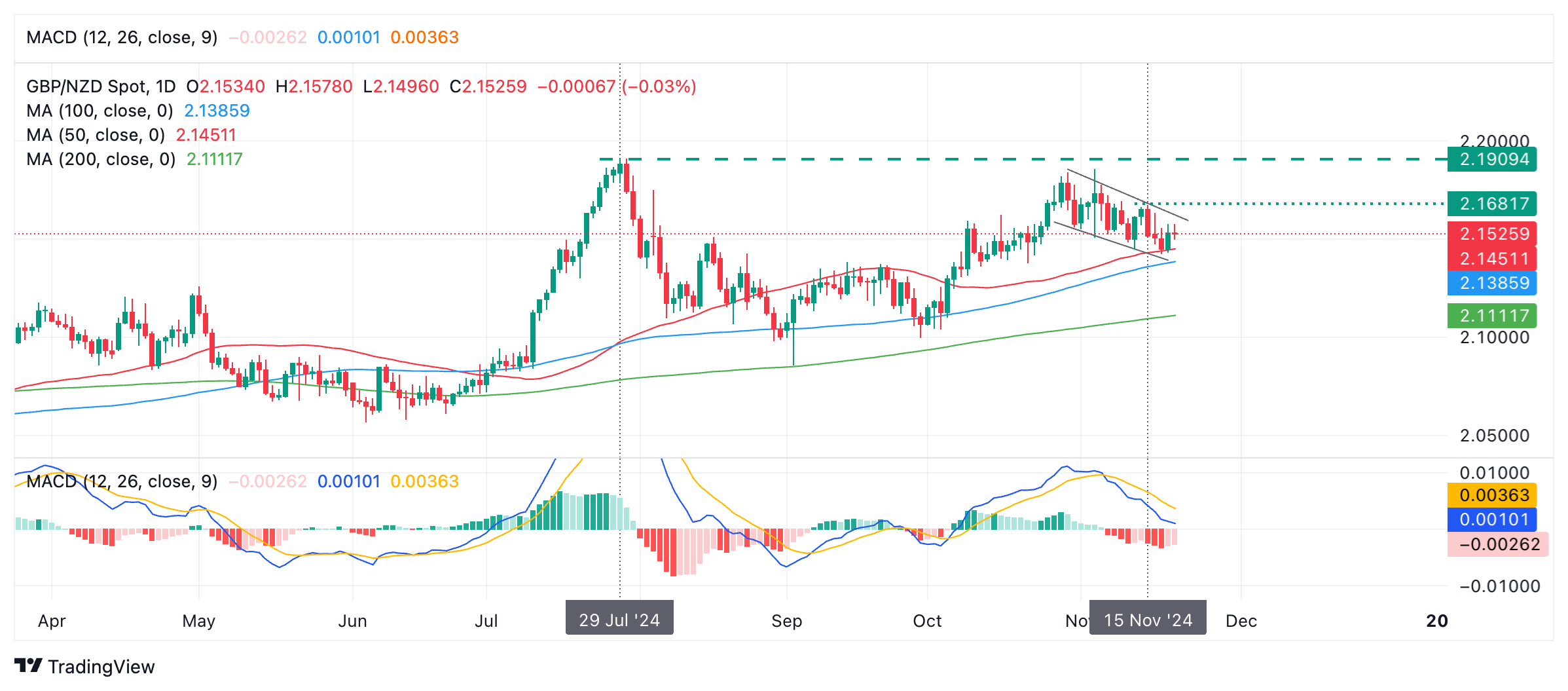
Widely diverging expectations of the trajectory of interest rates in the UK and New Zealand suggest the odds favor more upside for GBP/NZD. This is because in global capital markets the flow of money tends to go towards currencies with higher interest rates, all other things being equal.
Although both the central banks of the UK and New Zealand have set base interest rates at the same level of 4.75%, the Reserve Bank of New Zealand (RBNZ) is expected to reduce its interest rate more quickly than the Bank of England (BoE). Overall, this should benefit the Pound Sterling (GBP) and give GBP/NZD a lift.
The divergence in interest rate expectations is most acute when it comes to the two central bank’s policy meetings in December. The RBNZ is expected to slash its cash rate by a minimum of 50 basis points (bps) (0.50%) – possibly even 75 bps – whilst the Bank of England (BoE) is not expected to cut its bank rate at all. This could mean that at the end of 2024, the RBNZ will have an interest rate of 4.25% whilst BoE’s will still be at 4.75%. This ought to further support flows into Sterling.
The more negative economic outlook in New Zealand is the reason for economists expecting the RBNZ to cut its interest rates so aggressively in December. Lower interest rates tend to lead to more credit and, in theory, spending on growth creation activities.
“With the New Zealand economy in a tailspin and inflation well on its way to target, we expect the RBNZ to keep cutting rates by 50 bps at its next two meetings. We expect rates to fall to 2.25% by end-2025, far lower than most anticipate,” says Toh Au Yu, Assistant Economist at Capital Economics.
In the UK the outlook for the economy is not as bad, and recent UK headline inflation data beat expectations, suggesting even less chance of the BoE cutting interest rates in December.
“UK inflation surprised to the upside, but services (inflation), (which rose) back up to 5.0%, was in line with the BoE forecast. The forecast in the last inflation report is for CPI to increase from the 2% target in 3Q24…(..).. An 8-1 vote by the MPC for no change in December looks certain,” says Kenneth Broux, Senior Strategist at Societe Generale.
Author

Joaquin Monfort
FXStreet
Joaquin Monfort is a financial writer and analyst with over 10 years experience writing about financial markets and alt data. He holds a degree in Anthropology from London University and a Diploma in Technical analysis.