GBP/JPY halts plunge to bounce back above 203.00 on Thursday
- GBP/JPY pumped the brakes on a recent decline to give a meager bounce.
- UK labor data printed slightly better than expected, helped to bolster the Pound.
- Japanese National CPI inflation, UK Retail Sales in the barrel for Friday.

GBP/JPY recovered from a recent plunge on Thursday, bouncing back over the 203.00 handle. GBP bidding fell just short of reclaiming 204.00 through Thursday’s market session, and the Guppy is grinding out a recovery after suspected “Yenterventions” pushed the Yen higher across the board.
There has been no official confirmation from Japanese officials whether the Bank of Japan (BoJ) and Japan’s Ministry of Finance (MoF) directly intervened in global FX markets, but rapid, one-sided market flows and an extreme upswing in BoF financial operations reporting compared to market forecasts has tipped the BoJ’s hand. Defending the Yen is becoming an increasingly expensive project for the MoF.
UK Average Earnings printed exactly at expectations early Thursday, and UK Claimant Count Change figures in June printed at 32.3K MoM, less than the previous month’s revised 51.9K, but still higher than the forecast decline to 23.4K. UK Retail Sales are in the pipe for Friday, and median market forecasts expect the volume of retail spending to print a -0.4% decline versus the previous 2.9% surge.
Japanese National Consumer Price Index (CPI) inflation is due early Friday, with modelers expecting national-level CPI inflation to tick upwards to 2.7% YoY compared to the previous period’s 2.5%.However, national Japanese inflation figures tend to be front run by Tokyo CPI inflation released several weeks earlier, so impacts tend to be muted. Despite the forecast uptick, the figure is unlikely to be enough to force the BoJ out of its hyper easy monetary policy stance. With the Japanese Yen floundering at the bottom of a wide rate differential between all other major currencies, Yen weakness could be expected to continue.
GBP/JPY technical outlook
The Guppy hit a demand zone near 202.50 early Thursday, catching a bounce towards 204.00 as bidders find their footing and push GBP/JPY bids into a recovery mode. Intraday price action is still trading south of the 200-hour Exponential Moving Average (EMA) at 204.82, and 202.50 has been marked out as a line in the sand for continued short pressure.
Daily candles are holding above the 50-day EMA at 201.38, and despite suspected “Yenterventions”, the pair is still trading firmly into 16-year highs. Bids are trading well above the 200-day EMA at 192.18.
GBP/JPY hourly chart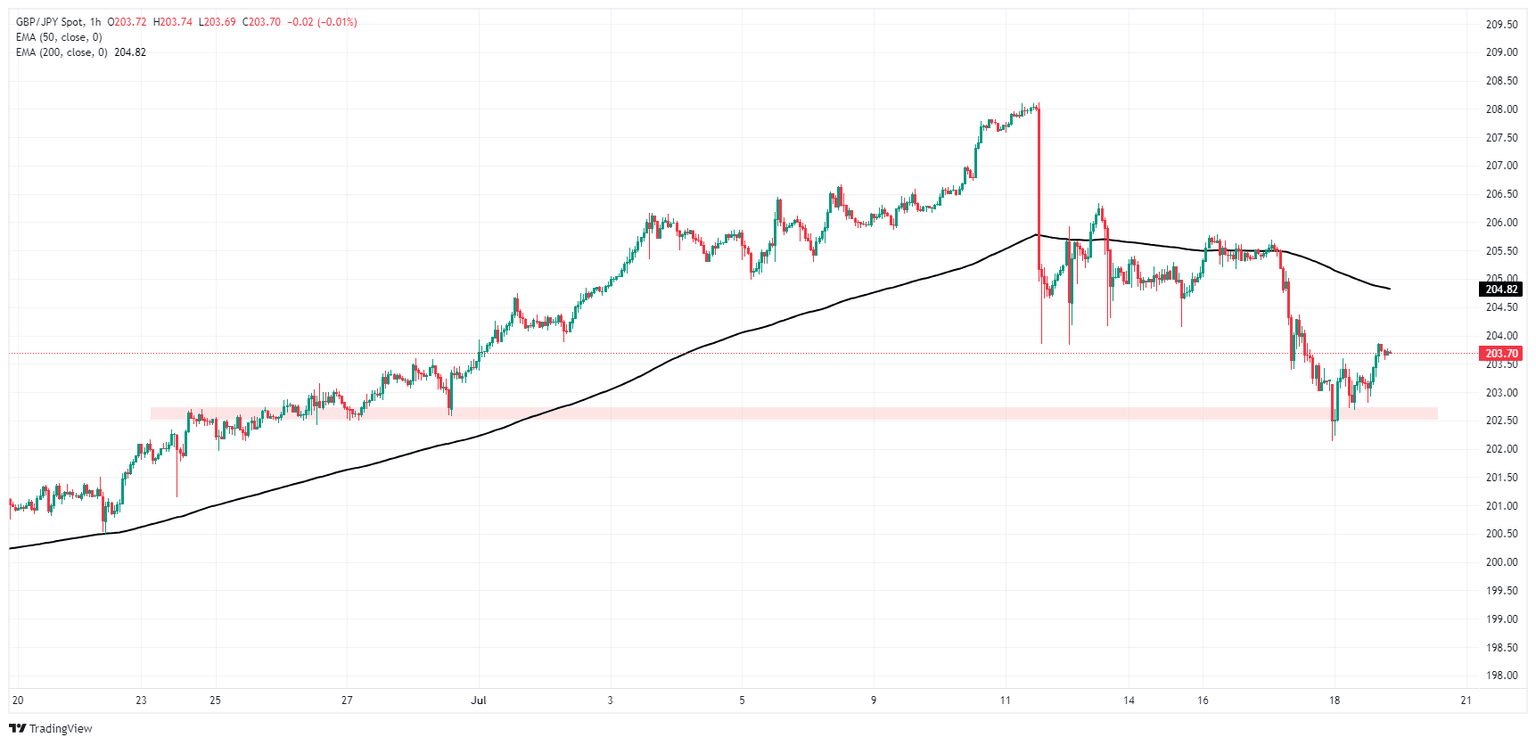
GBP/JPY daily chart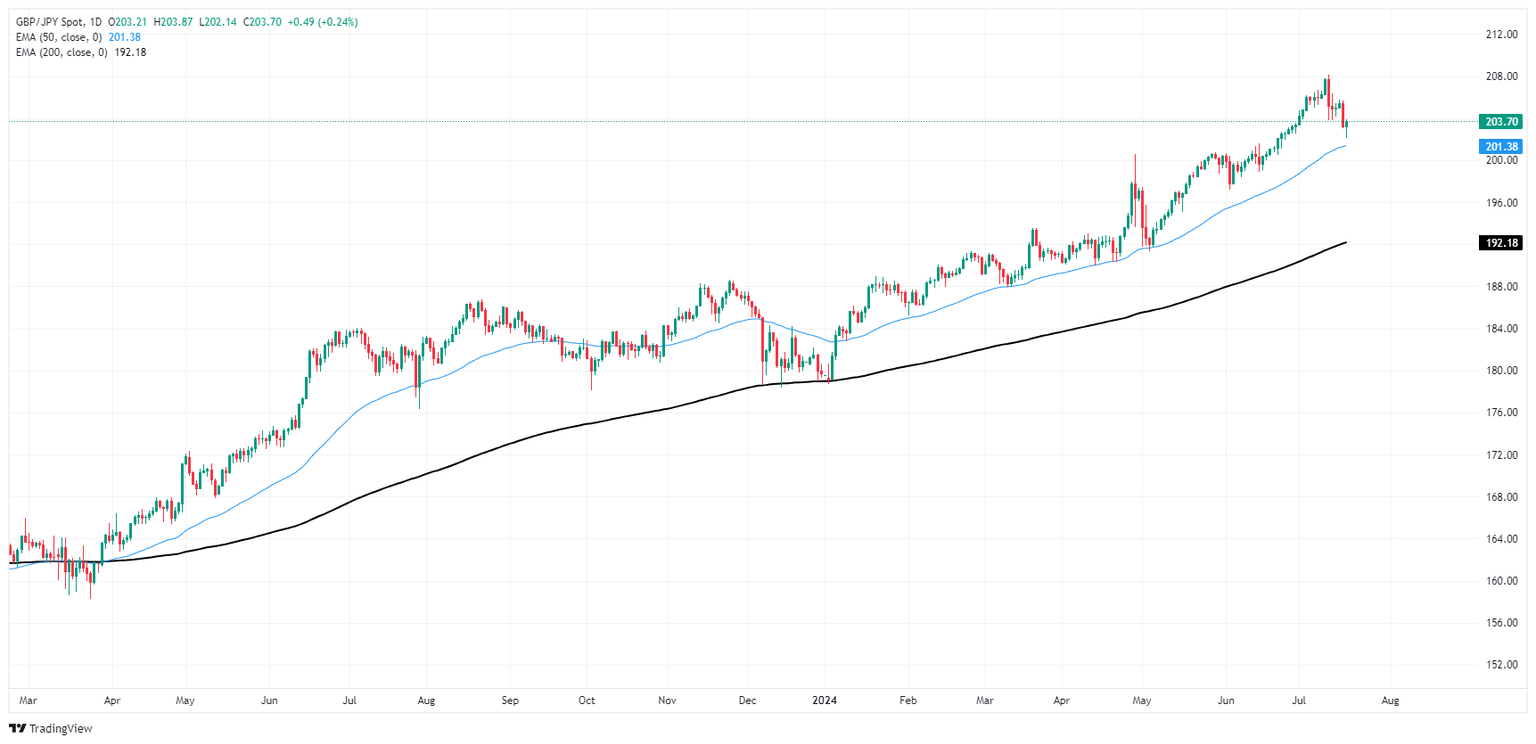
Pound Sterling FAQs
The Pound Sterling (GBP) is the oldest currency in the world (886 AD) and the official currency of the United Kingdom. It is the fourth most traded unit for foreign exchange (FX) in the world, accounting for 12% of all transactions, averaging $630 billion a day, according to 2022 data. Its key trading pairs are GBP/USD, aka ‘Cable’, which accounts for 11% of FX, GBP/JPY, or the ‘Dragon’ as it is known by traders (3%), and EUR/GBP (2%). The Pound Sterling is issued by the Bank of England (BoE).
The single most important factor influencing the value of the Pound Sterling is monetary policy decided by the Bank of England. The BoE bases its decisions on whether it has achieved its primary goal of “price stability” – a steady inflation rate of around 2%. Its primary tool for achieving this is the adjustment of interest rates. When inflation is too high, the BoE will try to rein it in by raising interest rates, making it more expensive for people and businesses to access credit. This is generally positive for GBP, as higher interest rates make the UK a more attractive place for global investors to park their money. When inflation falls too low it is a sign economic growth is slowing. In this scenario, the BoE will consider lowering interest rates to cheapen credit so businesses will borrow more to invest in growth-generating projects.
Data releases gauge the health of the economy and can impact the value of the Pound Sterling. Indicators such as GDP, Manufacturing and Services PMIs, and employment can all influence the direction of the GBP. A strong economy is good for Sterling. Not only does it attract more foreign investment but it may encourage the BoE to put up interest rates, which will directly strengthen GBP. Otherwise, if economic data is weak, the Pound Sterling is likely to fall.
Another significant data release for the Pound Sterling is the Trade Balance. This indicator measures the difference between what a country earns from its exports and what it spends on imports over a given period. If a country produces highly sought-after exports, its currency will benefit purely from the extra demand created from foreign buyers seeking to purchase these goods. Therefore, a positive net Trade Balance strengthens a currency and vice versa for a negative balance.
Author
Joshua Gibson
FXStreet
Joshua joins the FXStreet team as an Economics and Finance double major from Vancouver Island University with twelve years' experience as an independent trader focusing on technical analysis.