First Republic (FRC), Western Alliance (WAL) Stock News: NYSE halts trading in a number of bank stocks
- First Republic tanks 75% on Monday as bank stocks are sold off.
- Western Alliance Bank corporation loses 77% despite President Biden speech.
- US government lending facility not holding market faith.
- NYSE halts trading in dozens of financial stocks.

Despite the Federal Reserve, the United States Treasury Department and the Federal Deposit Insurance Corporation (FDIC) joining hands to develop lending facilities to halt bank runs from spreading, the New York Stock Exchange (NYSE) halted a number of bank stocks from trading on Monday. These include First Republic Bank (FRC) and Western Alliance Bankcorporation (WAL). Western Alliance stock was down 77% in the first half hour after the open, while First Republic stock tanked 75%.
The S&P 500 is off 0.7%, while the NASDAQ 100 actually rose 0.3% at the Monday open.
First Republic, Western Alliance stock news: Why is US government backstop not working?
A bank run started by Peter Thiel and other venture capital firms led to the demise of Silicon Valley Bank last week, and the FDIC came in to make depositors whole over the weekend. On Sunday the FDIC, the Fed and the Treasury announced new lending facilities. These include the Fed's Bank Term Funding Program (BTFP), which will offer loans up to a year in length. Additionally, the US Treasury said it will use $25 billion from the Exchange Stabilization Fund to reinforce the BTFP facility.
The BTFP should work since the facility will purchase Treasuries, mortgage-backed securities and agency debt at par rather than the current market rate. You may remember that Silicon Valley Bank's collapse came about because the bank was forced to sell long maturity bonds at a reduced market rate in order to meet customer deposit withdrawals. This caused the $1.8 billion loss that led to the run on the bank. If Silicon Valley Bank could have sold these securities at par, there would not have been any problem.
This policy from regulators has clearly not done the trick so far. Many financial institutions not thought to be in trouble, such as Regions Financial (RF), Bank of Hawaii (BOH) and The Charles Schwab Corporation (SCHW), all plummeted enough at the open to cause theNYSE to halt trading in these equities. Many of them were reopened to trading before lunch however.
First Republic Bank announced that it had worked with the Fed and JPMorgan (JPM) to gain $70 billion in liquidity over the weekend. That is a lot of cash on hand or waiting in the wings, but the market has remained distrustful. This might be due to First Republic being headquartered in San Francisco and sharing many of the same tech-related customers as Silicon Valley Bank. The primary cause of the latter's demise was that its many startup clients have been burning through their cash deposited at Silicon Valley since the beginning of the Fed's interest rate hiking cycle began last spring.
For its part, Western Alliance issued guidance on Friday that seemed to show it was weathering the storm gracefully. Of $61.5 billion in deposits, only $6.5 billion are technology-related. The bank has seen a greater than 10% increase in deposits since the end of 2022, which would appear to show that it is not facing the deposit exodus of Silicon Valley Bank. Western Alliance has $24.2 billion in liquidity and credit lines available to it and $5.3 billion in marketable securities, meaning half of its deposits are already easily backstopped.
FRC, WAC stock forecast
The daily, year-to-date graph below, shows First Republic stock underperforming all of its peers. FRC stock is down 79% year to date, while Western Alliance is off just shy of 59%. Of course, the vast majority of that pullback is just last Friday and Monday. JPMorgan stock is down just 2.3%, showing its reputation as the most trusted systemic bank in the market. Western Alliance stock is the most noteworthy as the stock rose more than 35% at the start of the year due to its solid earnings and deposit growth.
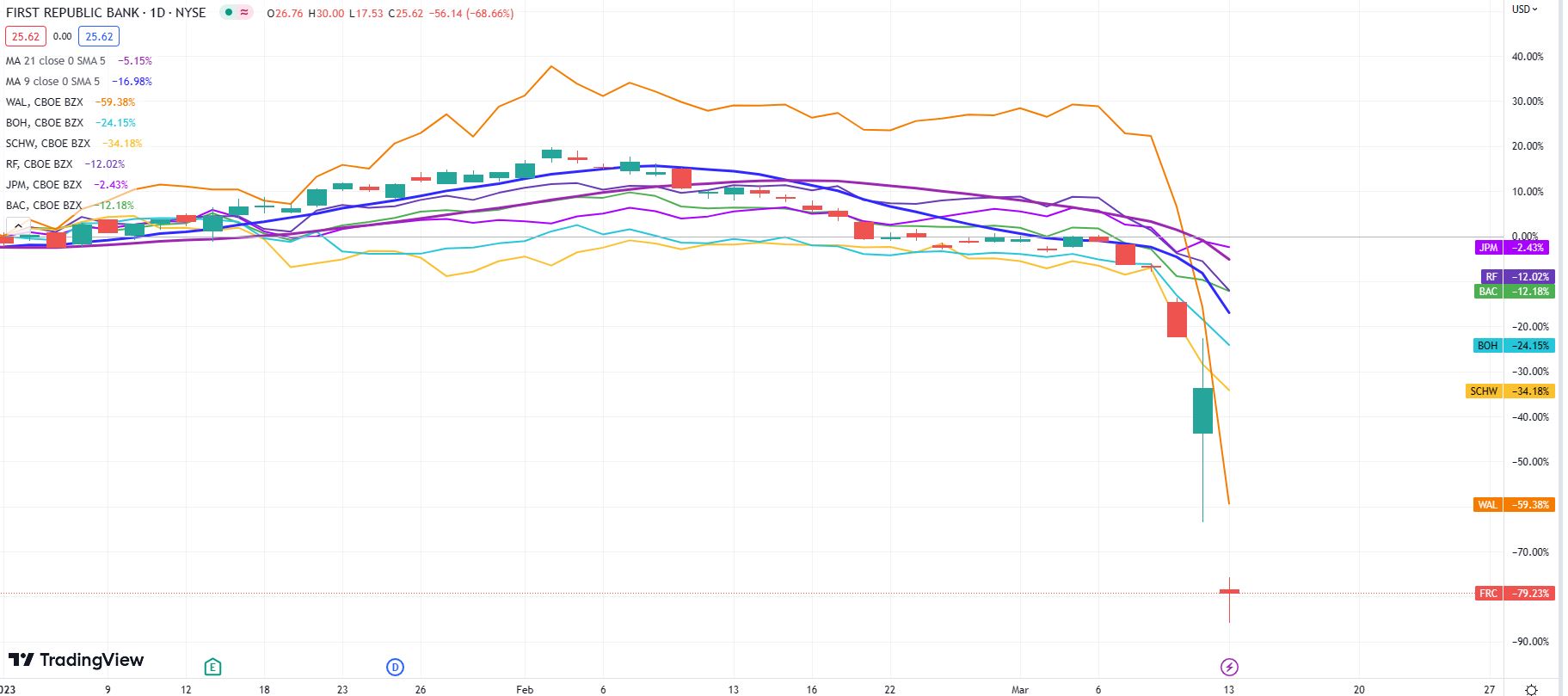
bank stocks daily YTD chart
Author

Clay Webster
FXStreet
Clay Webster grew up in the US outside Buffalo, New York and Lancaster, Pennsylvania. He began investing after college following the 2008 financial crisis.