|

Fed's Kashkari: Supply, demand shocks expected to be temporary

Minneapolis Federal Reserve Bank President Neel Kashkari is speaking at an Eau Claire Area Chamber of Commerce event and has said he believes the forces that are currently keeping people out of the labour market and pushing up prices will prove to be temporary.

He said the pressures will fade as COVID-19 turns from being pandemic to being endemic.

"We are getting mixed signals out of the economy," Kashkari said

"I'm optimistic, in the next three, six, nine months we will get a lot more information," and clarity about the outlook for both inflation and the labour market, he said.

Key comments

The next 3, 6, 9 months will be very important in getting more clarity on the economic outlook.

Right now there's a lot of uncertainty.

Whether it's a demand shock or a supply shock, either way, the story should be temporary.

Should reach equilibrium in the next few quarters.

The future outlook for inflation depends in part on what will happen with the labour supply.

Fed's Kashkari says he is ‘keeping an open mind’ on the monetary policy stance and has said that once the taper ends, the Fed would consider appropriate timing for rate hikes.

Market implications

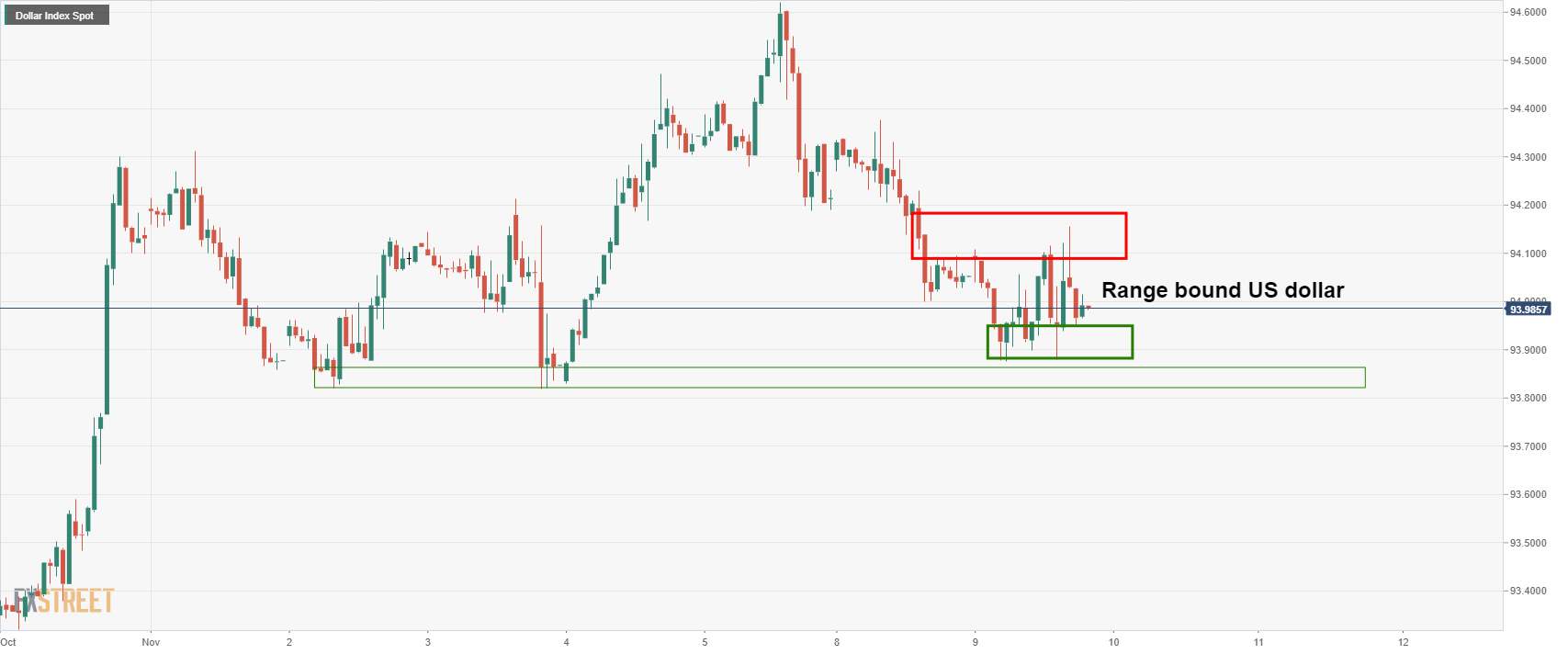
Forex markets are waiting for the US Consumer Price Index and hence the US dollar is consolidating, rather than reacting to each comment from central bankers on Tuesday. 

The US dollar has been moving in a tight range between 93.90 and 94.10 since data earlier the day showed that US Producer Prices had increased solidly in October.

Traders noted that while high inflation could persist for a while amid tight supply chains related to the pandemic,  tomorrow's key event in CPI will be more key in this regard.

US dollar hourly chart
Author

Ross J Burland

Ross J Burland, born in England, UK, is a sportsman at heart. He played Rugby and Judo for his county, Kent and the South East of England Rugby team.


More from Ross J Burland
Share:

Editor's Picks

USD/JPY bulls pause near 160.75 amid intervention risks

USD/JPY is consolidating below 160.75 in Thursday's Asian trading, with intervention fears lending support to the Japanese Yen and capping the pair's upside amid a modest US Dollar downtick. The signing of a US-Iran peace deal to end the war and reopen the Strait of Hormuz undermines the Greenback's reserve-currency status.

AUD/USD rebounds toward 0.7050 on US-Iran deal optimism

AUD/USD bounces back toward 0.7050 in the Asian session on Thursday as the US Dollar retreats from its highest level since late March, touched in reaction to the Fed's hawkish tilt the previous day. The US and Iran electronically signed a MoU aimed at ending the war and reopening the Strait of Hormuz, boosting investors' confidence and undermining the safe-haven USD.

Gold reclaims $4,300 as USD  cuts Fed-led gains amid US-Iran peace deal

Gold attracts fresh buyers and regains $4,300 in the Asian session on Thursday, reversing part of the previous day's hawkish Fed-inspired slump to a fresh weekly low. As traders price in the possibility of a Fed rate hike this year, the signing of a US-Iran peace deal – to end the war and reopen the Strait of Hormuz – drags the safe-haven US Dollar away from its highest level since late March, offering support to the bullion.

Binance founder CZ urges governments to tokenize stock markets and launch sovereign stablecoins

Binance founder Changpeng Zhao has called on governments to tokenize their stock markets and issue sovereign stablecoins, arguing that blockchain technology can expand access to capital markets and increase the global use of national currencies. In an X post on Wednesday, CZ said countries should "tokenize their stocks, allowing worldwide buyers."

A new era for the Fed
The Fed has shifted to a more hawkish stance at the first meeting chaired by Kevin Warsh. Although rates were left unchanged, there will be meaningful adjustments to how the Federal Reserve operates in the coming months and years. There are two main takeaways from today’s meeting, firstly what the Fed did, and secondly, what they are planning to do.
Why a hawkish RBA is no longer enough to lift the Australian Dollar

The Reserve Bank of Australia delivered more than what markets expected: a hawkish hold that should have supported the Aussie. But markets widely ignored it, focusing instead on slowing economic growth and proving that central bank messaging alone isn’t always enough to drive currencies.