EUR/USD touches 1.13 after Fed’s Powell signals ready to cut rates
- EUR/USD tipped into 1.1300 for the first time in over a year on Friday.
- Fed policymakers open the door to rate cuts during Jackson Hole.
- Coming up next week: key EU and US inflation prints.

EUR/USD rallied into its second-best day of August, climbing seven-tenths of one percent as the US Dollar tumbles across the board. Market risk appetite is pinned into the ceiling after Federal Reserve (Fed) officials broadly tipped their hand to investors, signalling that the US central bank is finally ready to start cutting interest rates.
Forecasting the Coming Week: Recession concerns take over Fed’s easing
According to the CME’s FedWatch Tool, rate markets are pricing in roughly three-to-one odds of a double cut on September 18, with the rest of the rate board still committed to a single quarter-point cut. Bets of a 50 bps opening rate trim in September rose after Fed Chairman Jerome Powell, while speaking at the Jackson Hole Economic Symposium on Friday, openly admitted that the time has finally come for the US central bank to begin pushing reference rates down.
Coming up: EU, US inflation metrics loom ahead late next week
Next week will open with a notably quiet data docket, however key inflation data points for both the EU and the US loom ahead in the darkness. US Gross Domestic Product (GDP) growth figures will serve as a precursor event on Thursday, but Fiber traders will broadly be focusing on an inflation double header slated for next Friday.
Preliminary EU Harmonized Index of Consumer Prices (HICP) inflation figures for August will kick off next Friday’s data docket, and the figures are widely forecast to show key EU inflation metrics continuing to cool toward the 2% annualized target set by the European Central Bank (ECB). On the US side, Personal Consumption Expenditure Price Index (PCE) inflation is expected to hold steady above the Fed’s own desired 2% target, with core PCE inflation for the year ended in July set to come in at or near the previous period’s 2.6%.
EUR/USD price forecast
Despite some hitches along the way, Fiber managed to squeeze out a fresh 13-month high on Friday, testing chart territory north of 1.1300. Despite a firm bullish presence in the order flow, intraday price action struggled to hold the key price level, but still wrapped up the trading week with a solid 1.51% gain, one of the pair’s best single-week performances since November of last year.
EUR/USD bids continue to stretch higher after the pair caught a bounce from the last swing low into the 200-day Exponential Moving Average (EMA) rising into 1.0850. Without a convincing break of 1.1300 on the table, bidders could see renewed short interest dragging price action back into the low side in the near-term.
EUR/USD daily chart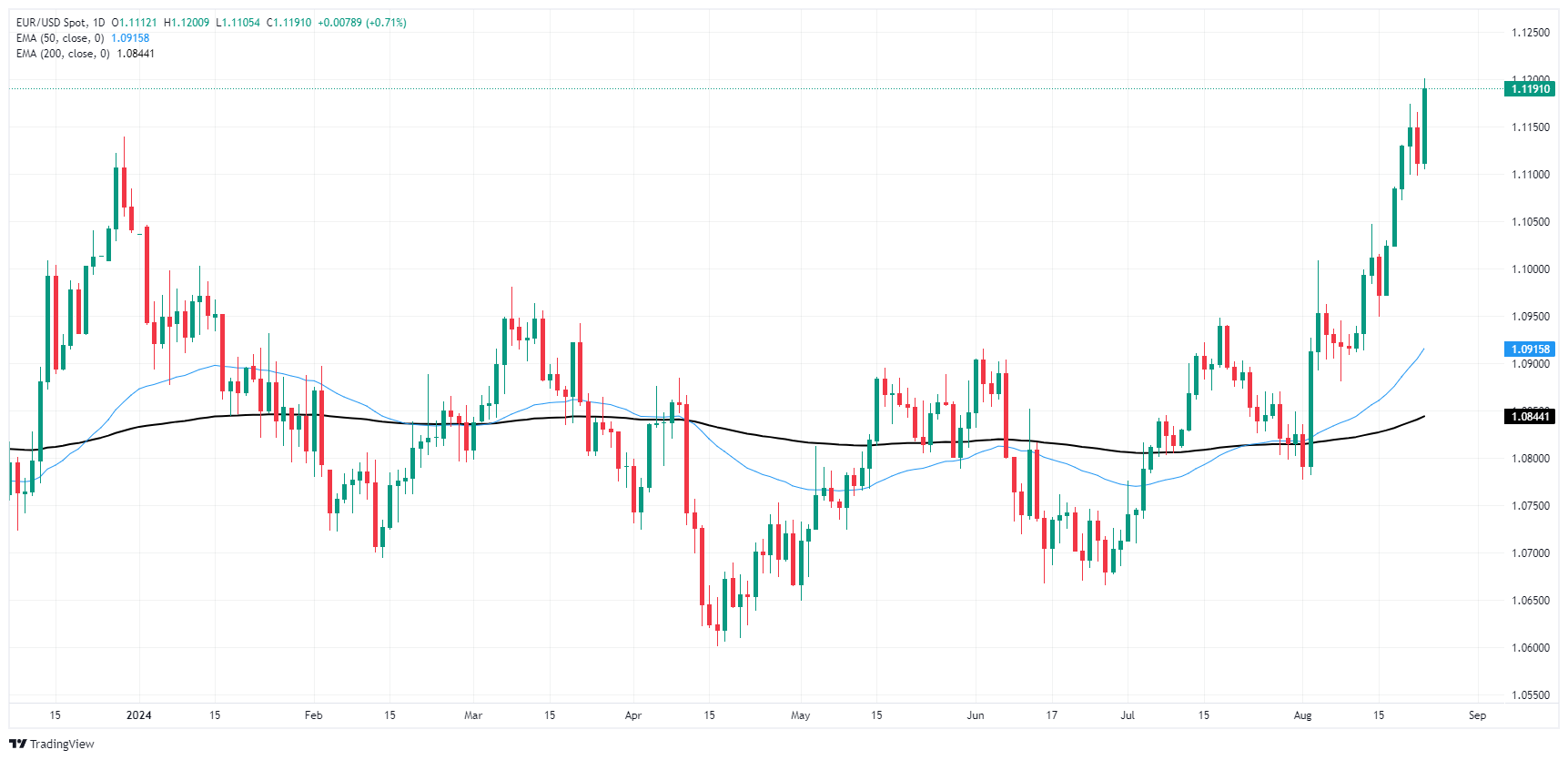
Euro FAQs
The Euro is the currency for the 20 European Union countries that belong to the Eurozone. It is the second most heavily traded currency in the world behind the US Dollar. In 2022, it accounted for 31% of all foreign exchange transactions, with an average daily turnover of over $2.2 trillion a day. EUR/USD is the most heavily traded currency pair in the world, accounting for an estimated 30% off all transactions, followed by EUR/JPY (4%), EUR/GBP (3%) and EUR/AUD (2%).
The European Central Bank (ECB) in Frankfurt, Germany, is the reserve bank for the Eurozone. The ECB sets interest rates and manages monetary policy. The ECB’s primary mandate is to maintain price stability, which means either controlling inflation or stimulating growth. Its primary tool is the raising or lowering of interest rates. Relatively high interest rates – or the expectation of higher rates – will usually benefit the Euro and vice versa. The ECB Governing Council makes monetary policy decisions at meetings held eight times a year. Decisions are made by heads of the Eurozone national banks and six permanent members, including the President of the ECB, Christine Lagarde.
Eurozone inflation data, measured by the Harmonized Index of Consumer Prices (HICP), is an important econometric for the Euro. If inflation rises more than expected, especially if above the ECB’s 2% target, it obliges the ECB to raise interest rates to bring it back under control. Relatively high interest rates compared to its counterparts will usually benefit the Euro, as it makes the region more attractive as a place for global investors to park their money.
Data releases gauge the health of the economy and can impact on the Euro. Indicators such as GDP, Manufacturing and Services PMIs, employment, and consumer sentiment surveys can all influence the direction of the single currency. A strong economy is good for the Euro. Not only does it attract more foreign investment but it may encourage the ECB to put up interest rates, which will directly strengthen the Euro. Otherwise, if economic data is weak, the Euro is likely to fall. Economic data for the four largest economies in the euro area (Germany, France, Italy and Spain) are especially significant, as they account for 75% of the Eurozone’s economy.
Another significant data release for the Euro is the Trade Balance. This indicator measures the difference between what a country earns from its exports and what it spends on imports over a given period. If a country produces highly sought after exports then its currency will gain in value purely from the extra demand created from foreign buyers seeking to purchase these goods. Therefore, a positive net Trade Balance strengthens a currency and vice versa for a negative balance.
Author

Joshua Gibson
FXStreet
Joshua joins the FXStreet team as an Economics and Finance double major from Vancouver Island University with twelve years' experience as an independent trader focusing on technical analysis.