|

EUR/USD steady around 1.0180s, post US NFP ahead into the weekend

  • June’s US Nonfarm Payrolls report exceeded expectations, further cementing the case for a Fed’s 75 bps rate hike.
  • The consensus amongst ECB policymakers is for a 25 bps rate hike in July; September is still open.
  • EUR/USD Price Analysis: Sellers in control might take a breather before launching an assault towards parity.

EUR/USD remains subdued as North American traders prepared for the weekend, in choppy trading within the 1.0150-80 range after June’s employment report and further Fed speakers crossing wires.

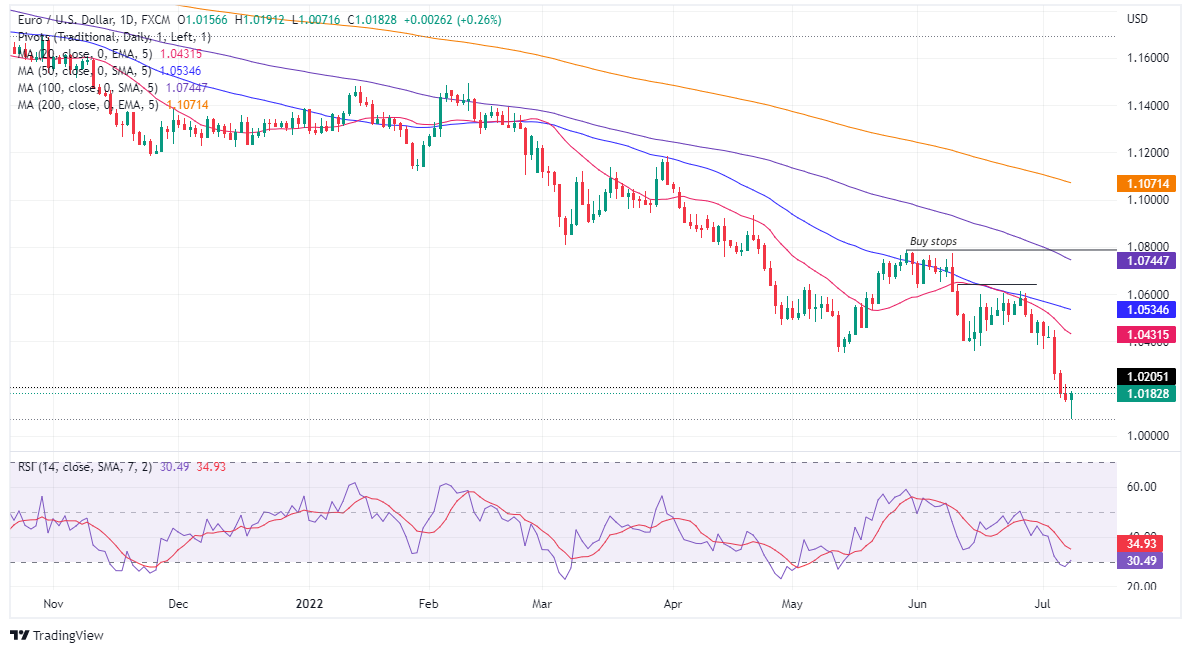
The EUR/USD is trading at 1.0182, having hit a fresh 20-year low at 1.0071 during the European session, though recovered after the release of the US Nonfarm Payrolls report, bouncing off late towards daily highs near 1.0190, before losing steam and settling at around current levels.

EUR/USD rallied despite solid US job report, EU’s energy crisis

Earlier in the North American session, the US Department of Labour reported that June’s Nonfarm Payrolls added 372K jobs to the economy, exceeding estimations of 268K. Average Hourly Earnings, and an indication of a wage-price spiral, remained contained at 5.1% YoY, above estimates, while the Unemployment rate prevailed unchanged at 3.6%. At the same time Fed speakers, namely Waller, Bullard, Bostic, and Williams, reiterated the case for a 75 bps rate hike to the Federal funds rate (FFR), while downplaying recession fears.

On the Eurozone side, ECB speakers remain vocal about hiking rates this month, and the consensus remained around a 25 bps rate hike. However, a 50 bps could be in play, but it is not the case scenario, as mentioned on its June minutes. Despite all that, the EU’s ongoing energy crisis hit the shared currency hard during the week, as the EUR/USD weekly chart illustrates the major is losing 2.47% in the week

Therefore, the EUR/USD path of least resistance is tilted to the downside, and a parity test is on the cards.

EUR/USD Price Analysis: Technical outlook

The EUR/USD daily chart indicates that sellers are in control, despite buyers’ effort to hold the fort around 1.0100. As the New York session waned, they achieved their task so far. However, oscillators like the Relative Strength Index (RS) exited oversold conditions, meaning sellers might be taking a breather before exerting additional pressure to drag prices lower.

Therefore, the EUR/USD first support would be 1.0100. Once cleared, the next support would be the current YTD low at 1.0071, followed by the EUR/USD parity at 1.0000. A decisive break would clear the way for September 2002 lows around 0.9608.
EUR/USD

Overview
Today last price1.0182
Today Daily Change0.0022
Today Daily Change %0.22
Today daily open1.0162
 
Trends
Daily SMA201.0451
Daily SMA501.0545
Daily SMA1001.0758
Daily SMA2001.108
 
Levels
Previous Daily High1.0221
Previous Daily Low1.0144
Previous Weekly High1.0615
Previous Weekly Low1.0366
Previous Monthly High1.0774
Previous Monthly Low1.0359
Daily Fibonacci 38.2%1.0174
Daily Fibonacci 61.8%1.0192
Daily Pivot Point S11.013
Daily Pivot Point S21.0099
Daily Pivot Point S31.0053
Daily Pivot Point R11.0207
Daily Pivot Point R21.0253
Daily Pivot Point R31.0284

Author

Christian Borjon Valencia

Markets analyst, news editor, and trading instructor with over 14 years of experience across FX, commodities, US equity indices, and global macro markets.


More from Christian Borjon Valencia
Share:

Editor's Picks

AUD/USD bulls seem hesitant below 0.7050 ahead of RBA on Tuesday

AUD/USD reverses an Asian session dip on Monday as renewed optimism over Iran diplomacy boosts investor confidence, keeping a lid on the safe-haven US Dollar and supporting the risk-sensitive Aussie. Spot prices, however, remain below the one-month high, touched last Thursday, as bulls wait for the crucial RBA decision before taking fresh positions.


USD/JPY climbs to 158.00 neighborhood as BoJ uncertainty weighs on the JPY

The USD/JPY pair gains some positive traction at the start of a new week, recovering further from Friday's post-Bank of Japan (BoJ) swing low to sub-157.00 levels. The momentum lifts spot prices to the 158.00 neighborhood during the Asian session and seems unaffected by fresh intervention warning from Japan's Finance Minister Satsuki Katayama.

Gold recovers on positive US-Iran headlines

Gold extends its recovery during American trading hours on Monday, supported by falling Oil prices following positive headlines on US-Iran talks. The metal regains ground after hitting a fresh yearly low of $3,870 on Friday and ending October down 6.87%. However, the rebound lacks conviction as the fundamental backdrop continues to raise doubts over a sustained recovery.

Bitcoin braces for US midterm elections as historical sell-offs revive downside concerns
Bitcoin (BTC) braces for the impact of the US midterm elections, just a week after the $6 billion hack from Binance. Historically, congressional elections have negatively affected not just the president’s party but also Bitcoin. In the last 22 midterms, the ruling party has gained House seats only twice, while the three most recent elections coincided with Bitcoin’s bear market bottoms.
Why strong US growth could not stop the bond rally and AI selloff

The US economy grew at a 3.4% annual rate, yet Treasury yields fell and the Nasdaq ended October with its worst monthly performance since March 2025. The market is no longer rewarding capital expenditure simply because it supports growth. Investors are testing whether that expenditure can produce cash flow and returns above the cost of capital.


The 2% inflation target came from a throwaway remark. It now moves trillions
The Federal Reserve's 2% inflation goal grew out of an off-the-cuff remark by a New Zealand politician in 1988. Bond investors still price long-term US debt as if 2% holds, so a change in how the Fed measures inflation would move markets.















