|

EUR/USD stays firm, shy of 1.0700 amid strong US Dollar and elevated US yields

  • EUR/USD maintains a position slightly above 1.0700, with minimal change despite a strong recovery in the US Dollar.
  • US Treasury yields increase after significant durable goods data and a major five-year note sale, impacting market sentiment.
  • Upcoming US GDP and Core PCE data, along with German consumer confidence figures, are next on the economic calendar.

The Euro is steady against the US Dollar, virtually unchanged after solid data from the United States (US) boosted the Greenback, which recovered from Tuesday's losses. However, the EUR/USD stands below the 1.0700 threshold posting minimal gains of 0.01%.

EUR/USD is flatlined ahead of crucial US GDP and inflation data

The market mood shifted sour as the US Treasury yields edged up after a record $70 billion sale of five-year notes in the US fixed-income market. In the meantime, the US Department of Commerce showed that US Durable Goods Orders increased in March, expanding by 2.6% MoM, up from a 0.7% rise previously and surpassing 2.5% estimates. Core goods, which excluded transportation, increased by 0.2% MoM, an improvement over February's 0.1% increase, but fell short of the 0.3% projected.

Today’s data contrasts with Tuesday’s S&P Global PMI figures in the US. Although business activity has eased somewhat, Goods Orders figures crushed February’s figures, signaling the economy remains strong.

On Thursday, the US Bureau of Economic Analysis (BEA) will reveal the Gross Domestic Product (GDP) for the first quarter of 2024, estimated at 2.5%, down from 3.4% in Q4 2023. At the same time, Initial Jobless Claims are expected to increase from 212K to 214K.

Besides that, EUR/USD traders would be eyeing the release of the Core Personal Consumption Expenditures (PCE) Price Index, the Federal Reserve’s preferred inflation gauge, which is estimated to remain steady at 0.3%. The annual Core PCE rate is expected to ease to 2.6%, down from February's rate of 2.8%, indicating a potential softening of inflation pressure.

Across the pond, traders would be eyeing the release of Germany’s GfK Consumer Confidence for May, projected to improve from -27.4 to -25.9.

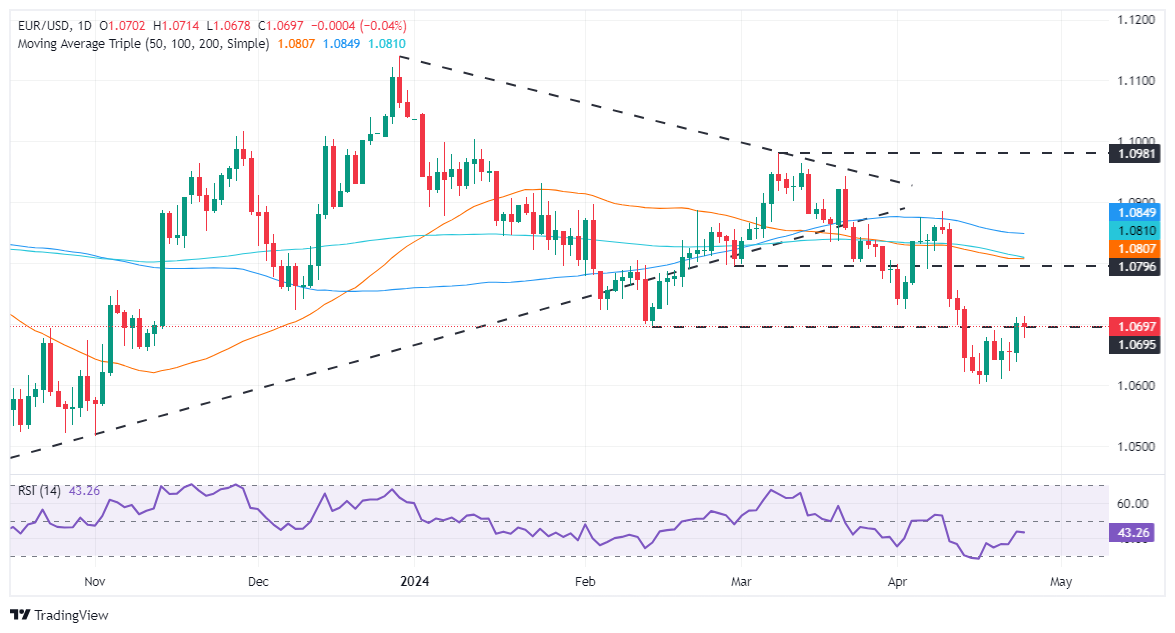
EUR/USD Price Analysis: Technical outlook

Even though the EUR/USD seems to have bottomed at around 1.0600, buyers' failure to achieve a daily close above 1.0700 could pave the way for a re-test of the year-to-date (YTD) low at 1.0601. In that event, a breach of the latter, will expose a key support level at 1.0448, the October 3, 2023, swing low. On the upside, if buyers keep the spot price above 1.0700, look for a test of the psychological 1.0750 before aiming toward the confluence of the 50 and 200-DMA.
EUR/USD

Overview
Today last price1.0698
Today Daily Change-0.0004
Today Daily Change %-0.04
Today daily open1.0702
 
Trends
Daily SMA201.0742
Daily SMA501.0808
Daily SMA1001.085
Daily SMA2001.0812
 
Levels
Previous Daily High1.0711
Previous Daily Low1.0639
Previous Weekly High1.069
Previous Weekly Low1.0601
Previous Monthly High1.0981
Previous Monthly Low1.0768
Daily Fibonacci 38.2%1.0684
Daily Fibonacci 61.8%1.0666
Daily Pivot Point S11.0656
Daily Pivot Point S21.0611
Daily Pivot Point S31.0584
Daily Pivot Point R11.0729
Daily Pivot Point R21.0757
Daily Pivot Point R31.0802

Author

Christian Borjon Valencia

Markets analyst, news editor, and trading instructor with over 14 years of experience across FX, commodities, US equity indices, and global macro markets.


More from Christian Borjon Valencia
Share:

Editor's Picks

AUD/USD consolidates above 0.7000; remains close to monthly top

AUD/USD holds steady above 0.7000 during the Asian session on Friday, trading just below the previous day's monthly low amid diverging forces. A hawkish RBA continues to support the Aussie, while the recent decline in US bond yields keeps the US Dollar depressed near a three-week low. However, oil-driven inflation fears reinforce Fed hike bets, which, along with geopolitical risks, could benefit the safe-haven buck and cap the currency pair.

USD/JPY drops to an over one-month low, around 156.00 after Japan's CPI report

USD/JPY attracts heavy follow-through selling on Friday, dropping to the 156.00 neighborhood, a one-month low, as Japan's National CPI report reaffirms bets for an imminent BoJ rate hike and boosts the Japanese Yen. Moreover, the recent steep fall in US bond yields counters hawkish Fed expectations and geopolitical risks, undermining the US Dollar and exerting additional pressure on the currency pair.

Gold seems vulnerable near August lows; eyes $4,000 break amid Fed hike bets

Gold touches a fresh low since early August during the Asian session on Friday, eyeing the key $4,000 psychological mark. Oil-driven inflation fears reinforce December Fed hike bets and continue to undermine the non-yielding bullion, which fails to benefit from the recent steep fall in US bond yields and the prevailing US Dollar selling bias. Moreover, the overnight breakdown below a trading-range support backs the case for further depreciation.


Bitcoin falls 4% as chip stocks plunge 6.7% and oil surges
Bitcoin (BTC) fell below $82,000 on Thursday as the crypto market joined a broader market sell-off driven by concerns over artificial intelligence (AI) spending, rising oil prices and escalating geopolitical tensions involving the US and Iran. The top crypto fell 4% to $81,130 as macro fears weighed on prices across the digital asset market.
The Bank of England just got its clearest reason to hike. Here's what it's really watching

UK inflation as measured by the CPI accelerated to 3.5% YoY in September, up from 3.1% in August, according to the Office for National Statistics. This is the highest level since October 2025, exceeding economists' expectations of 3.4% and pushing inflation further from the BoE's 2% target.

What November 3 means for the Fed's rate path and the US Dollar

The USD faces a decisive period ahead of the November 3 midterm elections. While markets anticipate another interest rate increase from the Fed in December, the battle for control of Congress could reshape fiscal policy expectations and, indirectly, the path of US monetary policy in 2027.















