EUR/USD slides yet clings to 1.1100 as market awaits Powell’s speech
- EUR/USD falls as robust US Treasury yields bolster the dollar, despite Fed signals of potential September rate cuts.
- Mixed US data: Rising jobless claims and PMI results show service growth but worsening manufacturing contraction.
- ECB's Kazaks suggests possible rate cuts with a cautious, restrictive policy approach.

The EUR/USD is set to finish Thursday’s session with losses of over 0.30% after the Greenback was bolstered by high US Treasury yields, even though Fed officials support a rate cut at the upcoming meeting in September. At the time of writing, the major clings around the 1.1100 figure for the third straight day.
EUR/USD hovers around 1.1100 for the third straight day, pressured by higher US Treasury yields
Wall Street ended the session with losses ahead of Fed Chair Jerome Powell's speech at Jackson Hole, due tomorrow at around 14:00 GMT. The Boston and Philadelphia Fed Presidents Susan Collins and Patrick Harker are ready to ease policy, with the former adding that the labor market remains healthy. At the same time, the latter said the Fed must lower rates in a “methodical” way.
Data-wise, US Initial Jobless Claims for the week ending August 17, were higher than the 230K expected, jumped by 232K, and exceeded the previous reading. Regarding business activity, S&P Global PMIs for August were mixed, with the Services expanding above estimates, while Manufacturing PMI contracted deeper, hinting at a more profound economic slowdown.
Across the pond, Eurozone Flash PMIs were mixed, yet the attention was on European Central Bank (ECB) ECB Martins Kazaks, who crossed the wires on Bloomberg. He said he’s open to discussing a rate cut in September yet suggests a gradual approach. He added that policy would remain restrictive despite lowering rates twice and hinted that if inflation goes sideways, they could still cut rates.
Ahead of the day, EUR/USD traders will eye the release of France Business Confidence data. On the US front, Fed Chair Jerome Powell's speech and housing data.
EUR/USD Price Forecast: Technical outlook
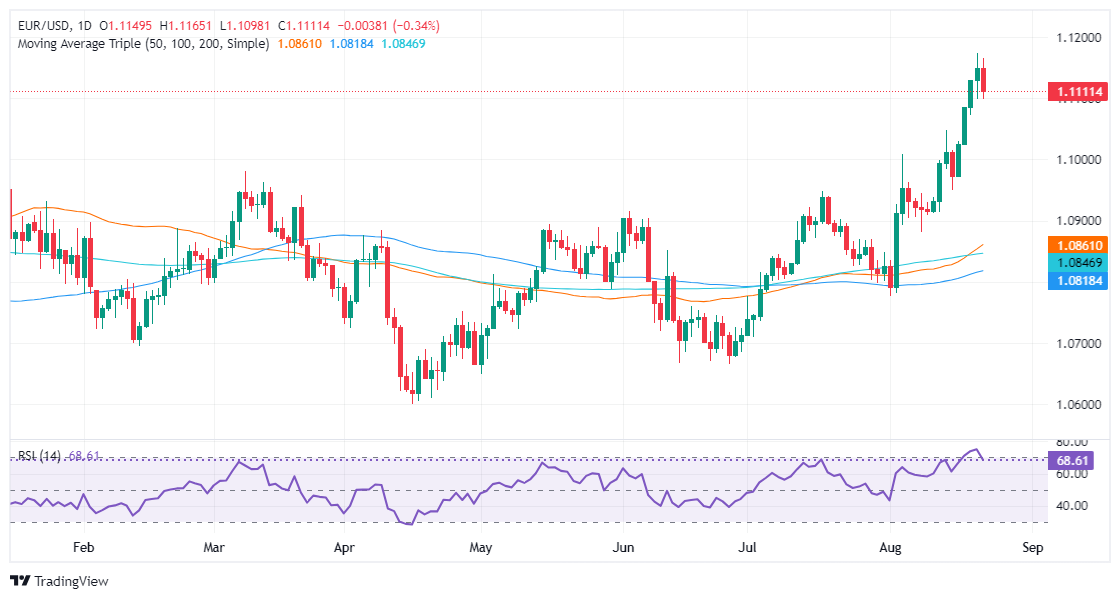
From a technical standpoint, the EUR/USD formed a ‘quasi bearish harami’ two-candle bearish chart pattern, yet sellers failed to push the exchange rate below 1.1100, which would’ve paved the way for further downside.
Momentum is still bullish, yet with the Relative Strength Index (RSI) exiting from overbought conditions, a EUR/USD drop below 1.11000 is possible.
In that outcome, the first support would be the August 14 high at 1.1047, followed by a test of the 1.1000 mark. On the other hand, if the pair clings above 1.1100, look for a re-test of the year-to-date (YTD) high of 1.1174, before challenging 1.1200.
Euro FAQs
The Euro is the currency for the 20 European Union countries that belong to the Eurozone. It is the second most heavily traded currency in the world behind the US Dollar. In 2022, it accounted for 31% of all foreign exchange transactions, with an average daily turnover of over $2.2 trillion a day. EUR/USD is the most heavily traded currency pair in the world, accounting for an estimated 30% off all transactions, followed by EUR/JPY (4%), EUR/GBP (3%) and EUR/AUD (2%).
The European Central Bank (ECB) in Frankfurt, Germany, is the reserve bank for the Eurozone. The ECB sets interest rates and manages monetary policy. The ECB’s primary mandate is to maintain price stability, which means either controlling inflation or stimulating growth. Its primary tool is the raising or lowering of interest rates. Relatively high interest rates – or the expectation of higher rates – will usually benefit the Euro and vice versa. The ECB Governing Council makes monetary policy decisions at meetings held eight times a year. Decisions are made by heads of the Eurozone national banks and six permanent members, including the President of the ECB, Christine Lagarde.
Eurozone inflation data, measured by the Harmonized Index of Consumer Prices (HICP), is an important econometric for the Euro. If inflation rises more than expected, especially if above the ECB’s 2% target, it obliges the ECB to raise interest rates to bring it back under control. Relatively high interest rates compared to its counterparts will usually benefit the Euro, as it makes the region more attractive as a place for global investors to park their money.
Data releases gauge the health of the economy and can impact on the Euro. Indicators such as GDP, Manufacturing and Services PMIs, employment, and consumer sentiment surveys can all influence the direction of the single currency. A strong economy is good for the Euro. Not only does it attract more foreign investment but it may encourage the ECB to put up interest rates, which will directly strengthen the Euro. Otherwise, if economic data is weak, the Euro is likely to fall. Economic data for the four largest economies in the euro area (Germany, France, Italy and Spain) are especially significant, as they account for 75% of the Eurozone’s economy.
Another significant data release for the Euro is the Trade Balance. This indicator measures the difference between what a country earns from its exports and what it spends on imports over a given period. If a country produces highly sought after exports then its currency will gain in value purely from the extra demand created from foreign buyers seeking to purchase these goods. Therefore, a positive net Trade Balance strengthens a currency and vice versa for a negative balance.
Author

Christian Borjon Valencia
FXStreet
Markets analyst, news editor, and trading instructor with over 14 years of experience across FX, commodities, US equity indices, and global macro markets.