EUR/USD bounces on diverging US-Eurozone monetary policy stances
- EUR/USD recovers as the chances remain quite high that the Fed might have to make steep cuts to interest rates.
- The Euro gains support as interest rates in the Eurozone could stay higher for longer due to persistent wage inflation.

EUR/USD trades marginally higher in the 1.1060s on Monday, as the Euro (EUR) strengthens against the US Dollar (USD) on the back of still-high probabilities the Federal Reserve (Fed) could implement a sharp cut in interest rates at their September meeting. This, in turn, weighs on the USD because lower interest rates make it less attractive to foreign investors, lowering capital inflows.
The Euro, in comparison, holds its ground amid expectations interest rates will remain higher for longer in the Eurozone due to persistent wage inflation, and this will lead the European Central Bank (ECB) to take a more cautious approach to cutting interest rates.
EUR/USD mildly higher on survival of chances of half-a-percent rate cut
EUR/USD edges higher as traders continue to evaluate the future path of interest rates in the US. The probability that the Fed could cut the fed funds rate by 0.50% – to a range between 4.75% and 5.00% – at their September 18 meeting remains above 30% whilst the chances of a 0.25% reduction is fully priced in, according to the CME FedWatch Tool. The still fairly high chance of a 0.50% “mega cut” remains a headwind for the Greenback and supports EUR/USD.
US inflation data out on Friday showed the Personal Consumption Expenditures (PCE) Price Index remained unchanged at 2.5% in July, with core PCE still at 2.6%. Expectations had been for them both to rise a basis point. The data might have slightly eased concerns the US economy could be heading for a hard landing. Still, it will not be until US employment data comes out this week that investors will have all the “test results in for the patient” and can confidently assess what the Fed is likely to do. Friday’s Nonfarm Payrolls data for August will be particularly key in this respect.
EUR/USD recovers after Eurozone inflation data keeps investors guessing
The previous week was volatile for the Euro. German and Spanish annualized preliminary Consumer Price Index (CPI) data for August showed on Thursday inflation falling lower than the previous month and missing expectations, and this initially caused some weakness in the single currency as investors started to price a steeper fall in interest rates. However, when Eurozone-wide data was released the day after – at 2.2% and 2.8% for core – although they fell, they met economists’ expectations, helping the Euro to recover.
The data failed to alter perceptions that the European Central Bank (ECB) will reduce interest rates in Europe at a steady and cautious pace, which contrasts with the still relatively high chance of a steeper rate-cut trajectory in the US.
“Headline inflation dropped to 2.2% y/y in August – the closest it has been to the ECB’s inflation target since 2021 – but risks remain: Wage growth remains high and will keep core inflation sticky for the rest of this year,” said on Friday Anders Svendson, Chief Analyst at Nordea Bank.
Wages in the Eurozone are expected to continue rising strongly in the second half of 2024 before easing in 2025-2026, said ECB Executive Board Member Philip Lane in a recent speech. In the short term, this is likely to put upside pressure on inflation which, in turn, is likely to keep the ECB cautious and data-dependent regarding interest rates – a supportive factor for EUR/USD.
Technical Analysis: EUR/USD rolls over into a short-term downtrend
EUR/USD has established a declining sequence of peaks and troughs since peaking at 1.1202 on August 26. This sequence probably indicates the pair is in a short-term downtrend and, since “the trend is your friend,” odds now probably favor lower prices to come.
EUR/USD 4-hour Chart
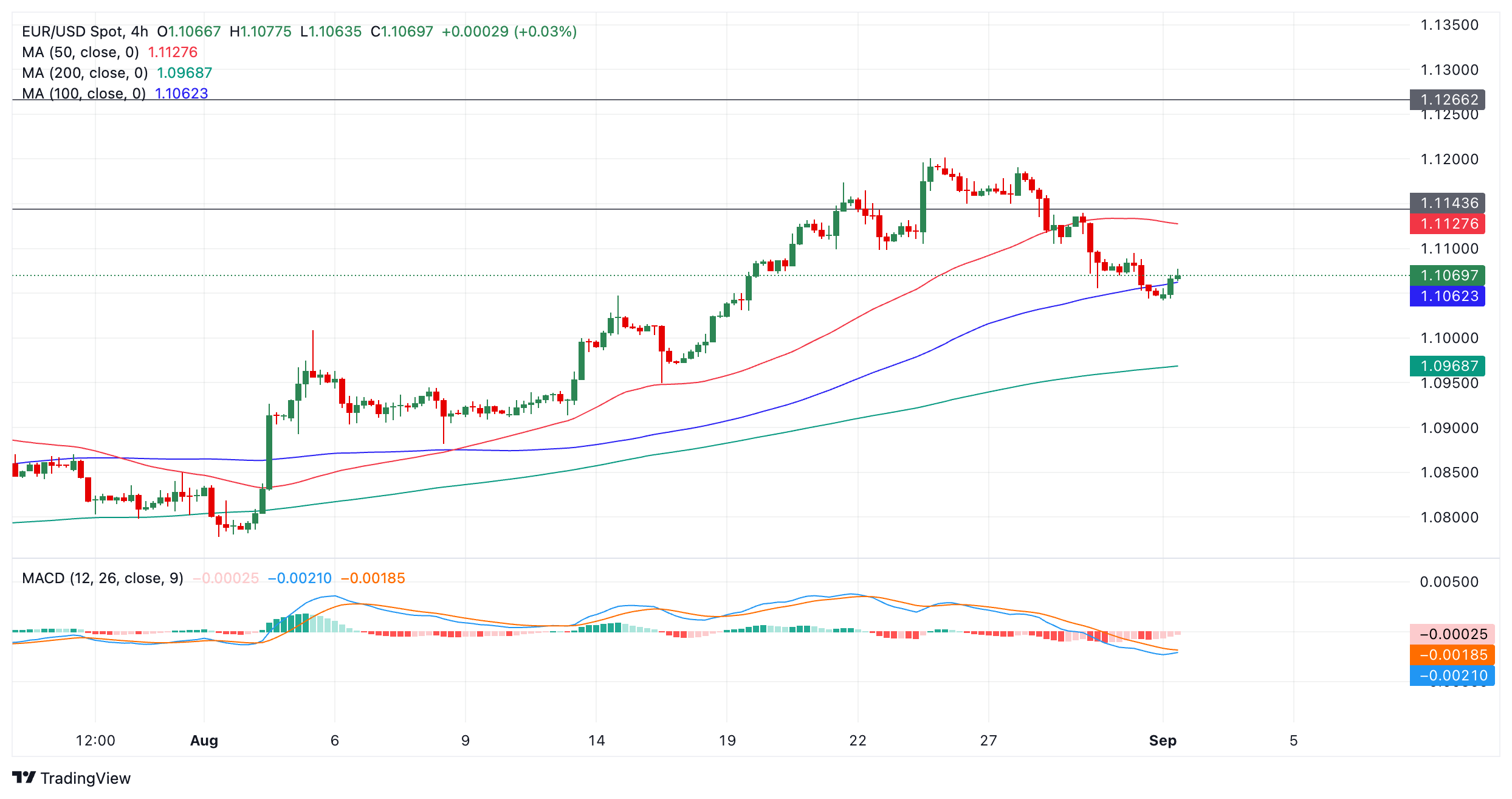
A break below 1.1040 would provide added confirmation of more downside, to a potential initial target at 1.1000, a psychological level of support.
Conversely, a close above 1.1100 would bring the short-term downtrend into doubt and suggest the possibility of higher prices.
EUR/USD Daily Chart
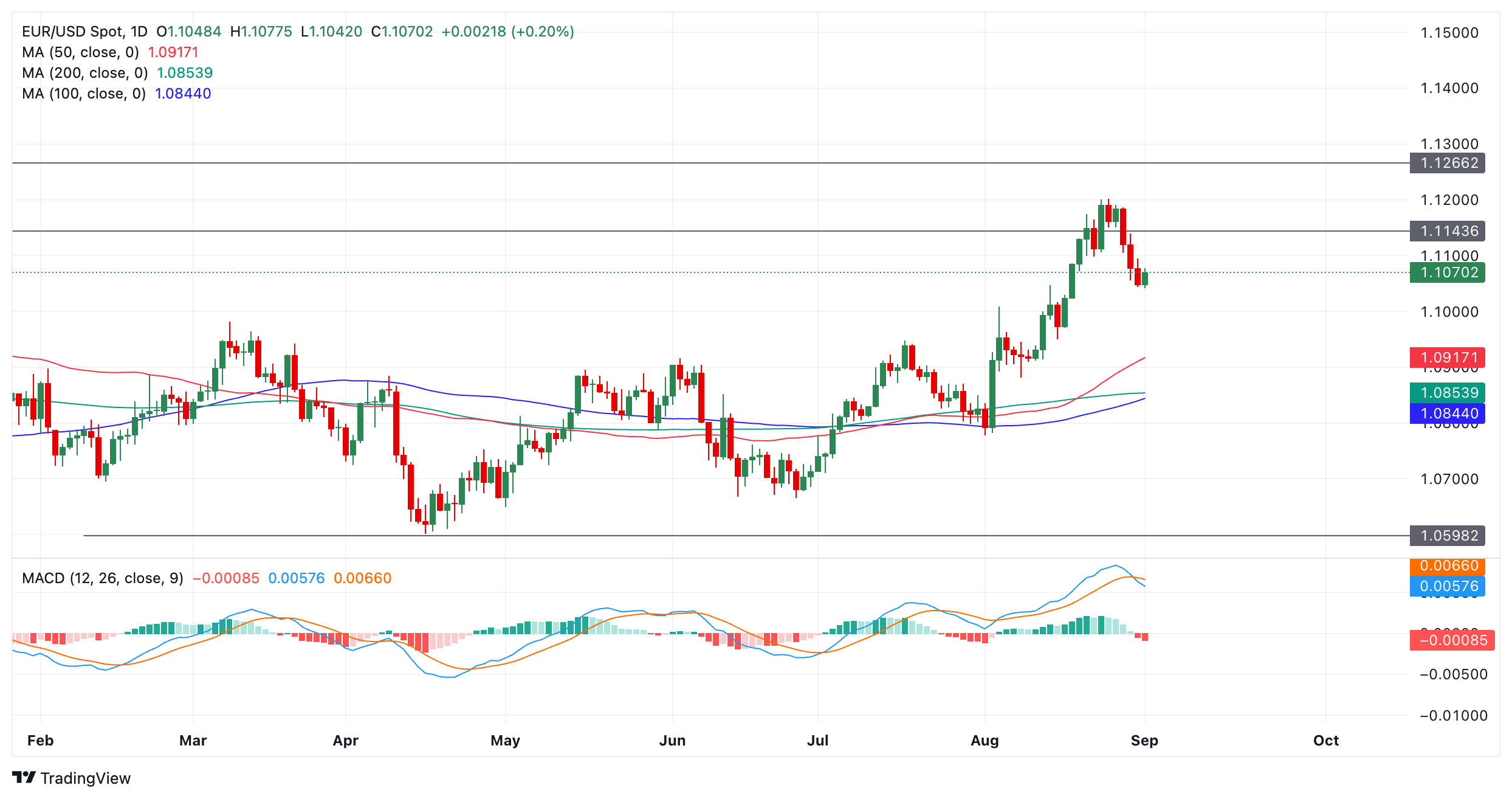
The daily chart shows that the Moving Average Convergence Divergence (MACD) momentum indicator has crossed below its signal line, further indicating the possibility a new down move is evolving.
EUR/USD Weekly Chart
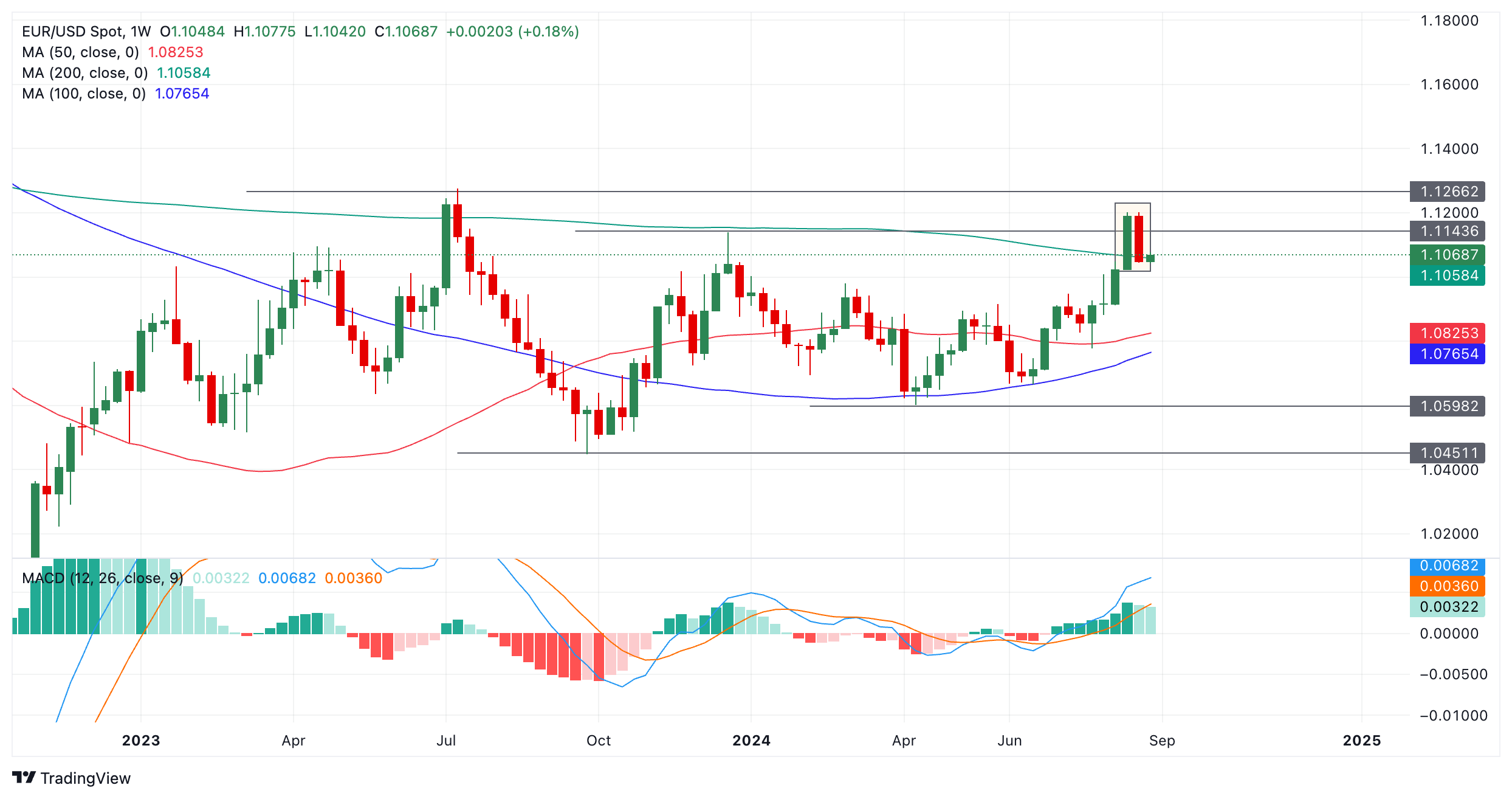
The weekly chart shows a bearish Two-Bar reversal pattern formed at the recent August highs (shaded rectangle). These occur when a long green-up week is followed by a similar-length red-down week. The pattern is a reliable indication of a reversal in the trend. The fact it formed at the 200-week Simple Moving Average level adds further evidence of a possibility of a move lower developing.
Economic Indicator
Nonfarm Payrolls
The Nonfarm Payrolls release presents the number of new jobs created in the US during the previous month in all non-agricultural businesses; it is released by the US Bureau of Labor Statistics (BLS). The monthly changes in payrolls can be extremely volatile. The number is also subject to strong reviews, which can also trigger volatility in the Forex board. Generally speaking, a high reading is seen as bullish for the US Dollar (USD), while a low reading is seen as bearish, although previous months' reviews and the Unemployment Rate are as relevant as the headline figure. The market's reaction, therefore, depends on how the market assesses all the data contained in the BLS report as a whole.
Read more.Next release: Fri Sep 06, 2024 12:30
Frequency: Monthly
Consensus: 165K
Previous: 114K
Source: US Bureau of Labor Statistics
America’s monthly jobs report is considered the most important economic indicator for forex traders. Released on the first Friday following the reported month, the change in the number of positions is closely correlated with the overall performance of the economy and is monitored by policymakers. Full employment is one of the Federal Reserve’s mandates and it considers developments in the labor market when setting its policies, thus impacting currencies. Despite several leading indicators shaping estimates, Nonfarm Payrolls tend to surprise markets and trigger substantial volatility. Actual figures beating the consensus tend to be USD bullish.
Author

Joaquin Monfort
FXStreet
Joaquin Monfort is a financial writer and analyst with over 10 years experience writing about financial markets and alt data. He holds a degree in Anthropology from London University and a Diploma in Technical analysis.