|

EUR/USD retreats below 1.0900 post-Fed dovish hike, despite ECB hawkish rhetoric

  • EUR/USD stumbled and headed to the 1.0830s area after printing a weekly high at 1.0929.
  • US jobs data suggests that the US Federal Reserve is not done raising rates.
  • European Central Bank policymakers continue to emphasize that more hikes are coming.

EUR/USD hit a seven-week high but reversed its course, dropping below 1.0900 as the US Dollar (USD) pared some of its earlier losses. On Wednesday, the US Federal Reserve (Fed) raised rates by 25 bps, though market participants perceived it as dovish. That underpinned the EUR/USD, but traders booking profits weakened the Euro (EUR). The EUR/USD is trading at 1.0829, down 0.17%.

Yellen’s soft tone improved sentiment and lifted the US Dollar

Wall Street finished positively. The US Secretary of Treasure Janet Yellen testified before the house and backpedaled on Wednesday’s remarks that the US government is not planning to introduce blanket insurance to all depositors. Yellen said, “The strong actions we have taken ensure that Americans’ deposits are safe. Certainly, we would be prepared to take additional actions if warranted.”

Data-wise, the US Department of Labor revealed that the labor market remains tight, unveiling the Initial Jobless Claims for the last week. Claims rose by 191K, less than the 201K estimates by the market. The Chicago Fed National Activity Index for February plunged to -0.19 vs. the prior’s month 0.23.

Meanwhile, European Central Bank (ECB) officials crossed the wires and remained hawkish. ECB Muller said that the ECB should likely raise rates a little. Echoing some of his comments was Klas Know, adding that the ECB is unlikely to stop raising interest rates.

Sources linked to the ECB commented that policymakers are confident that the Eurozone (EU) banking system stood tall in the recent turbulence. Therefore that would allow the ECB to resume additional interest rate increases.

EUR/USD Daily chart
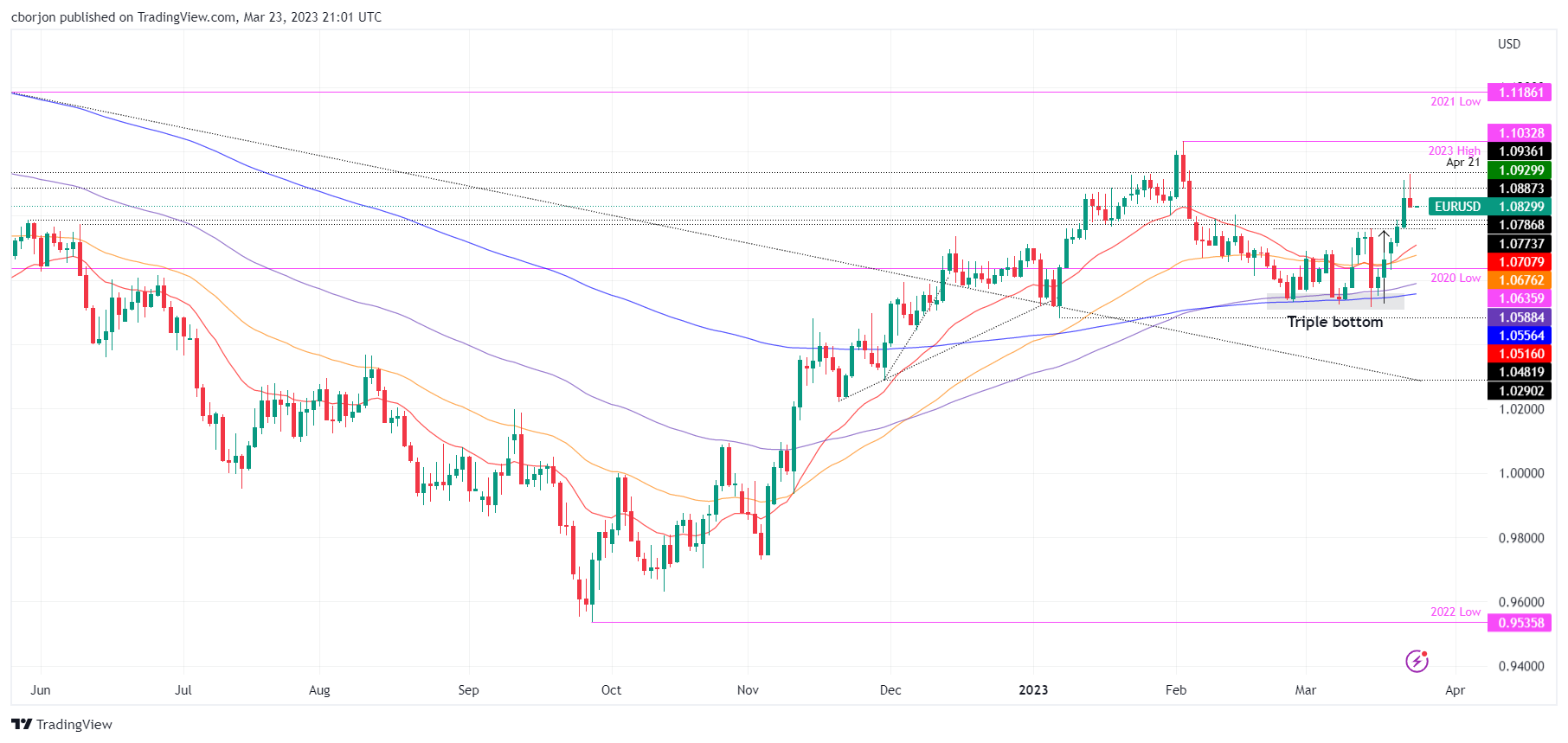
EUR/USD Daily chart

EUR/USD Technical levels

EUR/USD

Overview
Today last price1.0831
Today Daily Change-0.0025
Today Daily Change %-0.23
Today daily open1.0856
 
Trends
Daily SMA201.0644
Daily SMA501.0731
Daily SMA1001.0597
Daily SMA2001.0331
 
Levels
Previous Daily High1.0912
Previous Daily Low1.0759
Previous Weekly High1.076
Previous Weekly Low1.0516
Previous Monthly High1.1033
Previous Monthly Low1.0533
Daily Fibonacci 38.2%1.0854
Daily Fibonacci 61.8%1.0818
Daily Pivot Point S11.0772
Daily Pivot Point S21.0689
Daily Pivot Point S31.0619
Daily Pivot Point R11.0926
Daily Pivot Point R21.0996
Daily Pivot Point R31.1079
 

Author

Christian Borjon Valencia

Markets analyst, news editor, and trading instructor with over 14 years of experience across FX, commodities, US equity indices, and global macro markets.


More from Christian Borjon Valencia
Share:

Editor's Picks

AUD/USD holds firm near 0.7000 after Chinese inflation, trade data

AUD/USD stays firm near 0.7000 in Wednesday’s Asian session, picking up some bids after China's mixed inflation and upbeat trade data. CPI rose less than expected in September, while PPI inflation picked up. Meanwhile, the Chinese trade surplus unexpectedly widened in September. The pair remains underpinned by a broadly subdued US Dollar, despite the Middle East escalation, as focus remains on US CPI data.

USD/JPY consolidates near 158.50; looks to US CPI for fresh impetus

USD/JPY stays range-bound near 158.50 in the Asian session on Wednesday, with looming intervention risks supporting the Japanese Yen and capping upside amid a softer US Dollar. However, geopolitical uncertainties act as a tailwind for the safe-haven USD and the pair. Traders also seem hesitant ahead of the release of the latest US inflation figures.

Gold looks to $4100 and US CPI inflation amid geopolitical risks

Gold falls for the third straight day on Wednesday, as the recent recovery falters ahead of US inflation. US Dollar pauses correction amid rising Oil prices and stabilizing US Treasury bond yields. The daily bearish RSI remains a headwind for Gold buyers, with $4,100 seen at risk.

Strategy bitcoin buying model faces scrutiny as STRC costs climb
Strategy’s (MSTR) STRC financing strategy increased its Bitcoin (BTC) holdings in H1, but made its capital structure more expensive, prompting an examination of its effectiveness, according to a Tuesday report by K33. STRC recovered close to its $100 par value, closing at $99.90 after an extended period of heavy buybacks.
What happens after a US Treasury market crash
The global bond market is under severe pressure as US Treasury yields reach multi-decade highs, driven by persistent inflation risk, heavy government and corporate debt issuance, and expanding term premiums. Higher yields raise borrowing costs and tighten financial conditions, but a severe bond selloff can ultimately shift investor focus from inflation to growth and financial stability.
Has Bitcoin really escaped the macro forces it was built to fight?
Over 17 years ago, Satoshi Nakamoto designed Bitcoin (BTC) on the back of a global financial crisis as an alternative to the global monetary system outside the control of central banks, governments and traditional intermediaries. This raises a key question: has Bitcoin really become independent of the macroeconomic forces it was built to challenge?















