EUR/USD retreats after release of weak Eurozone Manufacturing data
- EUR/USD slumps after German and Eurozone PMI data show contraction in Manufacturing.
- The move pares gains made after the dovish hold by the Fed weakened the US Dollar.
- The Fed continues to expect to make three 0.25% interest rate cuts in 2024, same as December.


EUR/USD is trading down by a half of a percent on Thursday, back in the 1.0800s, after the release of US and Eurozone PMI data, as well as US Initial Jobless Claims and Philadelphia Fed Manufacturing. The US data broadly came out better-than-expected.
The move pared the gains made on the back of the Federal Reserve's decision to hold interest rates at their current levels and maintain the expectations that it will cut interest rates three times in 2024.
EUR/USD retreat deepens after release of US data
EUR/USD suffered further losses after the release of US PMI data for March, Initial Jobless Claims and the Philadelphia Fed Manufacturing Index all supported the USD and saw the pair fall back close to the day’s lows in the 0.6580s.
US S&P Global Composite PMI came out at 52.2, holding above the 50 level that distinguishes expansion from contraction. US Manufacturing PMI came out at 52.5, beating estimates and previous figures. Services PMI, however, undershot expectations and previous results, coming out at 51.7 in March.
The Philadelphia Fed Manufacturing Survey came out higher than estimated at 3.2, and Initial Jobless Claims at 210K were lower than the 215K forecast.
EUR/USD rotates lower after Manufacturing PMI weighs
EUR/USD pared its Fed gains after the release of Eurozone HCOB PMI data painted a lopsided picture of growth in the Eurozone. Although the Composite PMI rose to 49.9 thereby beating estimates of 49.7 and the previous February reading of 49.2, an unexpected fall in Manufacturing spoiled the outlook.
HCOB Manufacutruing PMI in March fell to 45.7, declining deeper into contractionary territory (below 50) than had been predicted. Economists had estimated a more bouyant rise to 47.0 from 46.5 previously.
Euro area HCOB Services PMI rose to 51.1 in March, beating estimates of 50.5 from 50.2 previous, according to data from S&P Global.
Europe's economic powerhouse Germany, meanwhile, revealed a similar trend, with German HCOB Manufacturing PMI declining to 41.6 which was below estimates of 43.1 and February's 42.5. It too showerd unexpected gains, however, in both Services component and the Composite number.
The decline of the Euro after the data was put down to a "Deeper manufacturing contraction both in Germany and EU," according to Dhwani Mehta, a senior analyst at FXStreet.
Fed maintains status quo
At its policy meeting on Wednesday, the Fed left the Fed Funds Rate unchanged at 5.25%-5.50% as widely expected. In its accompanying forecast document, the Summary of Economic Projections (SEP), it continued to foresee rates falling to a median target of 4.6% in 2024, like it did in December.
This is equivalent to expecting around three 25 bps (0.25%) of rate cuts this year, even though some market participants had speculated it might reduce the number of cuts to two because of stickier-than-expected inflation.
It did, however, see less rate cuts in 2025, with the Fed Funds Rate falling to a median of only 3.9% rather than the 3.6% in the December SEP.
The Fed revised up its GDP forecast substantially, to 2.1% for 2024, from 1.4% in December – regarded by many as indicative of a “soft landing”.
The central bank’s preferred gauge of inflation, the Core Personal Consumption Expenditure (PCE) – Price Index, was revised up to 2.6% for 2024 from 2.4% in December.
In his press conference after the meeting, Federal Reserve Chairman Jerome Powell sought to play down the latest batch of hot inflation readings, saying only two months of data was not enough to dissuade the Fed from its path.
The overall interpretation was of a “dovish hold,” which resulted in the US Dollar selling off from overbought territory. The EUR/USD pair, which measures the buying power of a single Euro (EUR) in US Dollars (USD), rallied back up into familiar territory.
Technical Analysis: EUR/USD returns to the 1.0900s
EUR/USD reversed on a dime at around the level of the 200-day Simple Moving Average (SMA) in the 1.0830s and surged higher after the Fed meeting. On Thursday, however, it pared gains following weak manufacturing data from the Eurozone.
It is now trading in the lower 1.0900s and seems to be trading in a range, with no real bias one way or another.
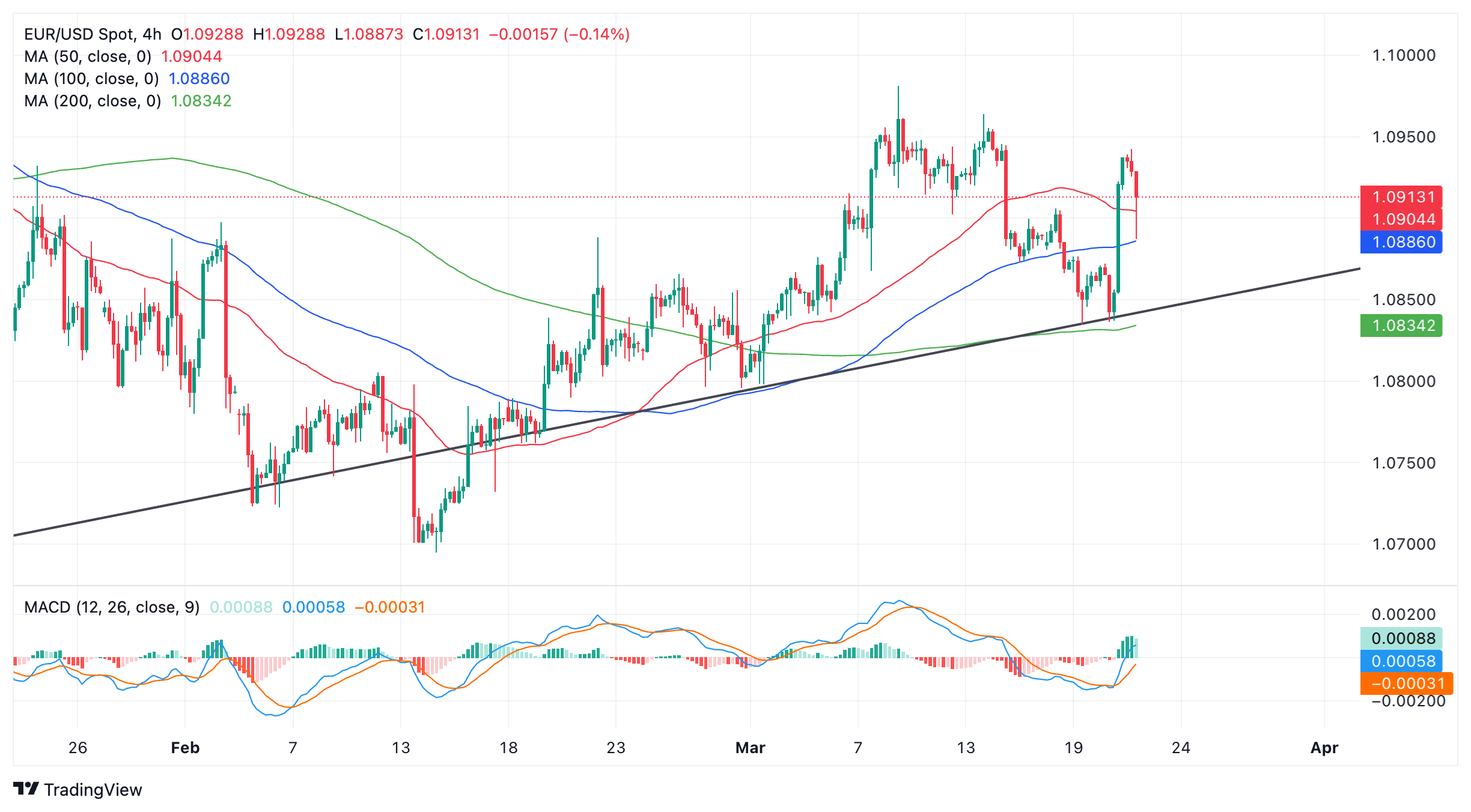
Euro versus US Dollar: 4-hour chart
The reversal at Wednesday’s lows continues to show momentum, however, and if price pushes higher it will probably meet resistance at the 1.0964 March 13 highs. If it breaks above them the March 8 highs for the month come into view at 1.0981. A break above them would turn the outlook bullish again.
Alternatively, the up move could petter out and price could also fall back down to target the 50-day SMA in the 1.0840s followed by the 200-day again in the 1.0830s.
Euro FAQs
The Euro is the currency for the 20 European Union countries that belong to the Eurozone. It is the second most heavily traded currency in the world behind the US Dollar. In 2022, it accounted for 31% of all foreign exchange transactions, with an average daily turnover of over $2.2 trillion a day. EUR/USD is the most heavily traded currency pair in the world, accounting for an estimated 30% off all transactions, followed by EUR/JPY (4%), EUR/GBP (3%) and EUR/AUD (2%).
The European Central Bank (ECB) in Frankfurt, Germany, is the reserve bank for the Eurozone. The ECB sets interest rates and manages monetary policy. The ECB’s primary mandate is to maintain price stability, which means either controlling inflation or stimulating growth. Its primary tool is the raising or lowering of interest rates. Relatively high interest rates – or the expectation of higher rates – will usually benefit the Euro and vice versa. The ECB Governing Council makes monetary policy decisions at meetings held eight times a year. Decisions are made by heads of the Eurozone national banks and six permanent members, including the President of the ECB, Christine Lagarde.
Eurozone inflation data, measured by the Harmonized Index of Consumer Prices (HICP), is an important econometric for the Euro. If inflation rises more than expected, especially if above the ECB’s 2% target, it obliges the ECB to raise interest rates to bring it back under control. Relatively high interest rates compared to its counterparts will usually benefit the Euro, as it makes the region more attractive as a place for global investors to park their money.
Data releases gauge the health of the economy and can impact on the Euro. Indicators such as GDP, Manufacturing and Services PMIs, employment, and consumer sentiment surveys can all influence the direction of the single currency. A strong economy is good for the Euro. Not only does it attract more foreign investment but it may encourage the ECB to put up interest rates, which will directly strengthen the Euro. Otherwise, if economic data is weak, the Euro is likely to fall. Economic data for the four largest economies in the euro area (Germany, France, Italy and Spain) are especially significant, as they account for 75% of the Eurozone’s economy.
Another significant data release for the Euro is the Trade Balance. This indicator measures the difference between what a country earns from its exports and what it spends on imports over a given period. If a country produces highly sought after exports then its currency will gain in value purely from the extra demand created from foreign buyers seeking to purchase these goods. Therefore, a positive net Trade Balance strengthens a currency and vice versa for a negative balance.
Author
Joaquin Monfort
FXStreet
Joaquin Monfort is a financial writer and analyst with over 10 years experience writing about financial markets and alt data. He holds a degree in Anthropology from London University and a Diploma in Technical analysis.