|

EUR/USD Price Analysis: Remains below 50-day SMA, bearish flag pattern in play ahead of NFP

  • EUR/USD oscillates in a narrow trading band on Friday as investors keenly await the US NFP report.
  • The formation of a bearish flag pattern warrants caution before positioning for any further upside.
  • Weakness below the 1.0600 mark could attract some dip-buying near the ascending channel support.

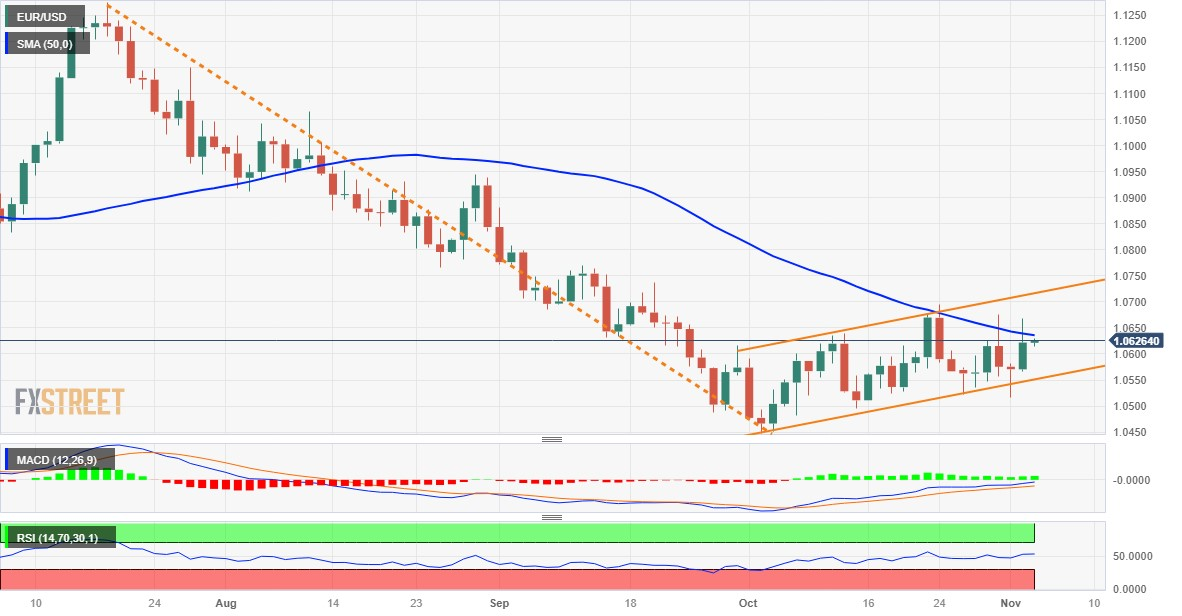
The EUR/USD pair holds steady through the Asian session on Friday and for now, seems to have stalled the overnight pullback from the vicinity of the 1.0670-1.0675 hurdle, or the weekly high. Spot prices currently trade around the 1.0625-1.0630 region, nearly unchanged for the day, as traders keenly await the US NFP report before positioning for the next leg of a directional move.

From a technical perspective, oscillators on the daily chart have again started gaining positive traction and support prospects for some meaningful appreciating move amid bets that the Federal Reserve (Fed) is nearing the end of its rate-hiking cycle. That said, the recent repeated failures near the 50-day Simple Moving Average (SMA) warrants caution before placing bullish bets around the EUR/USD pair. Moreover, the recovery from the YTD low, around the 1.0445-1.0450 area touched in October, along an upward-sloping channel constitutes the formation of a bearish flag pattern, against the backdrop of a sharp fall from a 17-month peak touched in June.

Hence, the 1.0665-1.0670 area might continue to act as an immediate strong barrier, above which the EUR/USD pair could aim to reclaim the 1.0700 mark and test the top boundary of the aforementioned trend channel, currently around the 1.0715 region. A sustained strength beyond the latter will negate the bearish setup and pave the way for additional gains. Spot prices might then accelerate the positive move towards the next relevant hurdle near the 1.0765 area en route to the 1.0800 round figure.

On the flip side, weakness back below the 1.0600 mark now seems to attract some buyers around the 1.0570 zone, nearing the ascending channel support. This is followed by over a two-week low, around the 1.0520-1.0515 region touched on Wednesday, and the 1.0500 psychological mark, which if broken decisively will be seen as a fresh trigger for bearish traders. The EUR/USD pair might then weaken further below the 1.0450-1.0445 area, or the YTD low, towards testing the 1.0400 round figure.

EUR/USD daily chart
fxsoriginal

Tehnical levels to watch

EUR/USD

Overview
Today last price1.0626
Today Daily Change0.0004
Today Daily Change %0.04
Today daily open1.0622
 
Trends
Daily SMA201.058
Daily SMA501.0639
Daily SMA1001.0809
Daily SMA2001.0808
 
Levels
Previous Daily High1.0668
Previous Daily Low1.0566
Previous Weekly High1.0695
Previous Weekly Low1.0522
Previous Monthly High1.0695
Previous Monthly Low1.0448
Daily Fibonacci 38.2%1.0629
Daily Fibonacci 61.8%1.0605
Daily Pivot Point S11.057
Daily Pivot Point S21.0517
Daily Pivot Point S31.0468
Daily Pivot Point R11.0671
Daily Pivot Point R21.072
Daily Pivot Point R31.0772

Author

Haresh Menghani

Haresh Menghani is a detail-oriented professional with 10+ years of extensive experience in analysing the global financial markets.


More from Haresh Menghani
Share:

Editor's Picks

AUD/USD languishes near two-month low amid renewed Iran tensions

AUD/USD holds above 0.7000 during the Asian session on Wednesday, though it remains close to a nearly two-month low set the previous day. Fresh US strikes on Iran temper hopes for a peace deal and benefit the safe-haven US Dollar. Furthermore, inflationary concerns continue to fuel hawkish Fed expectations, lending additional support to the buck ahead of the US CPI report. Adding to this, reduced bets on an RBA rate hike in June cap the currency pair.


USD/JPY sits near 160.50 intervention zone as bulls shrug off Japan's strong PPI

USD/JPY consolidates just below mid-160.00s, or its highest level since late April, as economic concerns stemming from the Middle East conflict continue to undermine the Japanese Yen (JPY). Furthermore, a fresh wave of US strikes on Iran benefits the safe-haven US Dollar and acts as a tailwind for the currency pair, countering Japan's hotter-than-expected PPI report. However, intervention fears cap the upside as traders seem hesitant ahead of the US consumer inflation figures later this Wednesday.

Gold flirts with $4,200, lowest since March 23 on hawkish Fed bets

Gold drops to a fresh low since March 23, around the $4,200 mark during the Asian session on Wednesday, as fresh US strikes on Iran fuel inflationary concerns and bolster bets for more hawkish central banks, including the US Fed. Meanwhile, US Dollar bulls are turning cautious ahead of the US CPI report, which could limit bullion losses. However, the recent breakdown below the 200-day SMA suggests that the path of least resistance for the XAU/USD is to the downside.

Bitcoin sell-off pushes over 50% of circulating supply into loss, hinting at market bottom

Bitcoin dropped near $61,000 on Tuesday, with the latest sell-off pushing long-term market indicators toward levels historically associated with bear-market bottoms, according to a report by K33 Research.

When the chips are down, the AI tape starts to shake

The market came into Tuesday trying to sell investors the comforting ”Turnaround Tuesday” idea that Friday’s AI fracture was just another pothole on the road higher. By the close, that story had lost its bid. Monday’s dead cat bounce had done what dead cat bounces always do.

The US economy defies the rules: 100 days into the Oil shock and the recession signal is still missing

More than three months after the start of the Iran war and the resulting disruption to global energy markets, the US economy continues to display remarkable resilience. The conflict has triggered a sharp rise in Oil prices, reignited inflationary pressures and fueled widespread concerns about a potential economic slowdown.














