|

EUR/USD holds steady as US Dollar recoups, German growth forecast dims

  • EUR/USD remains stable at 1.0807, with USD gaining ground amid anticipation of FOMC minutes.
  • German economic growth projection for 2024 slashed to 0.2%, stoking recession fears.
  • US Fed officials signal cautious approach to rate cuts, awaiting disinflation signs in labor and goods markets.

The EUR/USD pair is virtually unchanged in early trading during the North American session, as the Greenback (USD) trims some weekly losses, as the US Dollar Index (DXY) edges back above 104.00. At the time of writing, the major exchanges hands at 1.0807.

DXY rebounds over 104.00; German outlook and FOMC minutes eyed

The Eurozone (EU) economic docket was light, though news from Germany could weigh on the common currency. The German government updated its forecasts for 2024 expecting an economic growth of 0.2%, far less than the 1.3% previously foreseen. A weaker global demand, geopolitical uncertainty, and high inflation dent an economic recovery. In 2023, the economy shrank -0.3%, expected to enter a recession in the first quarter of 2024.

Regarding the economic situation, German Economy Minister Robert Habeck added, “Looking ahead, however, we see clear signs that the trend can improve again,” at a news conference presenting the annual economic report.

In the US, traders are awaiting the release of the latest Federal Open Market Committee (FOMC) minutes. However, the Richmond Fed President Thomas Barkin said the latest CPI and PPI reports were “less good,” showing the dependence of disinflation on goods. He commented that the labor market is improving while emphasizing the US has a “ways to go” to get a soft landing.

US Treasury bond yields had paired their earlier gains as investors await the release of January’s FOMC minutes. Since then, Federal Reserve (Fed) officials have expressed they are ready to cut rates but would not rush the beginning of the easing cycle. Later, the Atlanta Fed President Raphael Bostic will cross the wires.

EUR/USD Price Analysis: Technical outlook

Even though EUR/USD buyers regained the 1.0800 figure, the pair remains vulnerable to selling pressure after failing to reclaim the 200-day moving average (DMA) at 1.0826. If the pair slumps below 1.0800, look for a test of the day’s low of 1.0789 before tumbling toward February’s 20 low at 1.0761. Further downside lies at 1.0700, ahead of the last cycle low of 1.0694. Conversely, if buyers regain the 200-DMA, expect a test of the 1.0900 mark.
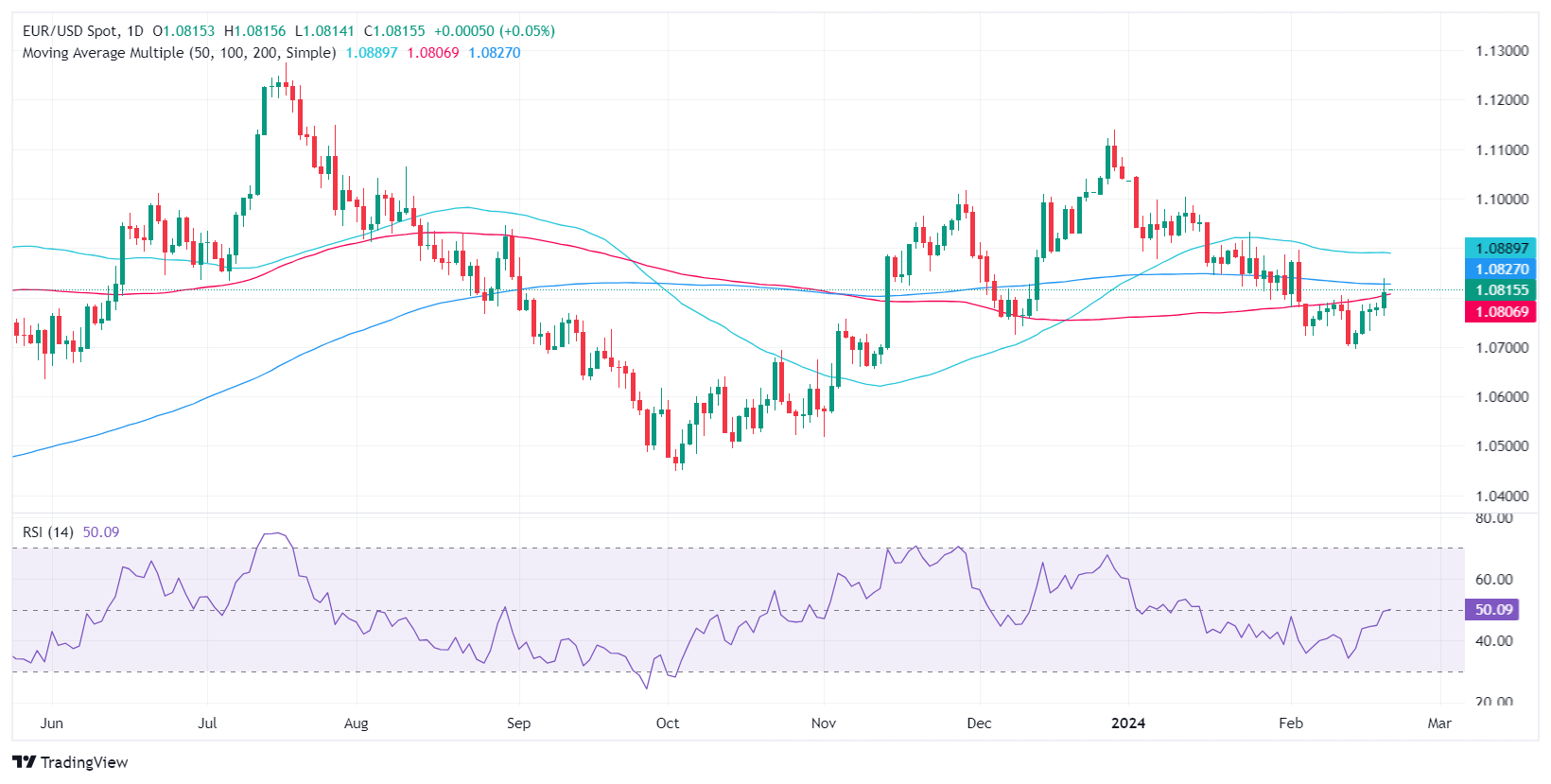
EUR/USD TECHNICAL LEVELS

Overview
Today last price1.0813
Today Daily Change0.0003
Today Daily Change %0.03
Today daily open1.081
 
Trends
Daily SMA201.0795
Daily SMA501.0891
Daily SMA1001.0804
Daily SMA2001.0827
 
Levels
Previous Daily High1.0839
Previous Daily Low1.0762
Previous Weekly High1.0806
Previous Weekly Low1.0695
Previous Monthly High1.1046
Previous Monthly Low1.0795
Daily Fibonacci 38.2%1.0809
Daily Fibonacci 61.8%1.0791
Daily Pivot Point S11.0769
Daily Pivot Point S21.0727
Daily Pivot Point S31.0692
Daily Pivot Point R11.0846
Daily Pivot Point R21.0881
Daily Pivot Point R31.0923

Author

Christian Borjon Valencia

Markets analyst, news editor, and trading instructor with over 14 years of experience across FX, commodities, US equity indices, and global macro markets.


More from Christian Borjon Valencia
Share:

Editor's Picks

AUD/USD renews two-month lows near 0.6950 after Australian CPI data

AUD/USD is renewing two-month lows near 0.6950 in the Asian session on Wednesday, as below-expectations August Australian underlying CPI data pours cold water on expectations for further RBA interest rate hikes. Chinese PMI data also fail to inspire the Australian Dollar, despite a pause in the US Dollar advance.

USD/JPY trades below 157.50 as Japan's weak data and bullish USD lend support

USD/JPY extends its consolidative price move during the Asian session on Wednesday, trading below mid-157.00s. Hawkish BoJ expectations, along with intervention risks, underpin the Japanese Yen, though dismal domestic data cap gains. Meanwhile, rising Fed rate hike bets and oil-driven inflation fears push US bond yields to fresh multi-year highs. Moreover, the US-Iran standoff supports a bullish US Dollar and acts as a tailwind for the currency pair.

Gold consolidates below $4,200 as bullish USD and Fed hike bets offset softer bond yields

Gold struggles to capitalize on the previous day's recovery from an eight-week low, consolidating below $4,200 during the Asian session on Wednesday. The overnight slide in oil prices eased the US Treasury bond rout, supporting the bullion. However, Fed rate-hike bets and inflationary concerns keep bond yields near multi-year highs. Moreover, geopolitical uncertainties underpin the safe-haven US Dollar, which, in turn, caps the commodity.

Ethereum sees profit-taking near $2,700 ahead of key US economic data
Ethereum (ETH) has shown signs of profit-taking near $2,700 over the past few days, with rising exchange deposits and a slowdown in exchange-traded fund (ETF) inflows ahead of US inflation and labor market data releases. The top altcoin's Exchange Reserves, which track the total amount of a crypto asset held across exchange wallets, have increased by roughly 125K ETH since Friday.
Silver is more volatile than Gold ahead of PCE and NFP. This chart shows the positioning gap
The market’s attention is focused on American data this week, but there’s something only those with a trained eye may be looking at: Gold and Silver positioning gap. Financial markets are moving on fears, mostly related to persistently high energy prices driven by the Middle East war. Sure, the US Dollar (USD) is strong, but at what cost?
Silver is more volatile than Gold ahead of PCE and NFP. This chart shows the positioning gap
The market’s attention is focused on American data this week, but there’s something only those with a trained eye may be looking at: Gold and Silver positioning gap. Financial markets are moving on fears, mostly related to persistently high energy prices driven by the Middle East war. Sure, the US Dollar (USD) is strong, but at what cost?