EUR/USD gains on delay in Trump’s reciprocal tariffs, poor US Retail Sales data
- EUR/USD climbs to near 1.0500 amid cheerful market sentiment due to multiple factors.
- US President Trump’s reciprocal tariffs are unlikely to be executed before April 1.
- The ECB is expected to cut interest rates further, while the Fed is anticipated to maintain a restrictive stance.

EUR/USD extends its winning streak for the fourth trading session on Friday. The major currency pair posts a fresh fortnight high to near the psychological resistance of 1.0500. The shared currency pair gains as demand for risk-perceived assets has increased due to multiple tailwinds.
Market sentiment becomes favorable for risky assets as the imposition of reciprocal tariffs by United States (US) President Donald Trump is unlikely to come into effect before April 1. On Thursday, Trump asked treasury and commerce chiefs to work on reciprocity. Later, Commerce Secretary nominee Howard Lutnick said the president would be ready to move on new tariffs by April 1. This scenario diminished fears of an immediate global trade war as investors anticipated that Trump would announce reciprocal levies on Thursday itself.
Investors expect US trading partners would get enough time to negotiate on potential tariffs with Trump, which will ease the scope of negative outcomes of the trade war.
Meanwhile, the European Commission has condemned Trump's reciprocal tariff plan and stated in Friday's European session that Trump's reciprocal tariffs are a step "in the wrong direction." The administration added that the European Union (EU) will react "firmly and immediately" against "unjustified barriers to free and fair trade."
Apart from the delay in reciprocal tariff imposition, optimism over the Russia-Ukraine truce has also offered a big relief to the Euro (EUR) against the US Dollar (USD). An end to a three-year-long conflict would fix the energy crisis and supply chain bottlenecks in the Eurozone to a great extent.
In spite of multiple tailwinds behind Euro’s strength against USD, market participants worry that expectations of widening rate differentials between the European Central Bank (ECB) and the Federal Reserve (Fed) could push the shared currency on the backfoot again.
A slew of ECB officials have been comfortable with expectations that the central bank will reduce its Deposit Facility rate three times more this year. The ECB cut its interest rates by 25 basis points (bps) to 2.75% last month.
On Thursday, ECB policymaker and Croatian central bank Governor Boris Vujčić said that the market pricing in three more interest rate cuts this year is something “not unreasonable”. Vujčić added that the ECB could remove the reference to “restrictive policy” in the March policy statement.
Daily digest market movers: EUR/USD moves higher as US Dollar weakens after poor US Retail Sales data
- EUR/USD is also up by weakness in the US Dollar (USD). The US Dollar Index (DXY), which gauges the Greenback’s value against six major currencies, extends its downside to near 106.70, the lowest level seen in almost four weeks. The Greenback falls further as the US Census Bureau has reported that Retail Sales declined at a faster-than-expected pace in January.
- On month, the Retail Sales data, a key measure of consumer spending, declined by 0.9%, faster than estimates of 0.1%. In December, the consumer spending measure rose by 0.7%, upwardly revised from 0.4%. Poor US Retail Sales data is expected to weigh on market expectations that the Federal Reserve (Fed) will keep interest rates steady in the range of 4.25%-4.50% for a longer period.
- According to the CME FedWatch tool, the Fed is expected to keep interest rates steady in the next three policy meetings. There is an almost 50% chance that the Fed can cut interest rates in the July meeting. Traders had been confident that the Fed will maintain a restrictive interest rate stance for longer amid persistent inflationary pressures and strong labor demand.
- This week, Fed Chair Jerome Powell said in his two-day testimony before Congress that the central bank can maintain “policy restraint for longer” if the economy remains strong and “inflation does not move toward 2%."
- Earlier in the day, the USD was already underperforming as its safe-haven demand had diminished amid a delay in the imposition of Trump’s reciprocal tariffs and hopes of peace between Russia and Ukraine.
Technical Analysis: EUR/USD reclaims 1.0500
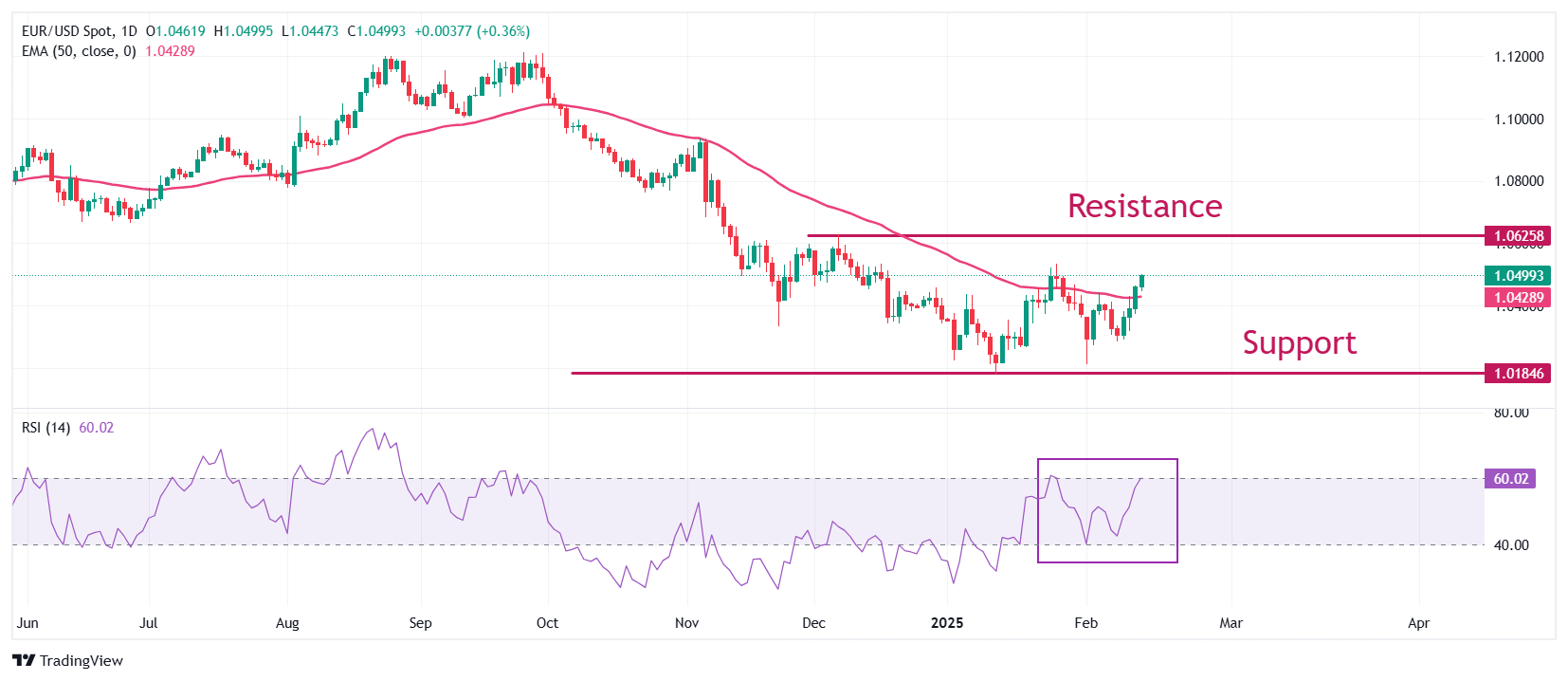
EUR/USD extends its recovery to near 1.0500 in North American trading hours on Friday. The major currency pair strengthens after climbing above the 50-day Exponential Moving Average (EMA), which trades around 1.04282.
The 14-day Relative Strength Index (RSI) advances to near 60.00. A bullish momentum would activate if the RSI (14) manages to sustain above that level.
Looking down, the February 10 low of 1.0285 will act as the major support zone for the pair. Conversely, the December 6 high of 1.0630 will be the key barrier for the Euro bulls.
Author

Sagar Dua
FXStreet
Sagar Dua is associated with the financial markets from his college days. Along with pursuing post-graduation in Commerce in 2014, he started his markets training with chart analysis.

















