EUR/USD extends declines in wide-market Greenback rebound
- EUR/USD declined for a fourth straight day on Wednesday.
- Market sentiment keeps one foot in safe havens amid geopolitical uncertainty.
- Upbeat US jobs data limits hopes for further overweighted Fed rate cuts.

EUR/USD trimmed further into the bearish side on Wednesday, dragging Fiber bids further into the low end as markets grapple with an uncertain outlook on the Middle East and evaporating hopes for a follow-up jumbo rate cut from the Federal Reserve (Fed) in November.
This week's data show is purely US, with European datapoints strictly low-tier appearances from European Central Bank (ECB) policymakers. US Nonfarm Payrolls (NFP) loom ahead on Friday, and investors are gearing up for a high-impact print in US net job additions.
The US ADP Employment Change data for September exceeded expectations, with 143,000 new jobs added, surpassing the median forecast of 120,000 and the revised August figure of 103,000. Investors are now eagerly anticipating the official non-farm payrolls (NFP) report due on Friday to confirm these preliminary numbers.
Federal Reserve Chair Jerome Powell cautioned against interpreting the 50 basis point rate cut in September as a precursor to further aggressive rate adjustments. The Fed's Summary of Economic Projections (SEP) indicates a total of 50 basis points in rate cuts over the next several meetings. Market sentiment aligns with the Fed's projection, with the CME's FedWatch Tool showing a 60% probability of a 25 basis point rate cut in November, while 40% are still anticipating a larger 50 basis point cut.
In addition to the focus on Fed rate cuts, the domestic US manufacturing outlook is uncertain due to a strike by port workers affecting the movement of goods along the East and Gulf Coasts. Escalating tensions in the Middle East, triggered by Iran's missile strike on Israel in response to Israel's actions in Lebanon, are further contributing to market volatility. Investors are closely monitoring the situation to gauge Israel's response to the escalating conflict.
EUR/USD price forecast
Intraday price action has officially been trucked into the 50-day Exponential Moving Average (EMA), and despite a half-hearted showing from Fiber bulls, the pair remains on the north side of the key moving average. EUR/USD continues to churn in the 1.1050 neighborhood, but a notable lack of a technical recovery leaves short flows in control of the pair with sellers targeting the 1.1000 round figure.
EUR/USD daily chart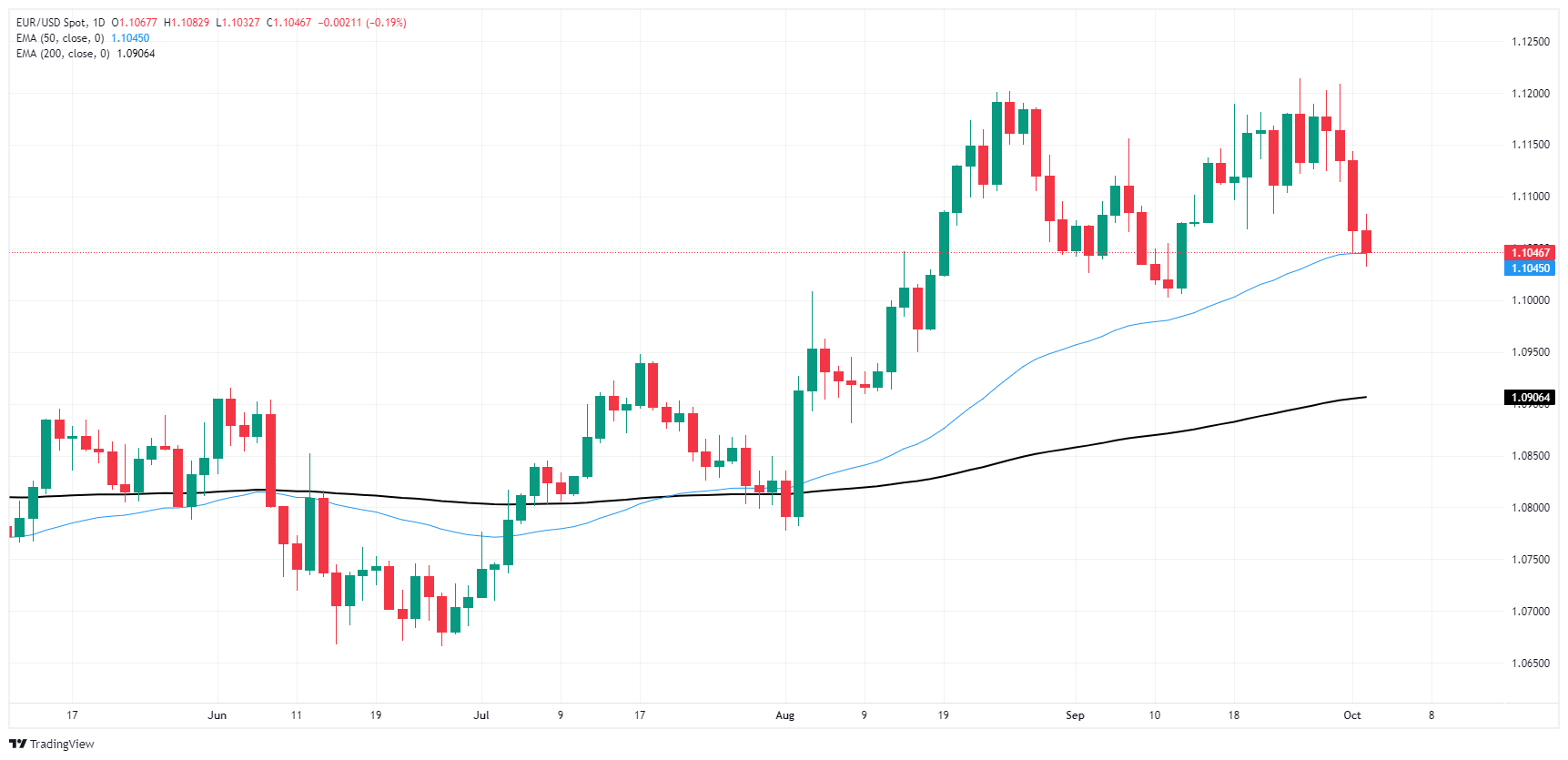
Euro FAQs
The Euro is the currency for the 19 European Union countries that belong to the Eurozone. It is the second most heavily traded currency in the world behind the US Dollar. In 2022, it accounted for 31% of all foreign exchange transactions, with an average daily turnover of over $2.2 trillion a day. EUR/USD is the most heavily traded currency pair in the world, accounting for an estimated 30% off all transactions, followed by EUR/JPY (4%), EUR/GBP (3%) and EUR/AUD (2%).
The European Central Bank (ECB) in Frankfurt, Germany, is the reserve bank for the Eurozone. The ECB sets interest rates and manages monetary policy. The ECB’s primary mandate is to maintain price stability, which means either controlling inflation or stimulating growth. Its primary tool is the raising or lowering of interest rates. Relatively high interest rates – or the expectation of higher rates – will usually benefit the Euro and vice versa. The ECB Governing Council makes monetary policy decisions at meetings held eight times a year. Decisions are made by heads of the Eurozone national banks and six permanent members, including the President of the ECB, Christine Lagarde.
Eurozone inflation data, measured by the Harmonized Index of Consumer Prices (HICP), is an important econometric for the Euro. If inflation rises more than expected, especially if above the ECB’s 2% target, it obliges the ECB to raise interest rates to bring it back under control. Relatively high interest rates compared to its counterparts will usually benefit the Euro, as it makes the region more attractive as a place for global investors to park their money.
Data releases gauge the health of the economy and can impact on the Euro. Indicators such as GDP, Manufacturing and Services PMIs, employment, and consumer sentiment surveys can all influence the direction of the single currency. A strong economy is good for the Euro. Not only does it attract more foreign investment but it may encourage the ECB to put up interest rates, which will directly strengthen the Euro. Otherwise, if economic data is weak, the Euro is likely to fall. Economic data for the four largest economies in the euro area (Germany, France, Italy and Spain) are especially significant, as they account for 75% of the Eurozone’s economy.
Another significant data release for the Euro is the Trade Balance. This indicator measures the difference between what a country earns from its exports and what it spends on imports over a given period. If a country produces highly sought after exports then its currency will gain in value purely from the extra demand created from foreign buyers seeking to purchase these goods. Therefore, a positive net Trade Balance strengthens a currency and vice versa for a negative balance.
Author

Joshua Gibson
FXStreet
Joshua joins the FXStreet team as an Economics and Finance double major from Vancouver Island University with twelve years' experience as an independent trader focusing on technical analysis.

















